

A decade ago, astronomers observed a strange phenomenon: a giant star in the Andromeda Galaxy first flashed brightly in infrared light and then faded away. Scientists are now aware that this was caused by its transformation into a black hole.
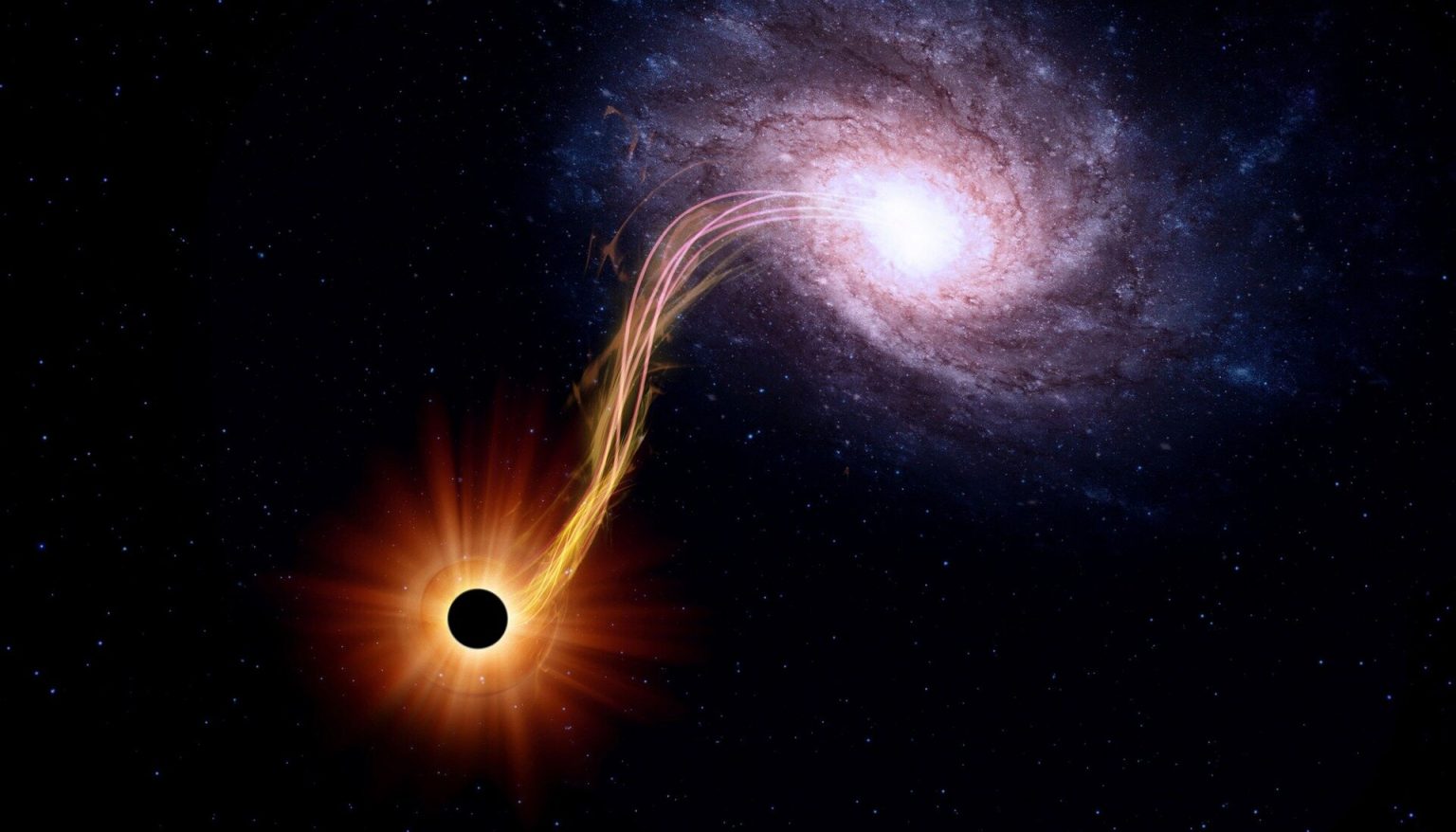
Strange disappearance of a star
In 2014, a NASA telescope observed infrared light emitted by a massive star in the Andromeda Galaxy gradually becoming brighter. This process lasted about three years before it suddenly dimmed and disappeared, leaving behind a shell of dust. Although the telescope recorded this phenomenon, it took years for scientists to understand what had happened.
Now, a research team led by Kishalay De, a professor of astronomy at Columbia University, has an explanation for what they saw: it was a star that collapsed and gave birth to a black hole — an event that astronomers had been expecting for decades, but for which convincing observational evidence had been limited.
It is likely that the star turned into a black hole without a supernova explosion. This scenario has been discussed for a long time, but so far it has not been observed anywhere.
Collapse without explosion
The supergiant flare, named M31-2014-DS1, was located in the Andromeda Galaxy, which is the closest large galaxy to the Milky Way, approximately 2.5 million light-years from Earth. When it was first formed, the star weighed about 13 times more than the Sun. At the time of its demise, it had about five solar masses, having lost most of its mass due to powerful winds during its lifetime. At the same time, it had virtually no hydrogen left.
“The dramatic and sustained fading of this star is very unusual, and suggests a supernova failed to occur, leading to the collapse of the star’s core directly into a black hole,” said De.
The scientist believes that the absence of a supernova explosion indicates that stars of the same mass may or may not successfully explode due to the chaotic interaction of gravity, gas pressure, and powerful shock waves within a dying star.
The way in which the star turned into a black hole indicates that at the end of its life, its inner core was not ejected as a result of a normal supernova explosion, but underwent a complete internal collapse.
The process of direct collapse may have been observed before, around 2010, in the galaxy NGC 6946, which is about 10 times farther away from us. But its exact nature remained unclear and a subject of debate, as it was 100 times dimmer and the data on it was not as high quality.
Formation of black holes
Black holes were first predicted theoretically more than 50 years ago, and today we know of dozens of such objects in our own galaxy and hundreds of sources detected through observations of gravitational waves in the distant universe.
However, scientists still do not have a clear consensus on which stars turn into black holes and how exactly this process occurs. This discovery provides the clearest insight into this process and indicates that this type of stellar collapse may occur more frequently than scientists previously thought.
Infrared glow before star collapse
The team discovered the star by analyzing archived data from NASA’s NEOWISE mission. They used a prediction from the 1970s that theorized that when a star underwent direct collapse, it would leave behind a faint infrared glow caused by the star’s last gasp shedding its outer shells and plunging into dust.
They conducted the largest survey of variable infrared sources in history, tracking every star in the Milky Way and other local galaxies to detect these events, and eventually stumbled upon M31-2014-DS1. Subsequent analysis showed that it perfectly matched their predictions.
“Unlike finding supernovae, which is easy because the supernova outshines its entire galaxy for a few weeks, finding individual stars that disappear without producing an explosion is remarkably difficult,” said De.
Where he said it was a shock to learn that a massive star had actually disappeared without exploding, and no one had noticed for more than five years. This case affects our understanding of stellar evolution and the process of star death in the universe.
According to phys.org

