

The term “geology” should only be used in relation to Earth, since in Greek it means “the science of Earth”. However, when astronomers study other planets in the Solar System, they naturally take the most studied one, i.e., ours, as a “reference point”. Mars has a lot in common with Earth, but in some ways it is very different. Some of its features are strange: although it has the largest volcanoes in the Solar System, there is currently virtually no volcanic activity. Clearly, there is still much we do not know about our neighbor.
Mars as a planet
Mars, like Earth, is a rocky planet. Its shape is nearly spherical, its chemical composition is mainly silicates and aluminates, it has a dense core, and it is covered by a relatively thin crust. This is where the similarities between the two celestial bodies end and their differences begin.
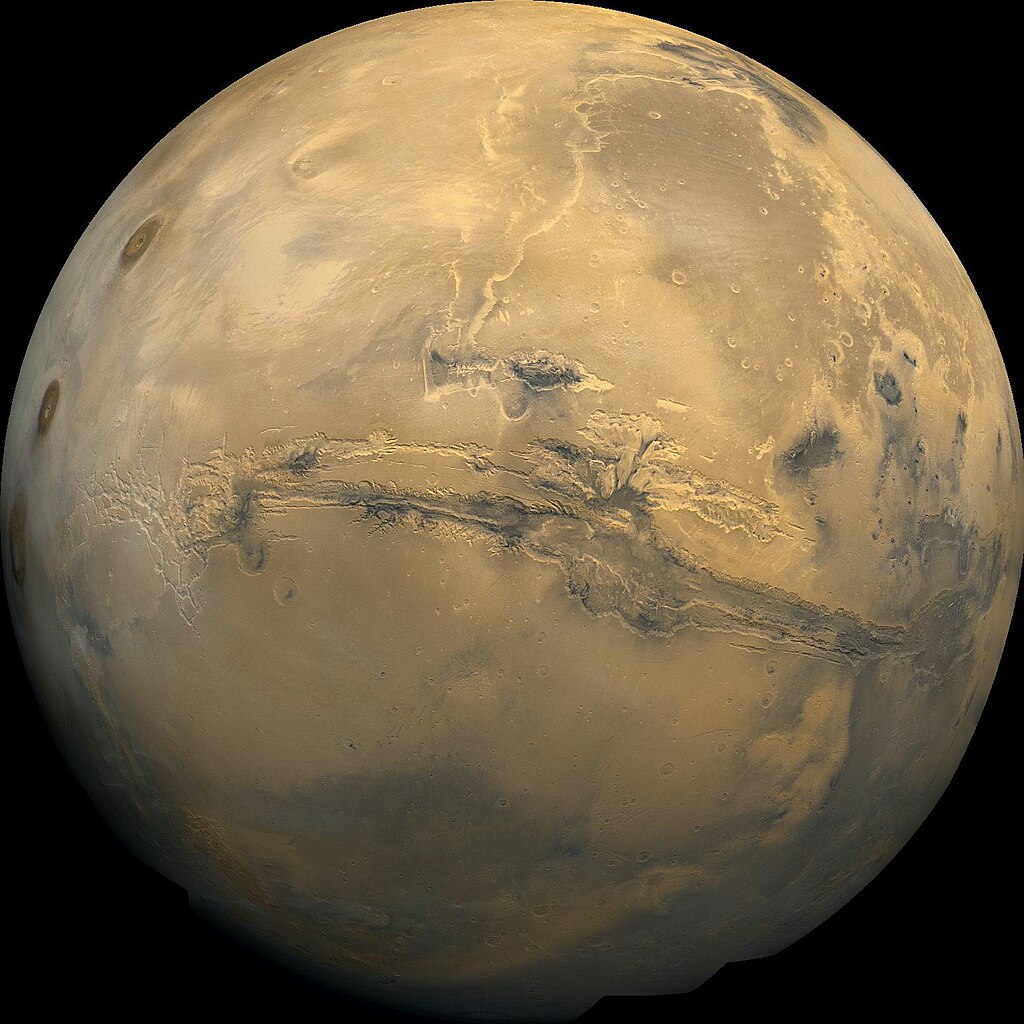
The fourth planet from the Sun is half the size of Earth. The average radius of Mars is only 3,389.5 km. Its surface area is 1.4437×10⁸ km2, which is only 28% of that of our world, if we include the oceans. This means that the geological formations found on Earth would appear gigantic on Mars. Incredibly, the mountains, canyons, and depressions there are indeed much larger than those on Earth.
The surface of Mars is very uneven compared to Earth. In particular, its northern hemisphere is almost entirely low-lying, while the southern hemisphere is dominated by mountain ranges and plateaus. To explain this striking difference, some scientists point to the specific mechanism of Martian tectonic plate formation, while others believe it is the result of a collision with a large space object.
Whatever caused this strange dichotomy between the hemispheres of Mars, astronomers are certain that it arose at the dawn of the planet’s existence. Therefore, all subsequent evolution there took place in conditions where there were lowlands in the north and highlands in the south.
Volcanoes of Mars
Approximately 4.5 billion years ago, when Mars was just formed, it was a red-hot ball. Then its crust solidified, but liquid magma remained inside. This created conditions for volcanic activity. However, it occurred in a way that was very different from what we are used to on Earth.
On our planet, the crust consists of separate lithospheric plates that are constantly in motion. Magma erupts mainly through cracks between them, which is why most volcanoes are located along the joints of large sections of the lithosphere. Only occasionally can another type of volcanism be found on Earth, when a flow of hot magma literally melts its way to the surface. Such volcanoes are called shield volcanoes.
It is not known for certain whether lithospheric plates ever moved on Mars. At least, no traces of them have been found there. For billions of years, Martian volcanoes have appeared exclusively due to hot flows that melt the crust, and this happens in a rather strange way. Some volcanoes are indeed similar to those on Earth. However, the largest of them, due to their tendency to group, have formed large provinces that have no analogues not only on Earth, but in the entire Solar System.
Tharsis
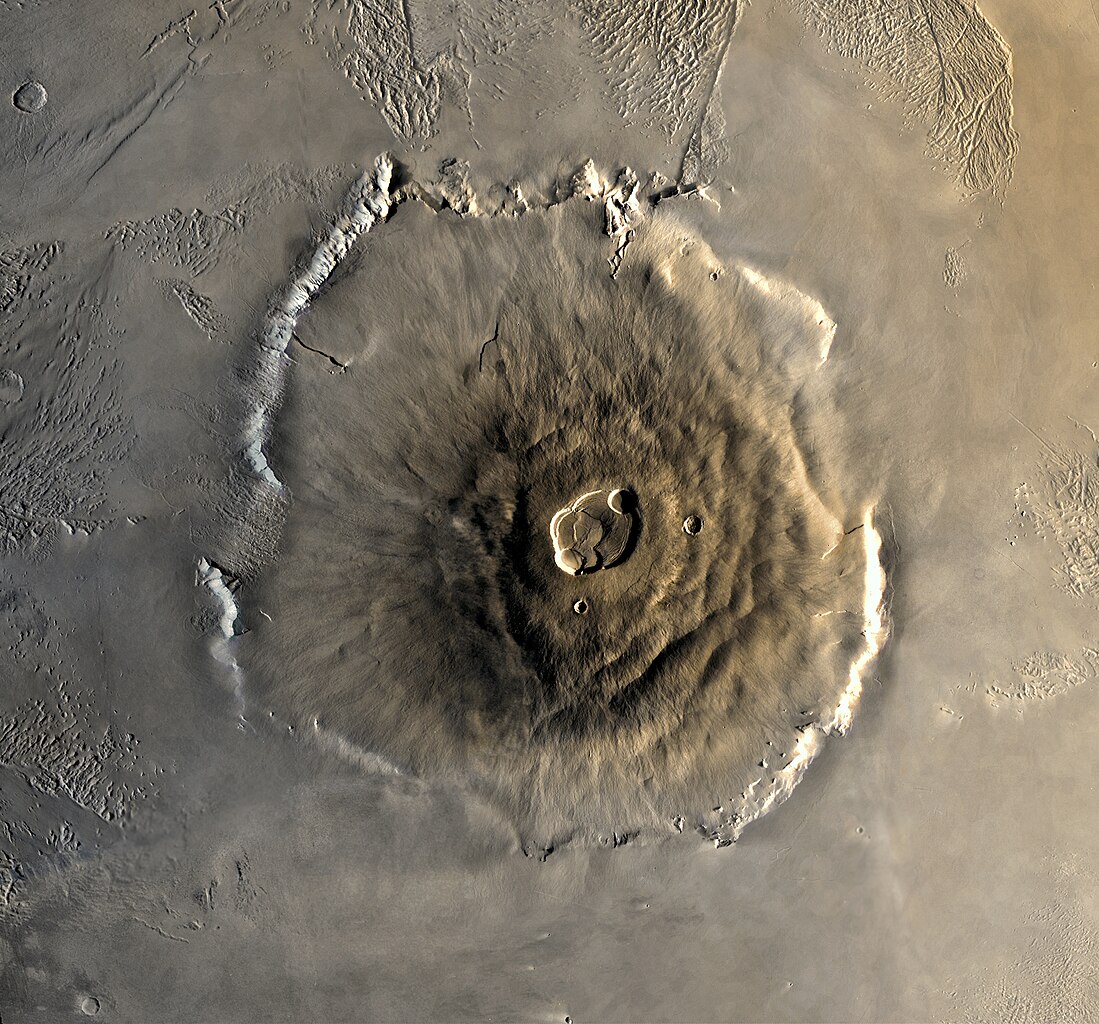
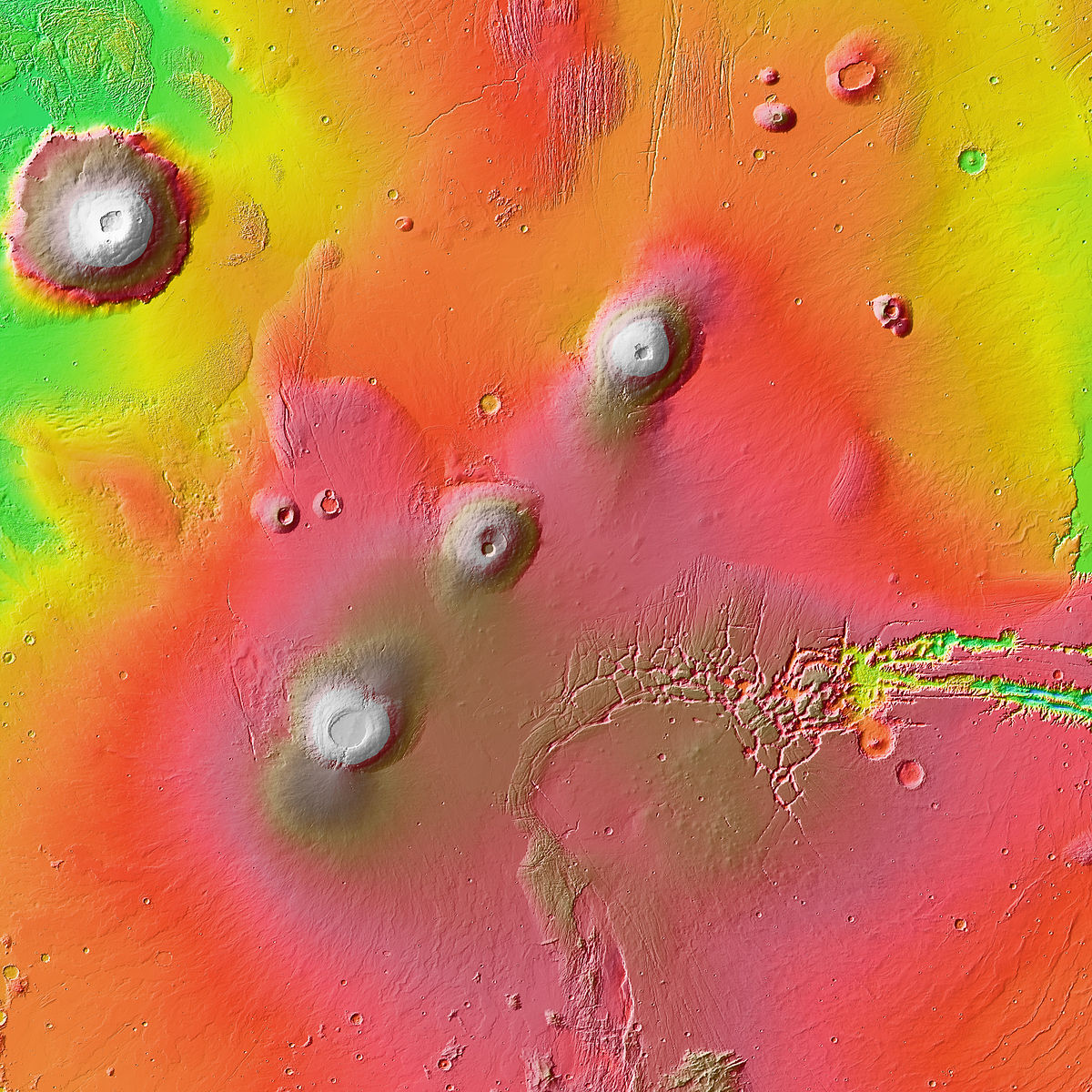
The best example of strange Martian volcanism is Tharsis, located in the northwestern part of Mars. Its area is 30 million km², which is larger than Canada, the United States, and China combined. It is here that the largest volcano in the Solar System rises – the 26-kilometer-high Olympus Mons, approximately three times higher than Everest.
However, the most interesting thing about this giant is not its height, but its width. The diameter of Olympus’ base is 624 km, which means that on Earth it would hardly fit in Ukraine. So, despite its dizzying height, it looks almost flat. More precisely, its upper part forms a plain with a minimal slope, while its edges are slopes up to 7 km high.
At the center of the giant volcano is a caldera measuring 85×60 km. Several craters actually merge into one giant pit up to 3 km deep, so large that the entire city of Kyiv could fit inside it.
At the same time, Olympus is the largest, but not the only, giant volcano in Tharsis. To the southeast of it, there are three more very similar structures – the Ascraeus Mons, Pavonis Mons, and Arsia Mons. Each of them is much higher than Everest, and their diameters are measured in hundreds of kilometers.
Incidentally, the highest of the Tharsis Olympus volcanoes is by no means the record holder in terms of area. Alba Mons is “only” 6.8 km high, but its diameter reaches 1,350 km. And in general, it is difficult to call it a mountain, because its slope reaches only 0.5°, which means that it is essentially a sloping elevation. Previously, the term “patera” was used to describe such relief features.
Elysium
Another volcanic province, Elysium, is also located in the northern hemisphere of Mars. There are also several giant shield volcanoes there: the Hecates Tholus, Mount Elysium, and the Albor Tholus. They are significantly smaller than Olympus, but their size is still impressive. For example, Elysium rises 16 km above the Martian surface and has a diameter of 240 km.
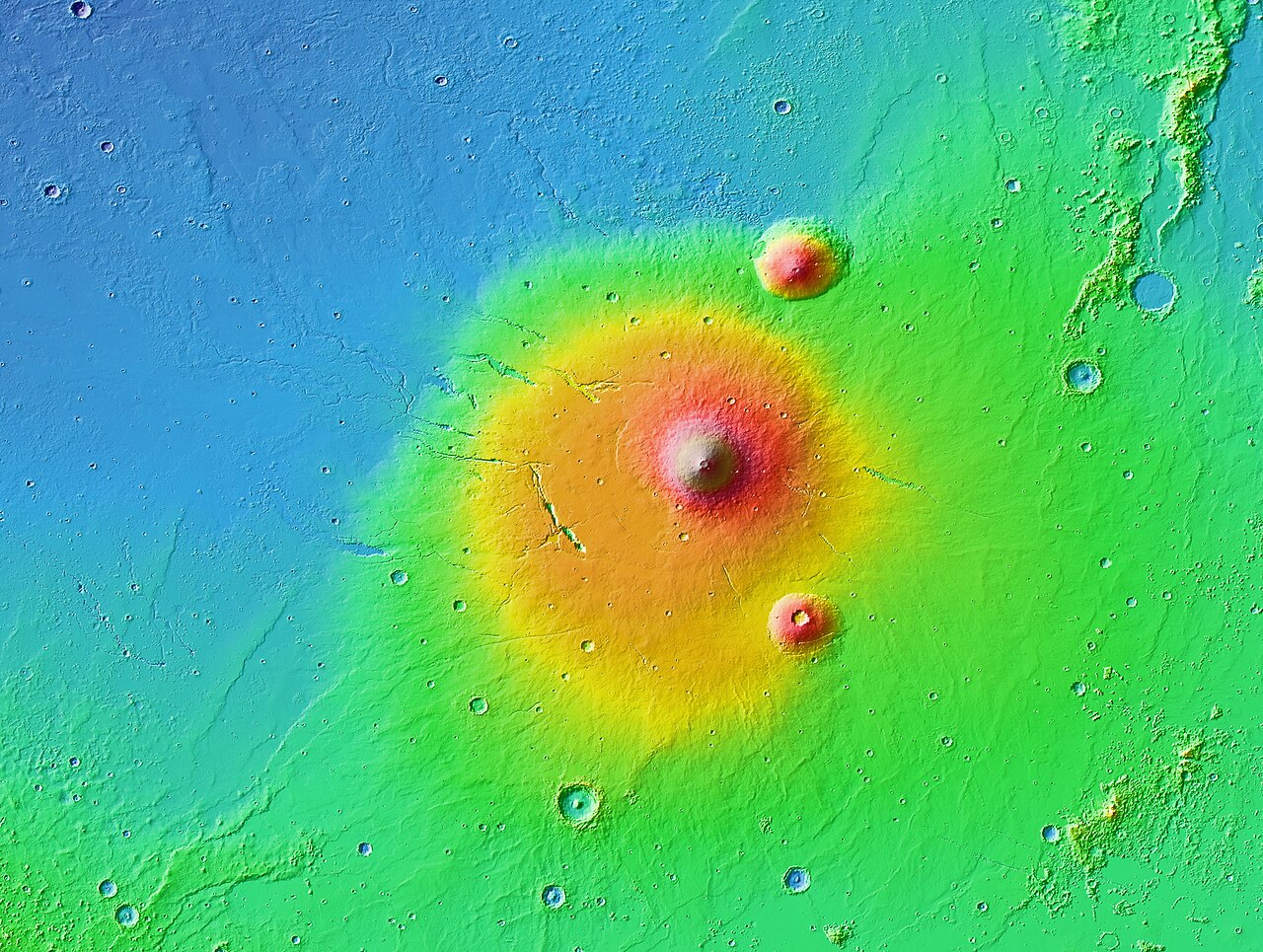
Although the two volcanic provinces are very similar, they were formed in completely different periods. Tharsis is extremely ancient, its origin dating back to the Noachian period of Martian history, meaning it is about 4 billion years old. Elysium is much younger. It was formed about 600 million years ago. This is relatively young by the standards of the Red Planet and closer to the time when multicellular life appeared on Earth.
Why shield volcanoes regularly form in such large groups on Mars is still unclear. Apparently, this is related to the peculiarities of the rise of the same hot magmatic flows in its depths, which scientists call plumes. Perhaps the fact that they abut against a solid crust rather than separate plates somehow affects the nature of volcanism.
In addition, Mars’s smaller size plays a role. If there are irregularities in the distribution of heat inside it, they will manifest themselves much more strongly than on Earth. It is quite possible that at a certain depth below the Martian surface, there are large pockets of lava that manifest themselves as volcanic provinces.
Giant faults
In addition to giant volcanoes, Mars has equally amazing surface faults. From a geological point of view, they are very different from those we encounter on Earth, where structures similar to the Dniester Canyon or the Grand Canyon of the Colorado River in the United States are formed as a result of soil particles being washed away by water.
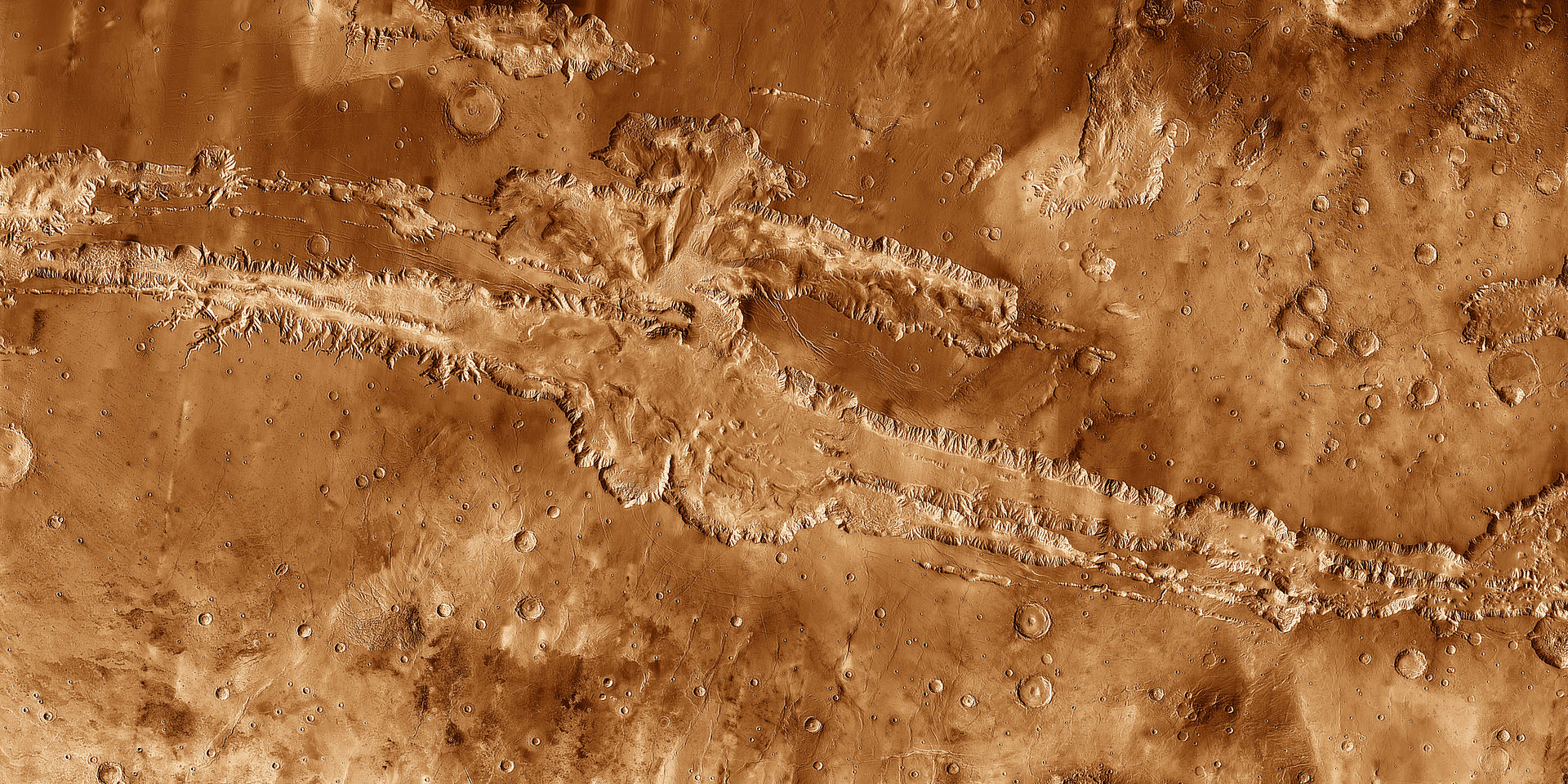
However, liquid water never flowed on the Red Planet long enough to wash out gorges tens and hundreds of meters deep. The nature of canyon formation there is completely different and is related to the same volcanic provinces. Giant mountains of solidified lava are so massive that they literally collapse under their own weight into the depths of the planet. As a result, the much thinner crust around them stretches and cracks.
Over time, cracks formed by erosion and other processes can reach truly enormous sizes. The largest of these is the Valles Marineris. It is often compared to the Grand Canyon in Colorado, but this only complicates its perception. The total length of this structure is 4,500 km, which means that on Earth it would stretch from Great Britain to the Caspian Sea.
In addition, the average width of the Valles Marineris is 200 km. This means that standing on one edge, you are unlikely to see the other. The picture will be more like a giant precipice, the bottom of which is lost somewhere below.
Another feature of the Martian landscape is related to the giant fractures on the surface: chaos terrains. This is the name given to areas where hills and furrows are scattered haphazardly, forming a veritable labyrinth. They appeared at a time when Mars still had plenty of ice and streams flowed across its surface. When the subsurface ice melted, the ground subsided. The water, flowing outwards, went to lower areas and eroded the already damaged rocks along the way. This happened extremely unevenly, resulting in the formation of chaos.
Sedimentary rocks on Mars
Although more large impact craters have been found on Mars than on the Moon or Mercury, smaller traces of collisions are much less common there. This is due to wind and water erosion.
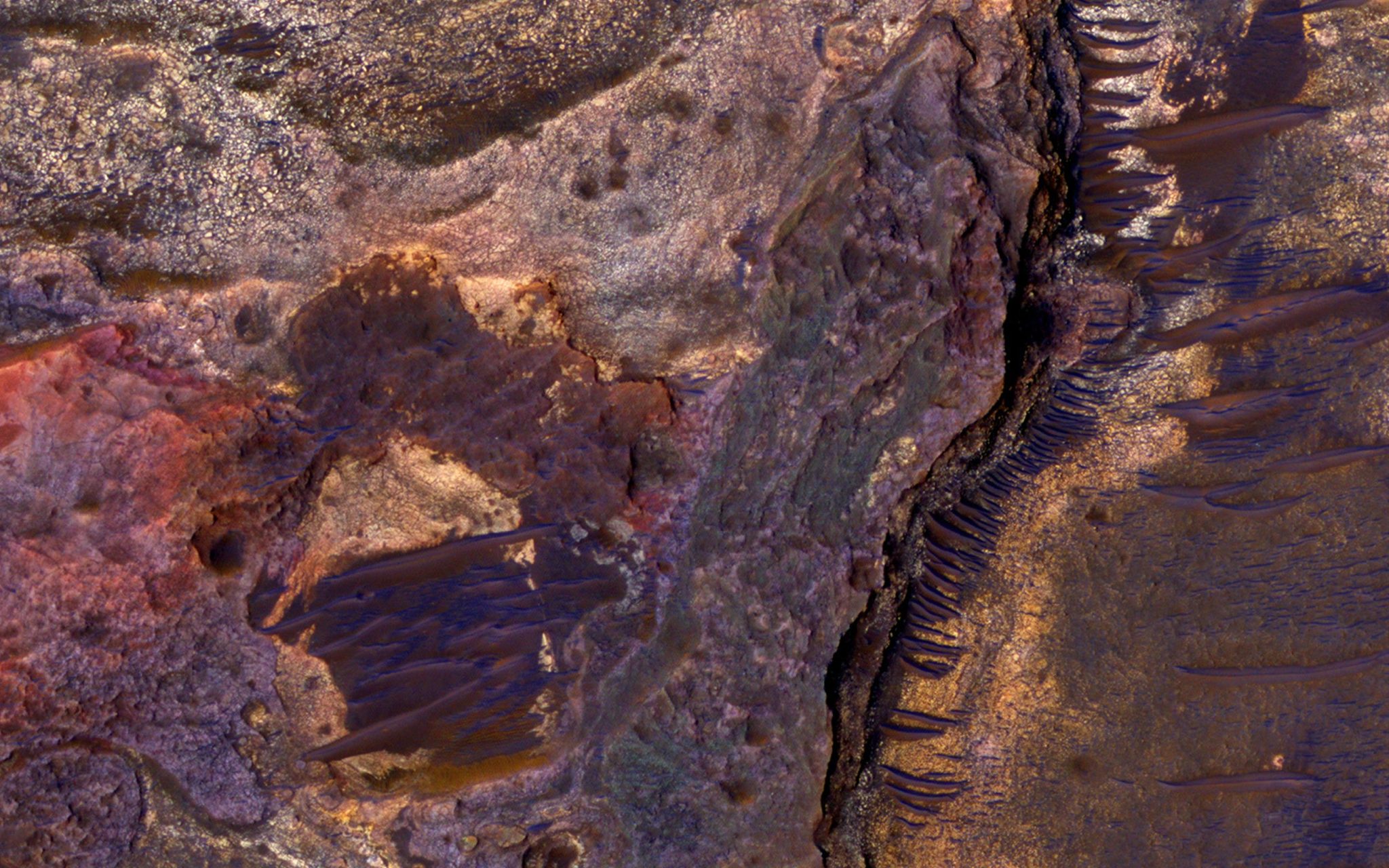
Wind and water cause the destruction of solid rock and transport small particles. Several billion years ago, when the planet’s atmosphere was denser and the northern basin was filled with an ocean into which water flowed, these processes were much more intense. They can still be seen on the surface in the form of dry riverbeds of ancient rivers.
Traces of erosion on Mars include not only certain landforms, but also the presence of rocks that we call sedimentary. These include sand, gypsum, and clay. These conglomerates of extremely fine particles can only form in the presence of large amounts of water, usually near or at the bottom of rivers and lakes.
Despite the similarity between Martian sedimentary rocks and those on Earth, they contain almost no organic matter, which is common on Earth. More precisely, it may be there, and scientists are eager to find it, but this will only be possible after samples of the substance have been brought from Mars to Earth.
Scientists have also not yet found any traces of a developed biosphere on Mars. This means that minerals commonly found on Earth, such as oil, natural gas, and coal, are most likely not present there, as they are the remains of living organisms.
Is Mars really dead?
No matter how spectacular the volcanic eruptions on Mars were, no matter how long water flowed in its streams, forming clay deposits, all this is now a thing of the distant past. This view of the planet has become mainstream over the last few decades.
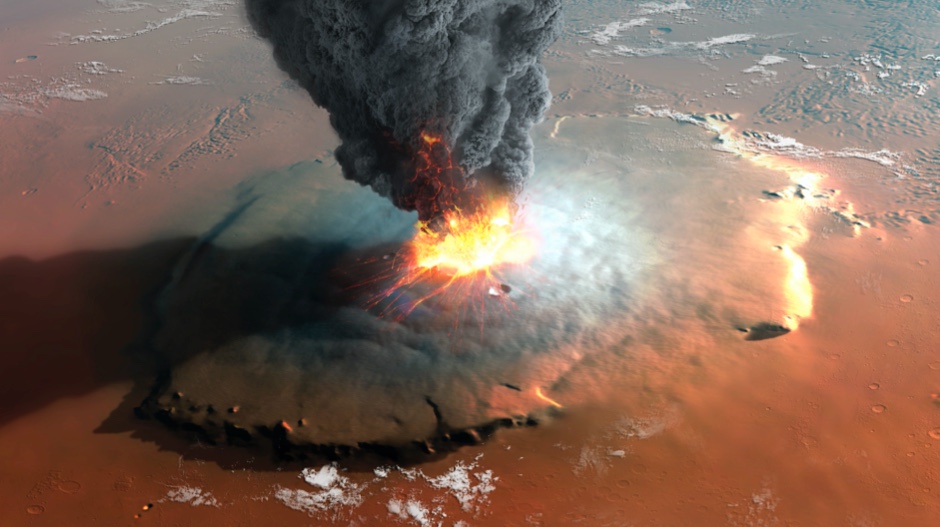
However, this trend has recently begun to change. One of the main reasons for this is the InSight probe. It operated on the surface of Mars for many months, while the seismograph on board recorded what was happening in the depths of the planet. Imagine the surprise of scientists when it began to register one surface vibration after another!
In general, astronomers had previously assumed the possibility of Marsquakes even in the absence of lithospheric plate movement. After all, tectonic vibrations occur even on the Moon, which is definitely “dead” in this sense. However, the events recorded by InSight turned out to be too frequent and too strong to be caused, for example, by the collapse of some underground cavities. More and more scientists are now inclined to believe that there is still liquid magma inside the Red Planet.
Research on Mars increasingly suggests that our current understanding of its “inner world” is not entirely accurate. However, humanity began exploring our neighboring planet relatively recently, so our knowledge of it is quite limited. It is quite possible that in a few thousand years, it will surprise researchers with active volcanoes… but that is a completely different story.
This article was published in issue No. 1 (190) of Universe Space Tech magazine in 2024. You can purchase this issue in electronic or printed form from our store.

