

The European Southern Observatory has published a time-lapse video compiled from images taken by the Very Large Telescope. It shows the movement of interstellar comet 3I/ATLAS.
3I/ATLAS was discovered on July 1, becoming the third confirmed object of interstellar origin to travel through the Solar System. The comet arrived from the region on the border of the constellations Sagittarius and Serpens, near the galactic plane, where the center of the Milky Way is located. It has the highest eccentricity of all known interstellar objects (6.14±0.02), and its velocity outside the gravitational field of the Solar System is 58 km/s. The exact dimensions of the 3I/ATLAS core are still unknown. According to the latest estimates, its diameter ranges from 0.8 to 2.4 km.
The published time-lapse shows how 3I/ATLAS moves to the right for approximately 13 minutes. These data were obtained using the FORS2 instrument mounted on the VLT on the night of July 3, 2025, just two days after the comet was first discovered.
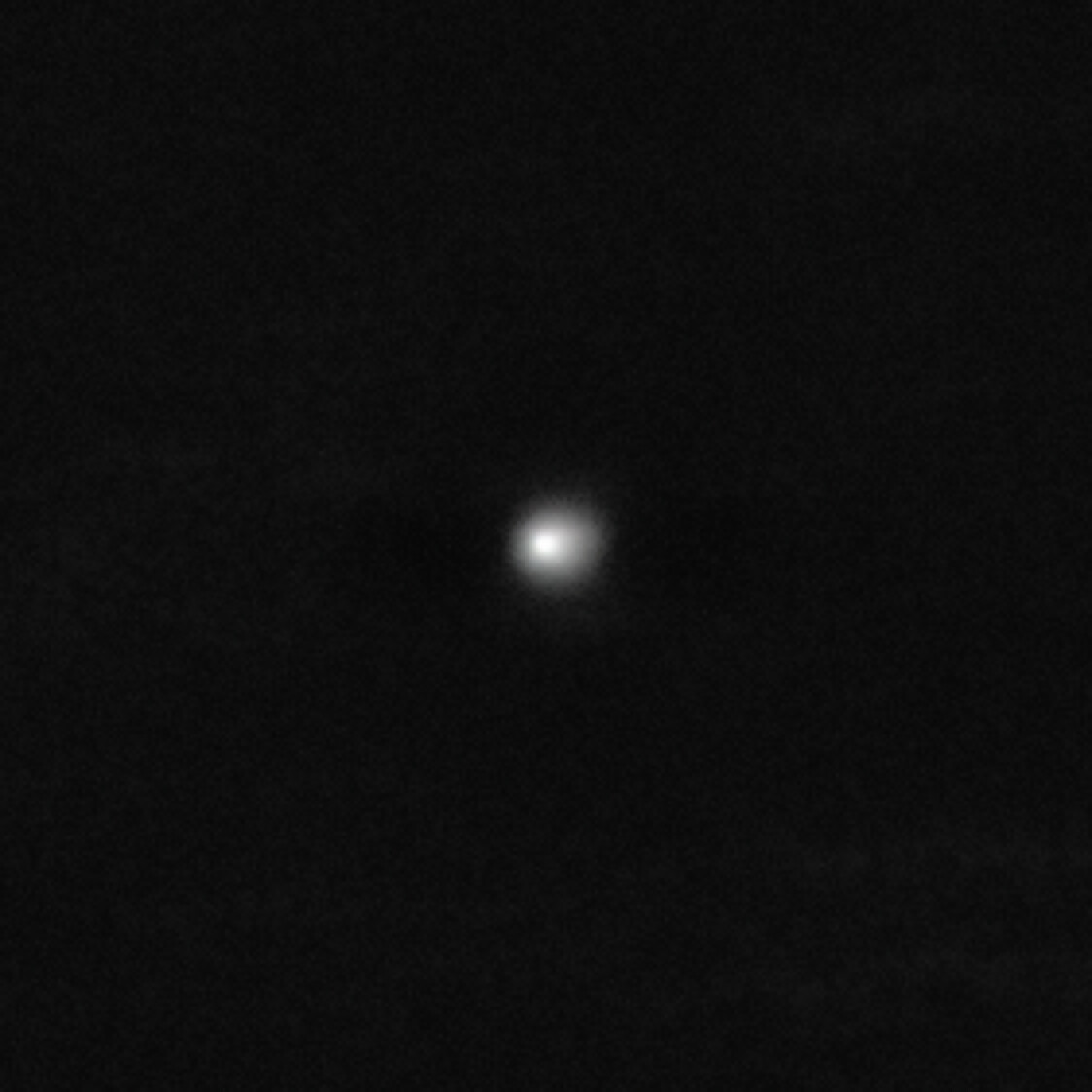
At the end of the video, we see all the frames combined into a single image. This is the deepest and best photo of an interstellar object to date. But this record will not last long, as the comet is approaching Earth and becoming increasingly brighter.
Currently, 3I/ATLAS is more than 600 million km from the Sun and is gradually approaching perihelion. It will pass on October 29. On this day, the interstellar comet will be 1.357 AU (203 million km) from the Sun.
3I/ATLAS poses no threat to Earth. It will not come closer to our planet than 1.8 AU (270 million km). At the same time, before passing perihelion, it will fly at a distance of about 0.19 AU (29 million km) from Mars. In theory, the interstellar comet can be photographed by the MRO spacecraft orbiting the Red Planet. And on March 16, 2026, 3I/ATLAS will fly by Jupiter at a distance of 0.36 AU (54 million km).
After that, 3I/ATLAS will once again head into interstellar space in the direction of the constellations Gemini and Orion. However, since its speed is lower than the fourth cosmic velocity (550 km/s), it is not destined to leave the Milky Way. As it moves away from the galactic center, the speed of 3I/ATLAS will gradually decrease until it reaches zero. After that, the comet will begin its return journey to the core of the Milky Way.
According to ESO

