

Hematite has been discovered on the Moon for the first time. On Earth, this mineral is a component of higher-quality steel ore. On the Moon, however, it was formed by a violent collision with large objects.
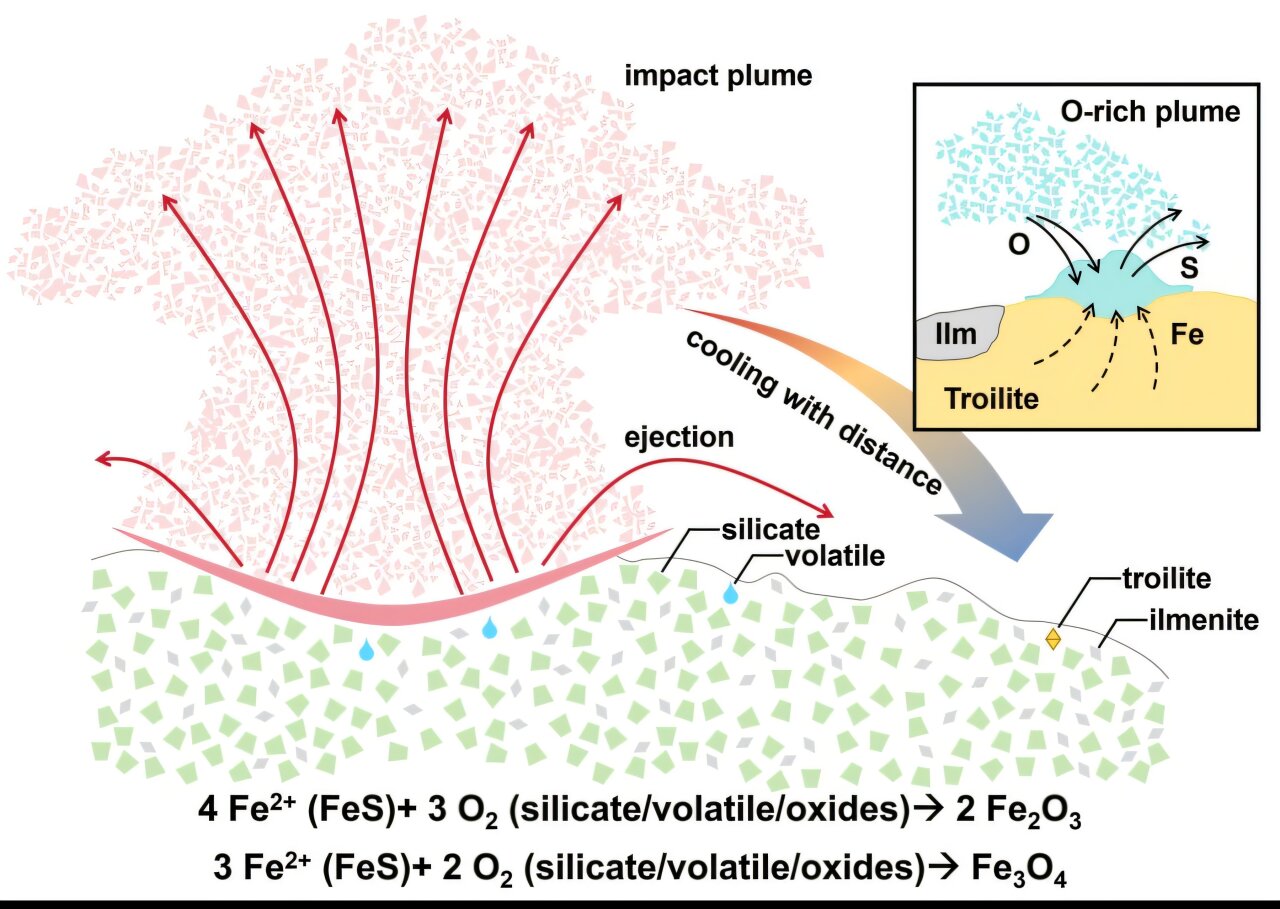
Oxidation-reduction reactions and oxidizing materials on the Moon
A joint research team from the Institute of Geochemistry, Chinese Academy of Sciences (IGCAS) and Shandong University has discovered crystalline hematite (α-Fe2O3) and maghemite (γ-Fe2O3) formed by strong impact in lunar soil samples collected by China’s Chang’e-6 mission from the South Pole–Aitken (SPA) Basin.
Oxidation-reduction reactions are a fundamental component of planetary formation and evolution. However, scientific research has shown that neither the volatility of oxygen in the Moon’s interior nor the environment on the Moon is conducive to oxidation. According to this, multivalent iron on the Moon exists mainly in the form of divalent (Fe2+) and metallic (Fe0) iron, which indicates a general reduced state. However, thanks to further research on the Moon, recent orbital remote sensing studies using spectroscopy in the visible and near-infrared range indicate the widespread presence of hematite in high-latitude regions of the Moon.
In addition, preliminary studies of Chang’e-5 samples have revealed for the first time submicron magnetite (Fe3O4) formed during the impact and traces of Fe3+ in the impact glass. These results indicate that localized oxidative environments existed on the Moon during the process of surface modification caused by external impacts.
Despite this progress in research, definitive mineralogical evidence for the existence of highly oxidizing minerals such as hematite on the Moon remained unclear. Furthermore, the extent of oxidation processes and the prevalence of characteristic oxidized minerals on the Moon have long been the subject of intense debate.
Samples from the SPA Basin reveal new facts
The SPA basin, one of the largest and oldest impact basins in the Solar System, with extremely complex scales and impact frequencies, is an ideal natural laboratory for studying oxidative reactions on the Moon’s surface. The successful return of soil samples from the SPA basin by the Chang’e-6 mission in 2024 made it possible to search for highly oxidized substances formed during major impact events.
A research team has discovered microscopic grains of hematite in the lunar soil of Chang’e-6 for the first time. Using a combination of electron microscopy, electron energy loss spectroscopy, and Raman spectroscopy, they confirmed the crystalline structure and unique characteristics of these hematite particles, verifying that the minerals are primary components of the Moon and not terrestrial contaminants.
The study suggests that hematite formation is closely linked to large impacts in the Moon’s history. The extreme temperatures resulting from large impacts would have vaporized surface materials, creating a temporary environment with high oxygen fugacity in the vapor phase. At the same time, this process would have caused the desulfurization of troilite; the released iron ions would then have oxidized in the highly fugitive environment and precipitated in the vapor phase, forming micron-sized crystalline hematite. This hematite coexists with magnetic magnetite and maghemite.
Understanding the evolution of the Moon
It is noteworthy that the origin of widespread magnetic anomalies on the Moon’s surface, including those in the northwestern part of the SPA Basin, remains insufficiently explained. Given the close relationship between oxidation processes and the formation of magnetic mineral carriers, this study provides key evidence based on samples that sheds light on the carriers and evolutionary history of these lunar magnetic anomalies.
This study challenges the long-held belief that the Moon’s surface is completely restored. It also provides important clues for deciphering the evolution of lunar magnetic anomalies and the mechanisms underlying major impact events, thereby contributing to our understanding of the Moon’s evolution.
According to phys.org

