

The far side of the Moon is considered one of the best places in the entire Solar System for building a powerful radio telescope. The reason for this is the almost complete absence of interference from other radio signals.
Radio telescope and mobile phones
Scientists have once again returned to discussing plans to build a radio telescope on the far side of the Moon. If previously this was merely a bold proposal that did not necessarily need to be implemented, now it may become a necessity.
And all because of mobile phones, satellite internet, and other achievements of civilization that create incredible noise in the radio spectrum, while space exploration requires silence so that the microwave in the next room is not mistaken for a signal from a distant galaxy.
That is why all large radio telescopes are now being located somewhere in deserts and mountains. However, it seems that there will soon be no quiet places left on earth. And scientists need not just a quiet place, but a super-quiet place, so that they can hear, for example, the signal from the neutral hydrogen that filled the Universe before the first stars ignited.
How to build a radio telescope on the Moon
So, a radio telescope on the Moon really needs to be built. However, scientists immediately warn that plans to build a developed infrastructure on our moon somewhat conflict with its concept. After all, if we try to make our moon “attractive to investors” by creating the same dense wireless network there as on Earth.
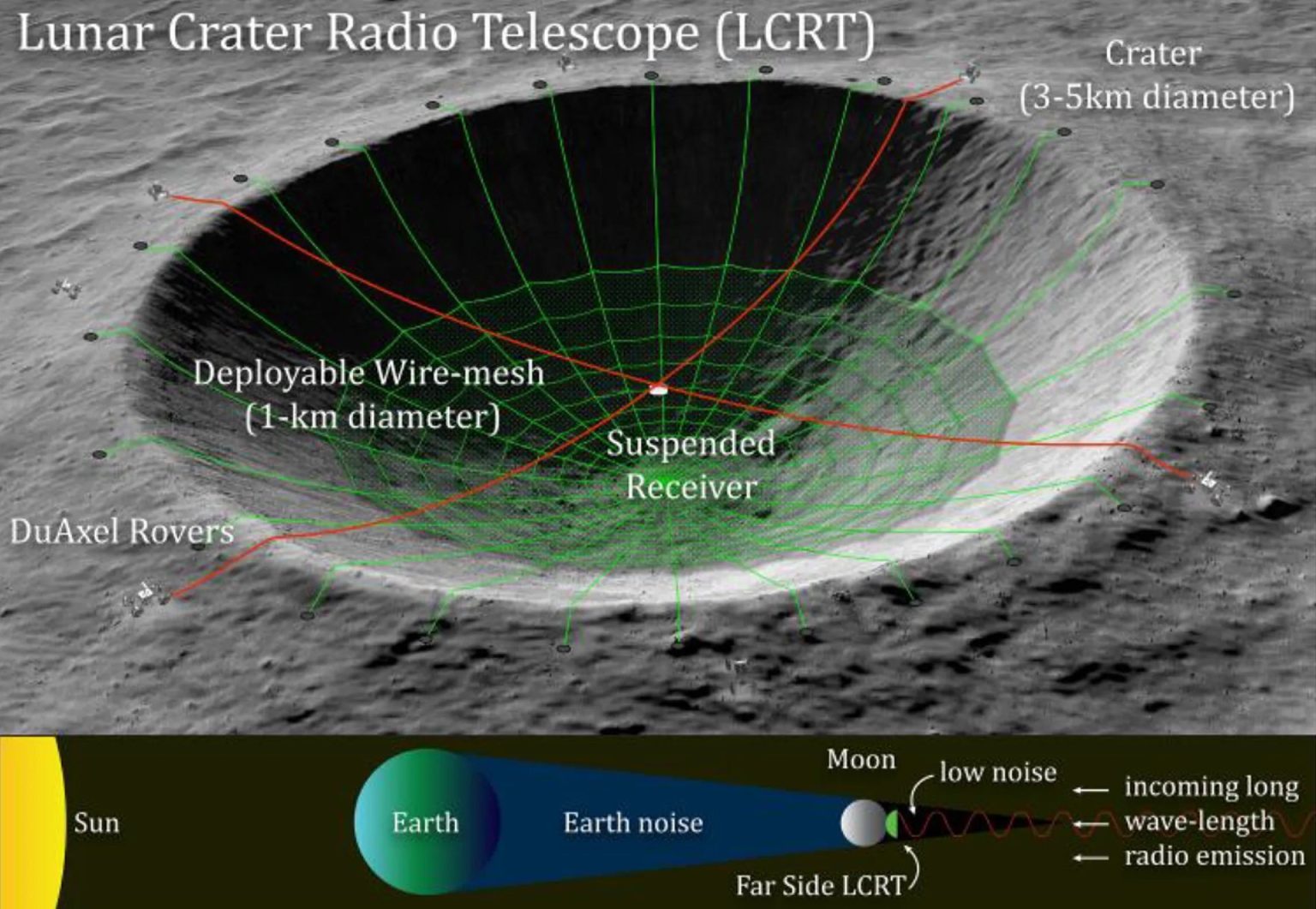
In this case, the far side of the Moon will no longer be any different from the side facing Earth. And the radio telescope projects are really interesting. For example, there is one in which several rovers stand on the edge of a small deep crater and lower cables to its bottom. Those connect to another module in the center. Together, they should function as one large dish.
Other proposals include the FARSIDE concept, which stands for Farside Array for Radio Science Investigations of the Dark ages and Exoplanets. I don’t know if it’s okay to use the word farside in the abbreviation farside, but here we are.
Instead of a single mega-antenna, the concept involves deploying many base stations of landing modules and independent vehicles that would unwind kilometers of radio antenna wire between themselves, creating a giant network of connected and correlated instruments to obtain extremely high-resolution images of the dark ages.
According to phys.org

