

The James Webb Space Telescope (JWST) has made the first direct measurements of the chemical and physical properties of the disk surrounding a large exoplanet. In the future, it may form an exomoon.
How exactly do planets acquire moons? Some, like our Moon, are the result of spectacular collisions between protoplanets occurring at the dawn of star system formation. Some bodies, such as Triton, are captured by planetary gravities. Some are formed from the disks surrounding planets. In particular, this is how Jupiter’s Galilean moons were formed.
To better understand how planetary moons are formed, scientists are actively studying young star systems. And JWST plays an invaluable role in this research. During observations of the forming exoplanet CT Cha b, located 625 light-years from Earth, it detected carbon molecules in its vicinity. This surprised scientists, as the protoplanetary disk surrounding the star is rich in water but not carbon. Therefore, they decided to conduct additional observations of CT Cha b.
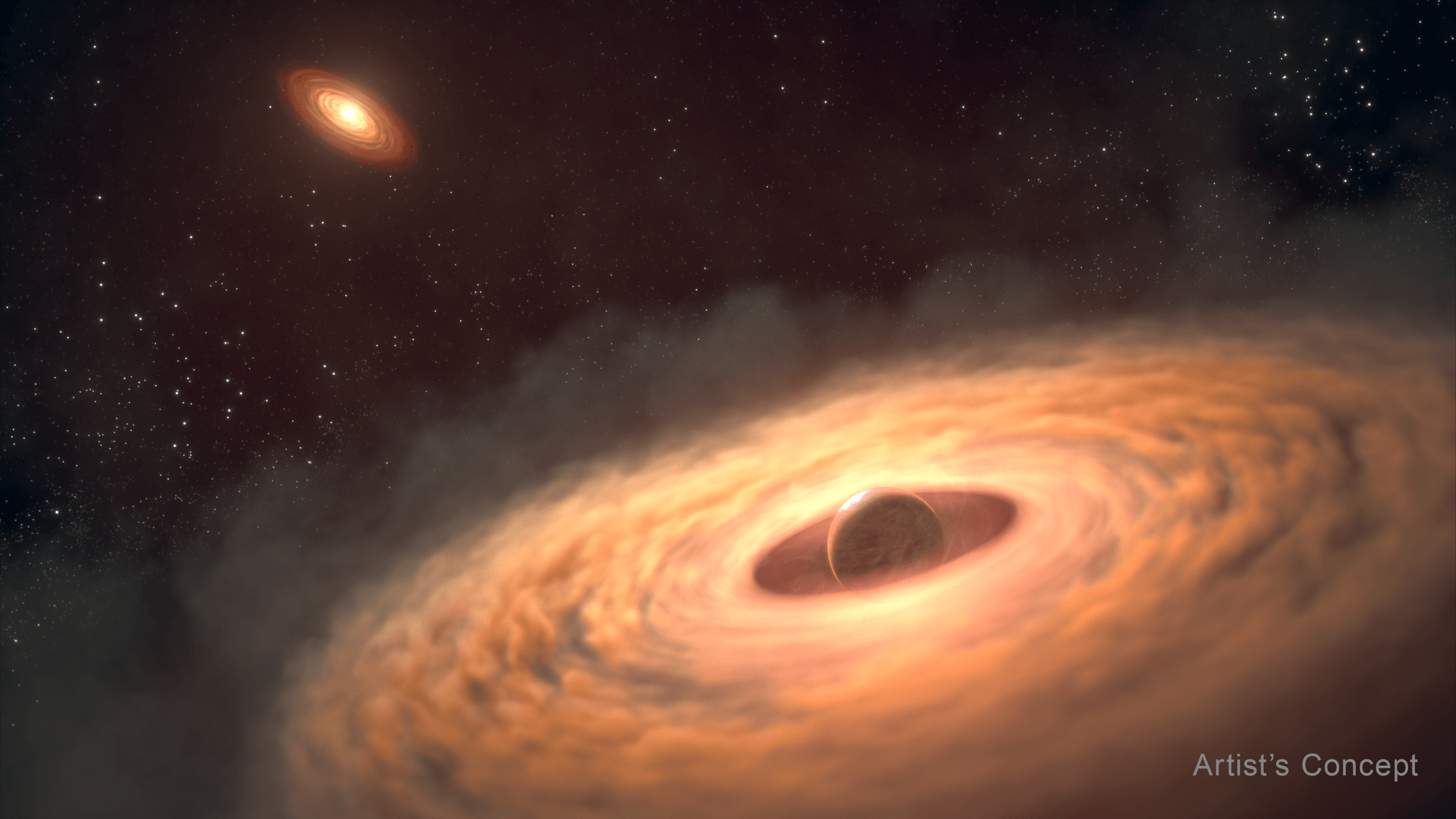
This proved to be the right decision. JWST detected seven carbon-containing molecules, including acetylene (C2H2) and benzene (C6H6). According to scientists, they are part of the circumplanetary disk around CT Cha b and are not part of the larger protoplanetary disk around the central star. These two objects are separated by a distance of 74 billion kilometers.
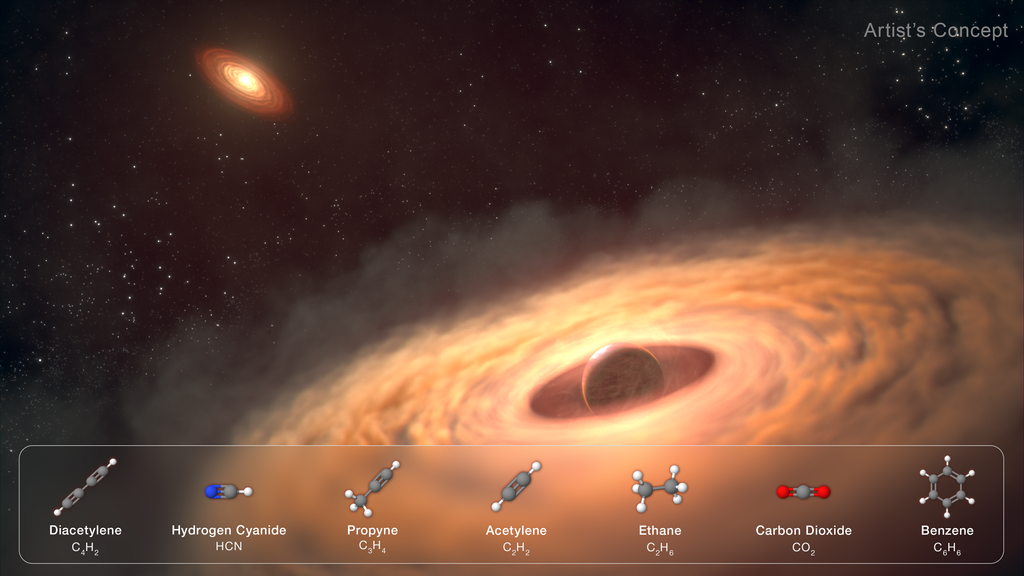
“We see evidence of a disk around the moon and can study its chemical composition for the first time. We are not only observing the formation of the moon — we are also observing the formation of this planet,” said study co-author Sierra Grant of the Carnegie Institution for Science in Washington.
The discovery is of great significance. The age of the young star around which CT Cha b orbits is only 2 million years. It is still accreting circumstellar material. The difference between the two disks indicates their rapid chemical evolution over a very short period of time. In the future, the circumplanetary disk around CT Cha b may well give rise to a family of moons.
According to researchers, this discovery contributes to a better understanding of the formation of exoplanets and exomoons. Exomoons probably outnumber planets, and some of them may be suitable for life.
Earlier, we reported on how astronomers managed to find a structure that would form an exoplanet in the future.
According to NASA

