

The James Webb Telescope (JWST) has managed to reveal the secret of the shape of the planetary nebula NGC 6072. Inside it, there are not one, but at least two stars.
Despite their name, planetary nebulae have nothing to do with planets. This is the name given to luminous shells consisting of gas and dust ejected by sun-like stars at the end of their life cycle.
Most planetary nebulae are round, elliptical, or bipolar in shape, but some deviate from the norm. Among them is the NGC 6072 nebula, located 3,000 light-years from Earth in the direction of the constellation Scorpio. To reveal the secret of its shape, astronomers used the JWST.
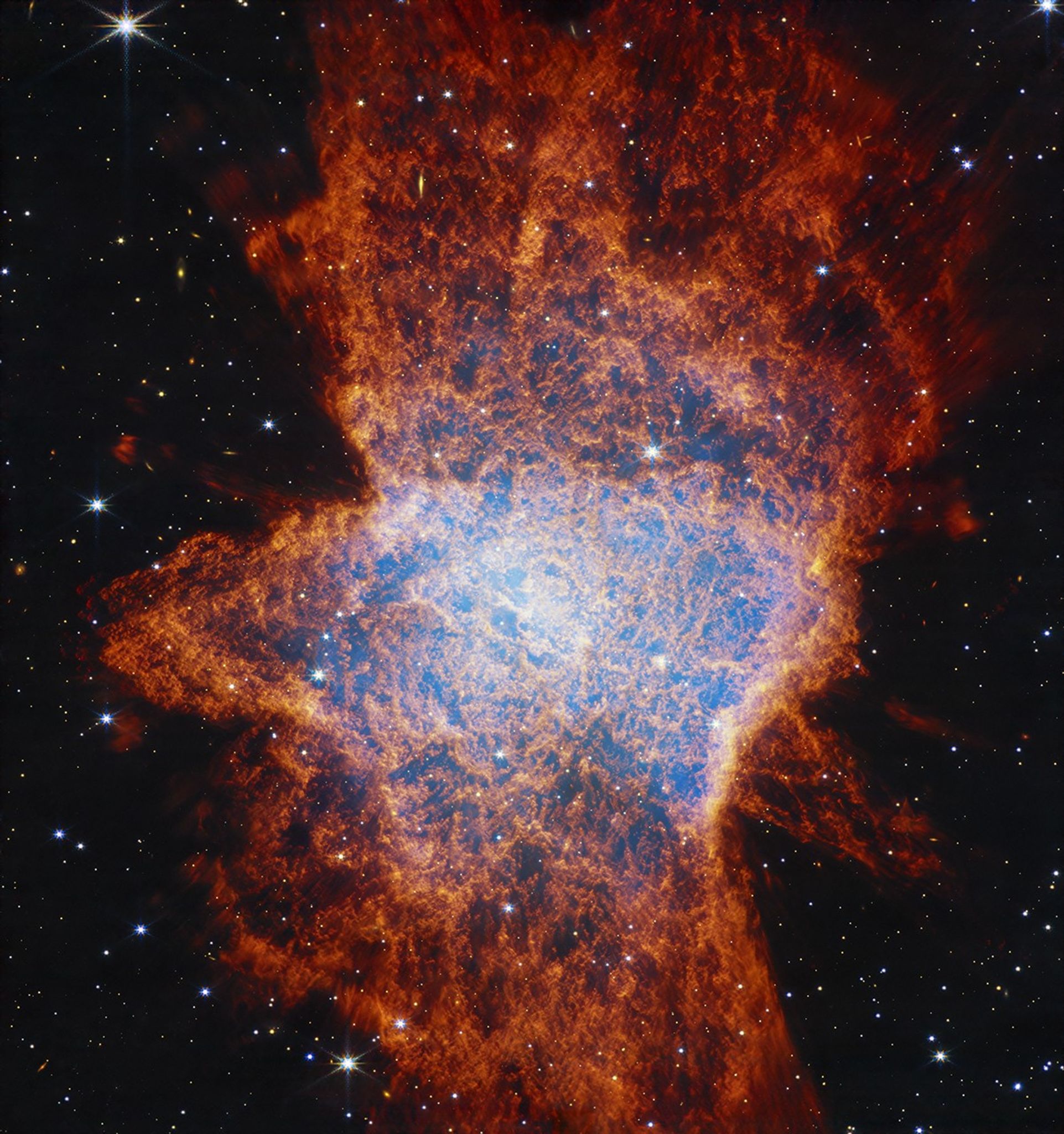
At first glance, JWST images show a random pattern that looks like splattered paint. However, the unusual asymmetrical structure of the nebula points to more complex mechanisms. A near-infrared image shows that the nebula is multi-polar. This means that several different streams of matter burst out from its center in both directions, compressing the material as they move. Astronomers believe that this indicates the presence of at least two stars. One of them interacts with a dying star that has already begun to lose the outer layers of its atmosphere.
The central region of the nebula glows from a hot stellar core, which has a light blue hue in near-infrared light. A dark orange material consisting of gas and dust surrounds the exposed areas, which appear dark blue. This clumpiness may have formed when dense molecular clouds formed, protected from the hot radiation of the central star.
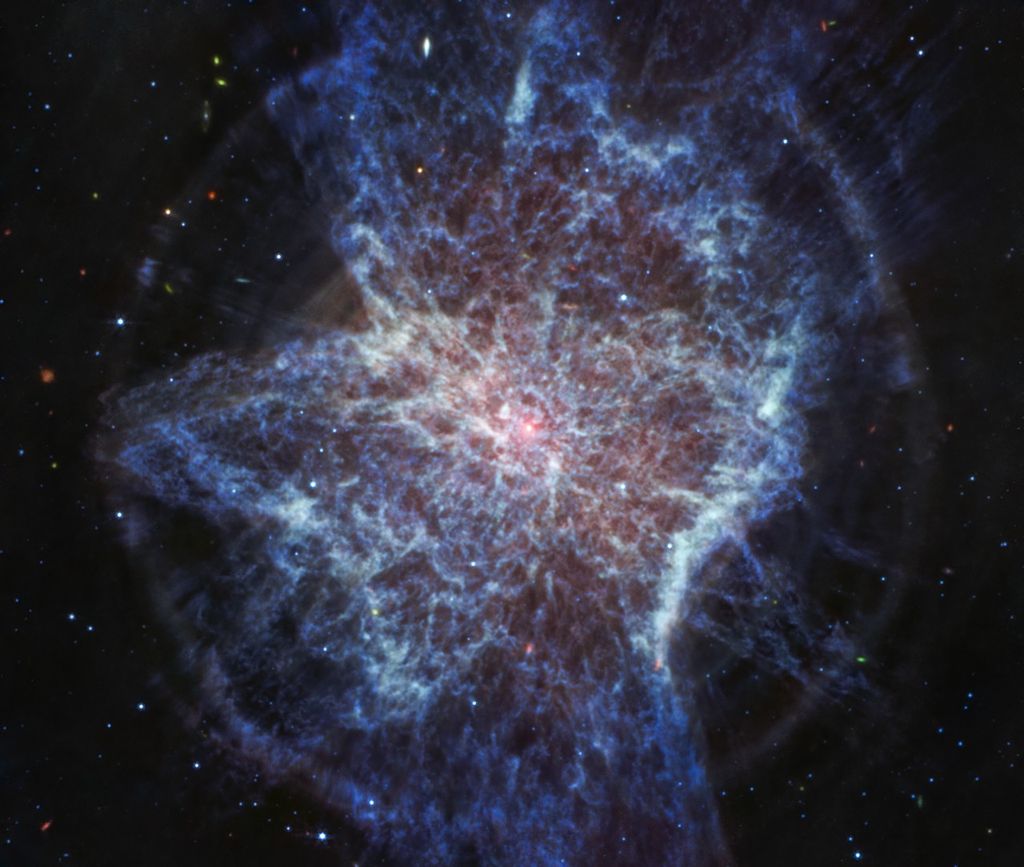
This JWST image in the mid-infrared range shows a star hidden in the center of the nebula. In the image, it appears as a small pinkish-white dot. The image also shows concentric rings expanding from the central area. They may be additional evidence of the existence of a second star, which, during its rotation, “carved” rings in the ejected material. The rings may also indicate some kind of pulsation, as a result of which gas or dust was ejected evenly in all directions at intervals of thousands of years.
As the star at the center of the planetary nebula cools, it will cease to be observable. Over time, its substance, enriched with heavy elements, will disperse into the surrounding space and then become part of a new generation of stars and planets.
Earlier, we talked about the JWST photo of a swirling nebula created by a pair of dying stars.
According to NASA

