

The James Webb Space Telescope has allowed scientists to get a good look at the planet WASP-121b. It turns out that this gas giant has two tails that extend in different directions. They are composed of helium molecules.
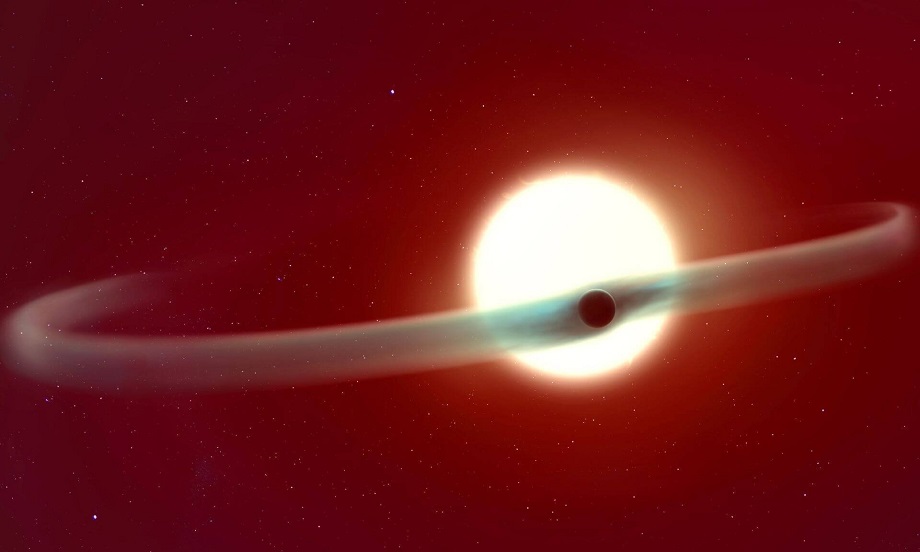
Gas giant WASP-121 b
For the first time, scientists conducted continuous monitoring of the planet’s atmospheric leakage during a complete orbit around the star and discovered that the gas giant WASP-121 b was surrounded not by one, but by two massive helium tails extending more than half the distance around the star.
The discovery was made by astronomers from the Université de Montréal’s Trottier Institute for Research on Exoplanets (IREx) and the Department of Astronomy at the University of Geneva (Switzerland) using the James Webb Space Telescope (JWST) and its Canadian instrument NIRISS.
Led by Romain Allart, PhD, of the University of Montreal and IREx, the observation provided the most detailed view to date of an exoplanet losing its atmosphere—a process that can dramatically change the shape of planets over time.
Extreme world of WASP-121 b
WASP-121 b is what astronomers call an ultra-hot Jupiter, which is a giant gas planet that orbits so close to its star that a year on it lasts only one day, or in this case, just 30 hours. The star’s intense radiation heats the planet’s atmosphere to thousands of degrees, allowing light gases such as hydrogen and helium to escape into space. Over millions of years, this slow leakage can change the size, composition, and future evolution of the planet.
Until now, scientists have mainly observed short bursts of these sources during planetary transits—a few hours when a planet passes in front of its star. But without continuous monitoring, it was impossible to know how far these streams spread and how they evolved over time.
Using NIRISS (Near-Infrared Imager and Slitless Spectrograph), Allart’s team observed WASP-121 b for nearly 37 hours non-stop, covering more than one full orbit. This dataset is the most complete continuous observation of a planet’s helium signature ever recorded.
Two giant helium tails
By tracking the weak absorption of helium atoms in the infrared range, researchers discovered that the gas surrounding WASP-121 b extends far beyond the planet. The signal persisted for more than half of the planet’s orbit, making it the longest continuous detection of atmospheric leakage ever recorded.
Even more surprising is that the helium particles form two different tails: a rear tail, pushed away from the star by radiation and stellar wind, and a front tail, curving in front of the planet, probably attracted by the star’s gravity.
In total, these two streams extend to a distance 100 times greater than the diameter of the planet and cover a distance three times greater than the distance between the planet and its star.
Key to understanding planetary evolution
Modern computer models of atmospheric leakage, such as the one developed at the University of Geneva and adapted for this study, can explain isolated comet-like tails, but cannot yet fully explain this newly observed double structure of WASP-121 b. This discovery indicates that gravitational forces and winds from the star play a decisive role in the formation of these streams, and a new generation of 3D modeling is needed to understand the physical processes involved.
“This is truly a turning point,” said Allart. “We now have to rethink how we simulate atmospheric mass loss—not just as a simple flow, but with a 3D geometry interacting with its star. This is critical to understand how planets evolve and if gas giant planets can turn into bare rocks.”
Beyond the spectacle of double tails, this discovery has profound implications for planetary evolution. Atmospheric escape or loss is one of the key processes that determines whether a world will remain a gas giant, shrink to the size of a Neptune-like planet, or become a rocky core.
Observing these dynamics in real time around WASP-121b gives scientists a unique field for testing models of how planets change over billions of years. The result may even help explain the “Neptune desert”: why the smallest close gas giants, known as “hot Neptunes,” seem so rare. They may be the remnants of larger planets whose atmospheres were destroyed by their stars.
Further observations
Helium has become one of the most powerful indicators of atmospheric leakage, and the JWST’s unique sensitivity now allows astronomers to detect it at vast distances and timescales as never before. Although data from ground-based observatories are crucial for determining the dynamics of planetary leakage, continuous monitoring from such facilities is impossible due to daylight and weather conditions, which break observations into short snapshots.
Upcoming JWST observations will be necessary to determine whether the double tail structure discovered around WASP-121 b is unique or common among hot exoplanets. By studying such systems, researchers hope to paint a broader picture of how radiation and stellar winds shape the atmospheres of planets in the galaxy, in order to better understand their fate.
According to phys.org

