

Scientists used the James Webb Space Telescope (JWST) to study the jet created by a black hole at the center of the M87 galaxy. It was able to reveal a number of previously unknown details about its structure.
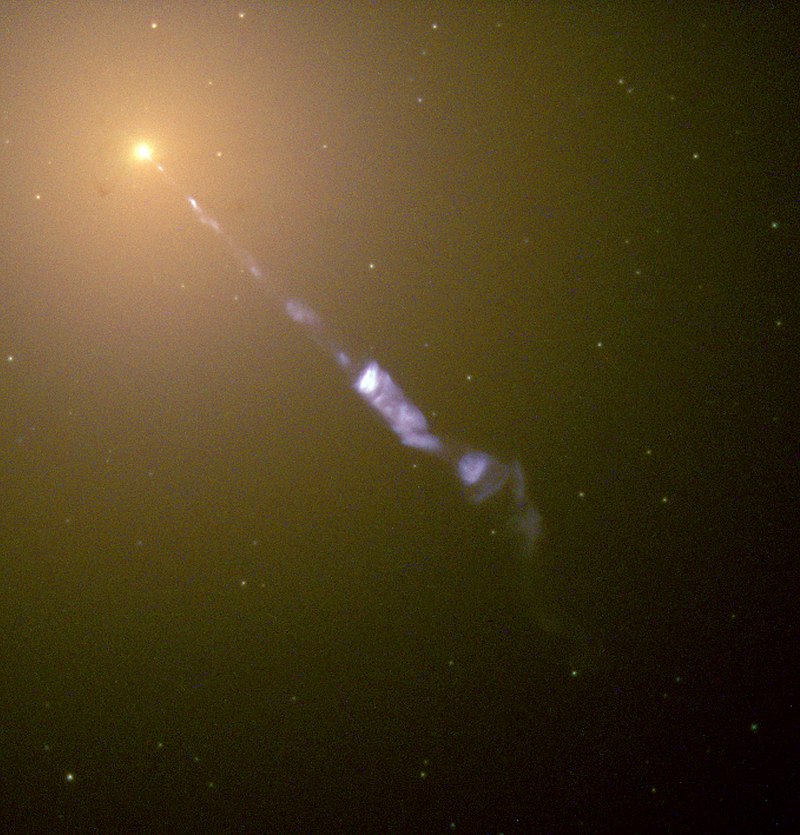
Scientists have long known about the existence of the massive elliptical galaxy M87. It is located 53 million light-years from Earth and is one of the most massive galaxies in our vicinity. At the center of M87 is an extremely active black hole whose mass is 3.5 billion times greater than that of the Sun. It is a powerful source of radiation in various ranges of the electromagnetic spectrum and emits a relativistic jet several thousand light-years long. In 2019, the Event Horizon Telescope collaboration obtained the first-ever image of the silhouette of a black hole at the center of M87.
Although M87 and its jet have been the subject of numerous observations, until recently scientists had little data in the infrared spectrum. Everything changed after the JWST was launched. It conducted a series of observations of the jet in the near-infrared range, the results of which were published in the journal Astronomy & Astrophysics.
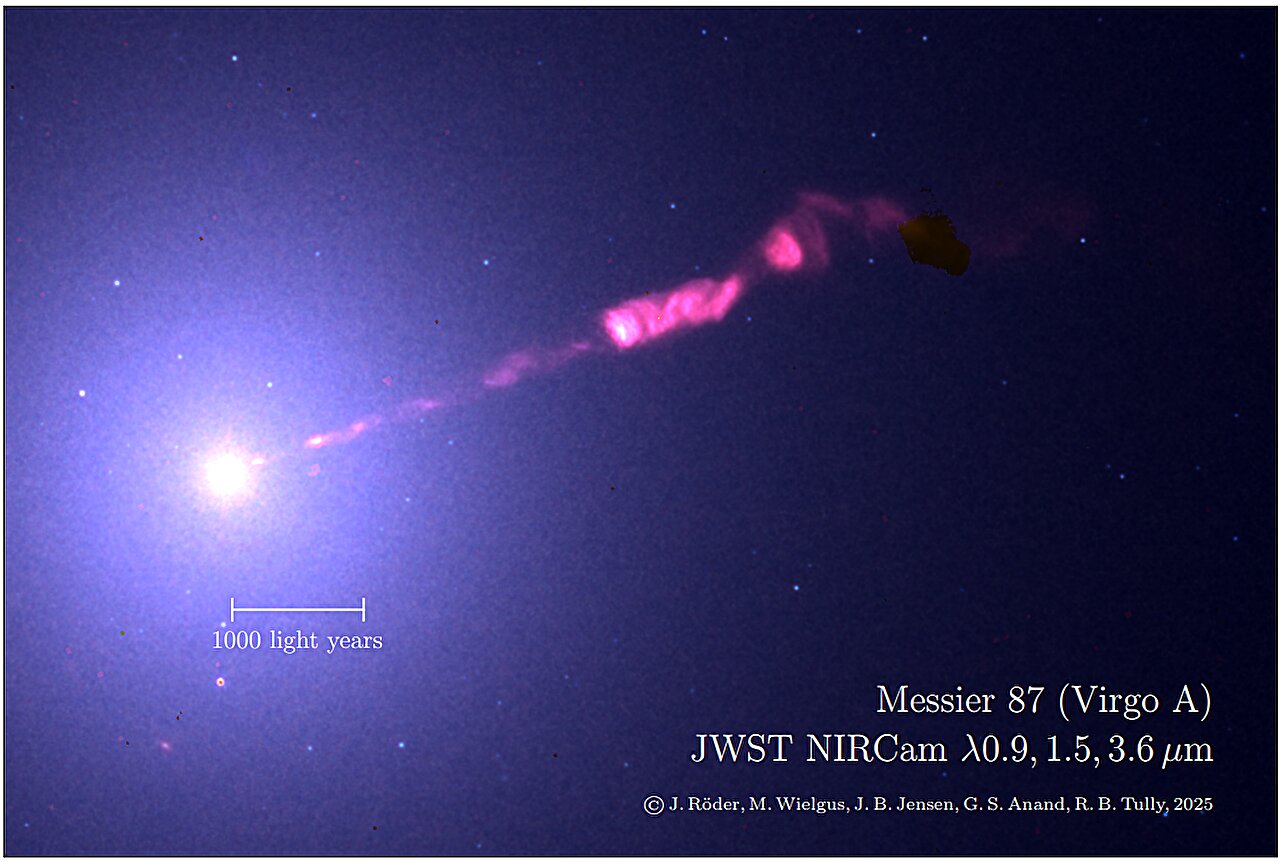
To isolate the radiation coming from the jet itself, scientists used a number of methods to remove light from stars, galactic dust, background galaxies, and globular clusters. This made it possible to obtain a detailed infrared image of the main jet, as well as the counter-jet, which emanates in the opposite direction from the black hole.
The M87’s jet has a spiral structure with a slow-moving bright knot (labeled “L”) and a component called “HST-1,” which is a fast-moving super-bright object. Both are relatively close to the center. The HST-1 component is divided into two substructures with different spectral indices.
The counter-jet, detected at a distance of ~24 arcseconds from the nucleus, is usually difficult to visualize because it is moving away at a speed close to the speed of light. However, during the study, the team was able to obtain a clearer image using infrared data. It consists of two filaments connected by a hot spot, forming a C-shape, which corresponds to its morphology in the radio band.
According to the research team, the M87 study will contribute to a better understanding of the physics of jets in active galactic nuclei and serve as a benchmark for future infrared studies of extragalactic jets. Additional data from JWST and other telescopes may help to further reveal details of both the jet and counter-jet, as well as reveal more information about magnetic fields and particle acceleration.
Earlier, we discussed how a black hole explosion could help scientists uncover the structure of the universe.
According to Phys.org

