

A team of scientists from the Southwest Research Institute has announced the discovery of methane on the dwarf planet Makemake. The discovery was made using the James Webb Space Telescope (JWST).

Makemake was discovered in 2005. Its diameter is 1,500 km (about two-thirds of Pluto’s diameter), and its orbit is 45 AU from the Sun. It has at least one moon.
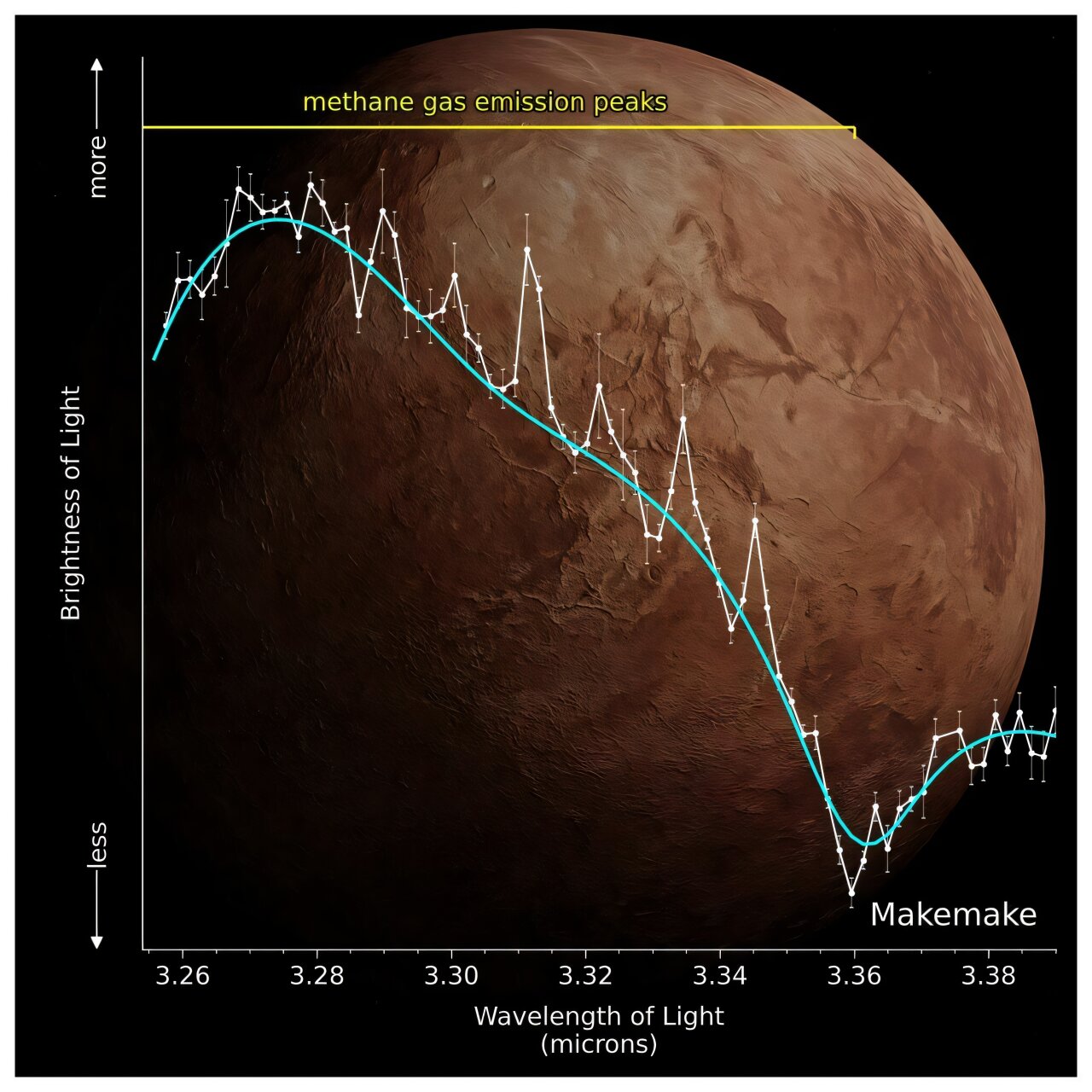
Scientists have long been interested in whether Makemake has an atmosphere and what its surface is made of. They engaged the JWST for this purpose. It succeeded in detecting spectral methane emissions. This discovery makes Makemake the second trans-Neptunian object after Pluto on which the presence of this gas has been confirmed.
The observed spectral radiation of methane was interpreted as fluorescence excited by the Sun, i.e., the re-emission of sunlight absorbed by gas molecules. According to scientists, this could indicate either a thin atmosphere, similar to Pluto’s, in equilibrium with surface ice, or more transient activity, such as comet-like sublimation or cryovolcanic plumes.
The first scenario assumes a surface pressure of only about 10 picobars (100 billion times lower than Earth’s atmospheric pressure) and a gas temperature of -233 °C. If confirmed, Makemake will join a small group of bodies in the outer Solar System where exchange between the surface and atmosphere is still active.
Another possibility is that methane is emitted in the form of plume-like emissions. The model created by scientists suggests that gas can be released at a rate of several hundred kilograms per second, which is comparable to the water plumes of Enceladus’ geysers and far exceeds the activity observed on Ceres.
In the future, scientists intend to continue observing the dwarf planet in order to better understand the processes taking place on its surface. In any case, the discovery shows that Makemake is not a lifeless remnant of the outer Solar System, but a dynamic body where methane ice is still evolving.
According to Phys.org

