

An international team of researchers has reported on a possible first observation of stars from the so-called Population III. They were assisted in this by the James Webb Space Telescope (JWST).
Scientists divide all stars into several groups (populations) depending on their chemical composition. Our Sun is characterised by a noticeable content of elements heavier than helium (in astronomy, they are called ‘metals’) in its spectrum and belongs to Population I. Stars with a content of heavy elements several orders of magnitude lower belong to Population II. These are old stars that formed shortly after the Big Bang and are more than 10 billion years old.
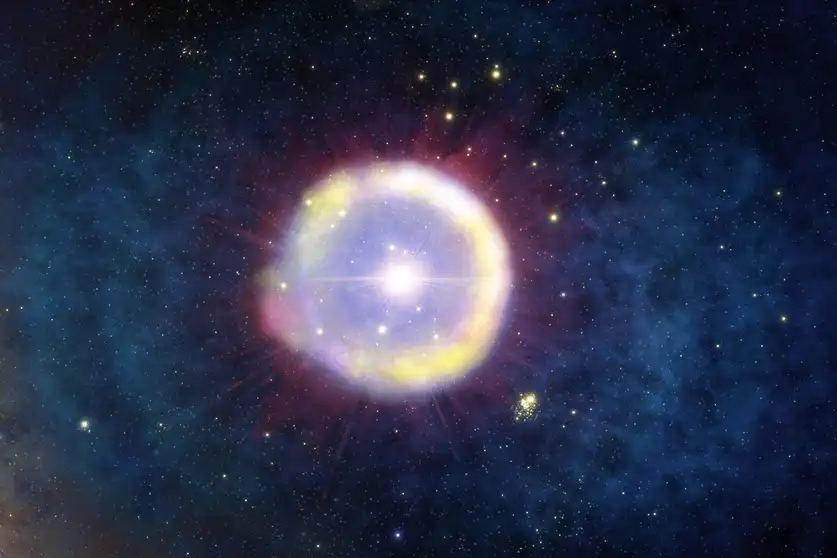
The Universe also should have contained Population III stars — the earliest stars, consisting exclusively of hydrogen and helium with a small amount of lithium. They formed approximately 200 million years after the Big Bang and had very large masses. Their demise enriched the Universe with heavy elements, making it possible for rocky planets to form, on which life could arise.
For many years, astronomers have been searching for Population III stars. In an article published in The Astrophysical Journal Letters, a team of researchers claims that thanks to the JWST telescope, they have managed to find these ancient relics of the Big Bang. They are located in the galaxy LAP1-B, which is on the edge of the observable Universe. The light emitted by it took 12.9 billion years to reach Earth.
According to scientists, the characteristics of LAP1-B stars correspond to the criteria of Population III. First, the galaxy formed in a dark matter cluster whose mass is approximately 50 million times greater than that of the Sun. Second, the stars have enormous masses, ranging from 10 to 1,000 times greater than that of our Sun. Thirdly, they are grouped into small clusters with a total mass of several thousand solar masses. Thus, they correspond to all three key theoretical predictions of what Population III stars should look like.
Further evidence is provided by the gas surrounding LAP1-B. It contains only trace amounts of metals. This is consistent with a scenario in which this galaxy is so young that some of the first massive stars died very recently, exploding as supernovae and contaminating the gas with these elements.
According to scientists, their discovery may be just the tip of the iceberg. They intend to continue their research to confirm that the stars they have found really belong to Population III.
According to Phys.org

