

The James Webb Space Telescope has determined the chemical composition of interstellar comet 3I/ATLAS. It turned out that it consists mainly of carbon dioxide. There is also water and carbon monoxide.
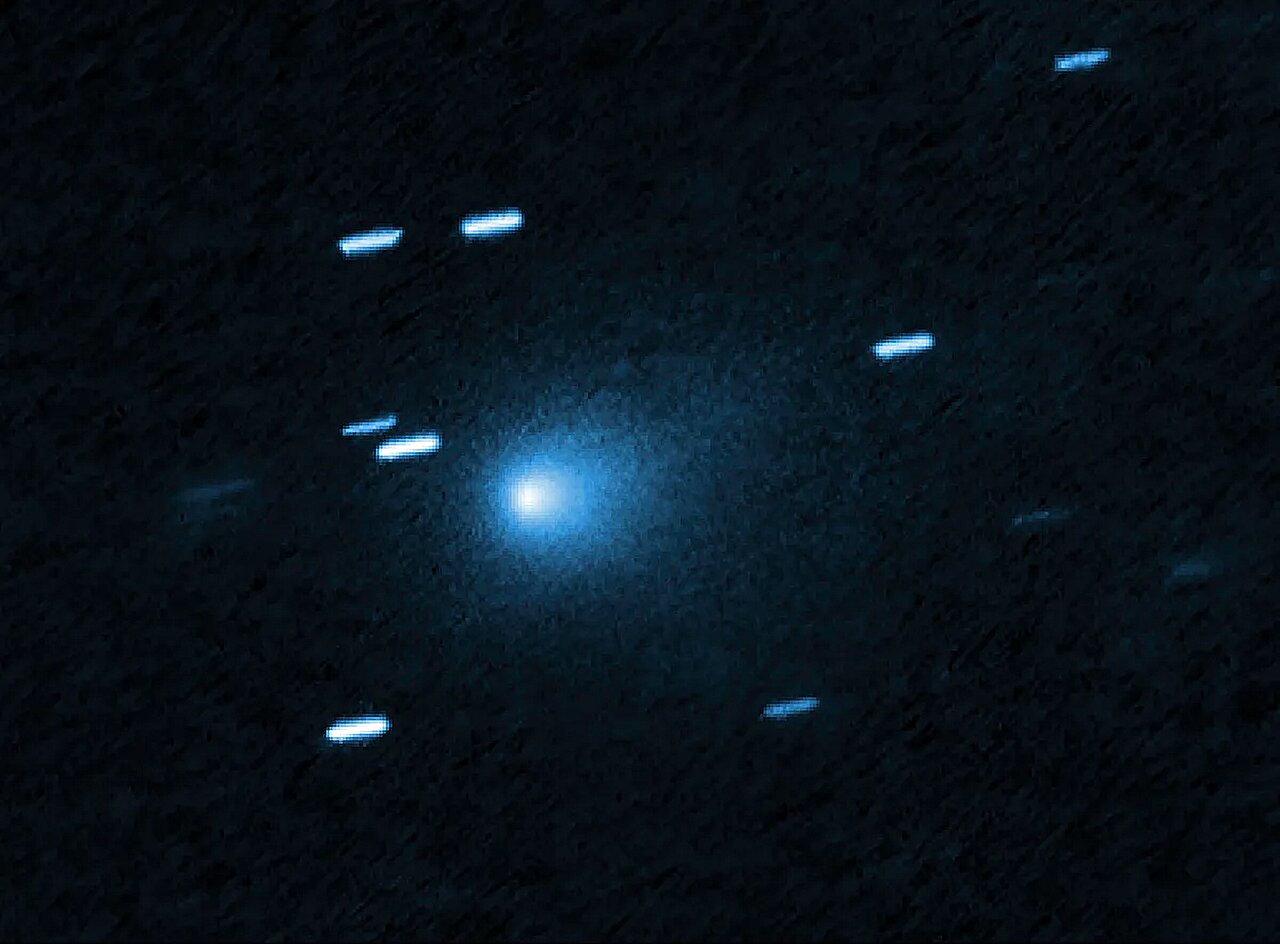
Interstellar comet
The James Webb Space Telescope has made a new observation of comet 3I/ATLAS. This celestial body flew to us from interstellar space and has caused a lot of excitement since its discovery in early July. That is why it has become the focus of attention for all the world’s leading astronomical instruments.
This time, James Webb’s main achievement was determining the exact chemical composition of both the comet’s icy core and its coma. This was made possible by the NIRSpec spectrograph installed on the telescope’s infrared camera. It turned out that the main component is carbon dioxide.
Water, carbon monoxide, and carbonyl sulfide were also detected in the composition of 3I/ATLAS. In general, these are substances that are quite common for comets that are constantly present in the Solar System. No signs of a metal probe, inside which “little green men” could be hiding, were found.
Features of the comet
Nevertheless, scientists have identified certain peculiarities in the chemical composition of 3I/ATLAS. The ratio of carbon dioxide to water is 8:1 — the highest ever recorded for a comet, and six standard deviations above the typical value. However, the ratio of carbon monoxide (CO) to water was more familiar, at 1.4, which is consistent with previous observations.
Another discovery was that the ratio of two carbon isotopes — carbon-12 and carbon-13 — was generally similar to that on Earth. This indicates that the comet formed in an environment with similar forms of carbon. At the same time, there are several features in the 3I/ATLAS formation process that could have led to an uneven CO₂/H₂O ratio.
One of them was the very high level of ultraviolet radiation in the star system in which the object was created. Another possibility is that it was created outside the carbon dioxide “snow line,” i.e., where not only water but also this gas is in a solid state.
According to phys.org

