

The James Webb Space Telescope (JWST) has captured the clearest images of the Helix Nebula to date. They show the possible fate of the Sun and the planets orbiting it.
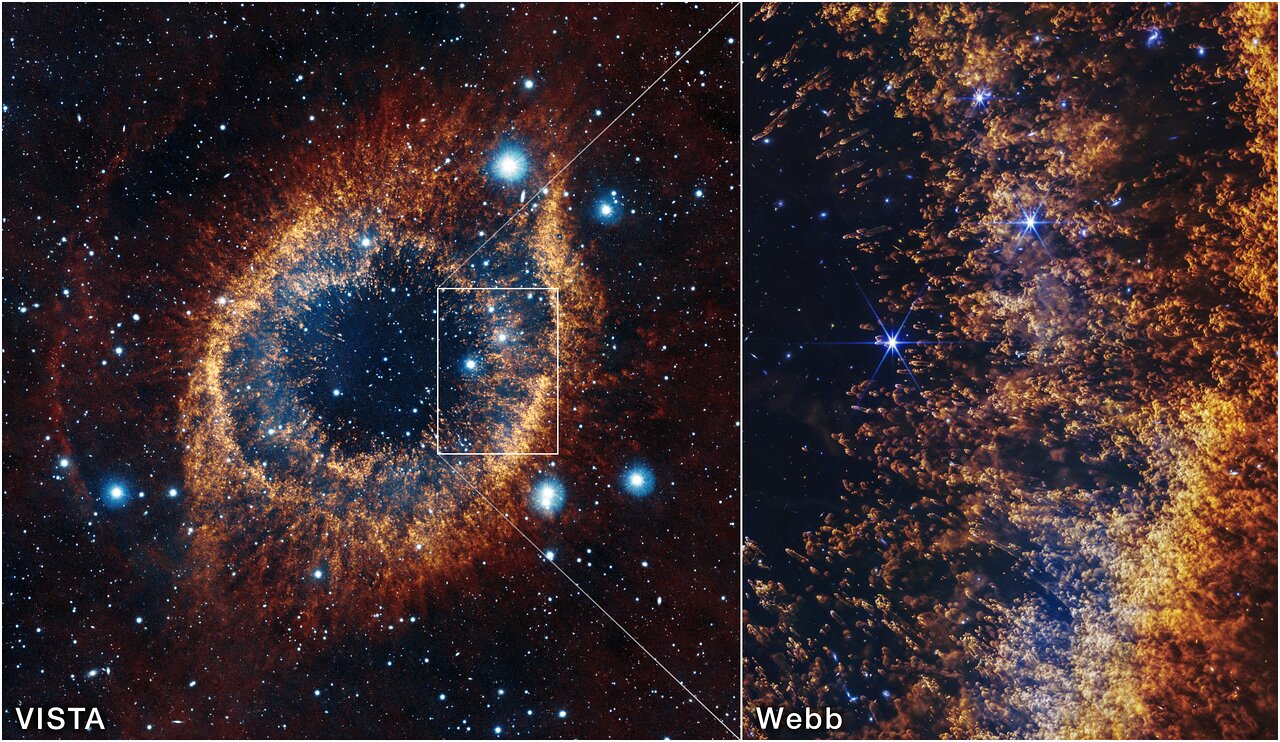
The Helix Nebula was discovered in the early 19th century. Thanks to its striking ring-like shape, it quickly became one of the most iconic representatives of the class of so-called planetary nebulae. Such objects are ionized shells around the exposed cores of dying stars that once resembled the Sun.
Located 650 light-years from Earth, the Helix Nebula is one of the closest planetary nebulae to us. It is not surprising that it is a popular object for observation among astronomers using ground-based and space telescopes. Recently, JWST joined them. It took this research to a new level by providing the clearest infrared images of this familiar object.
The JWST image shows pillars resembling comets with long tails that outline the inner region of the expanding gas shell. Here, the hot winds of hot gas from a dying star collide with colder shells of dust and gas that were ejected earlier in its life, forming the nebula’s remarkable structure.
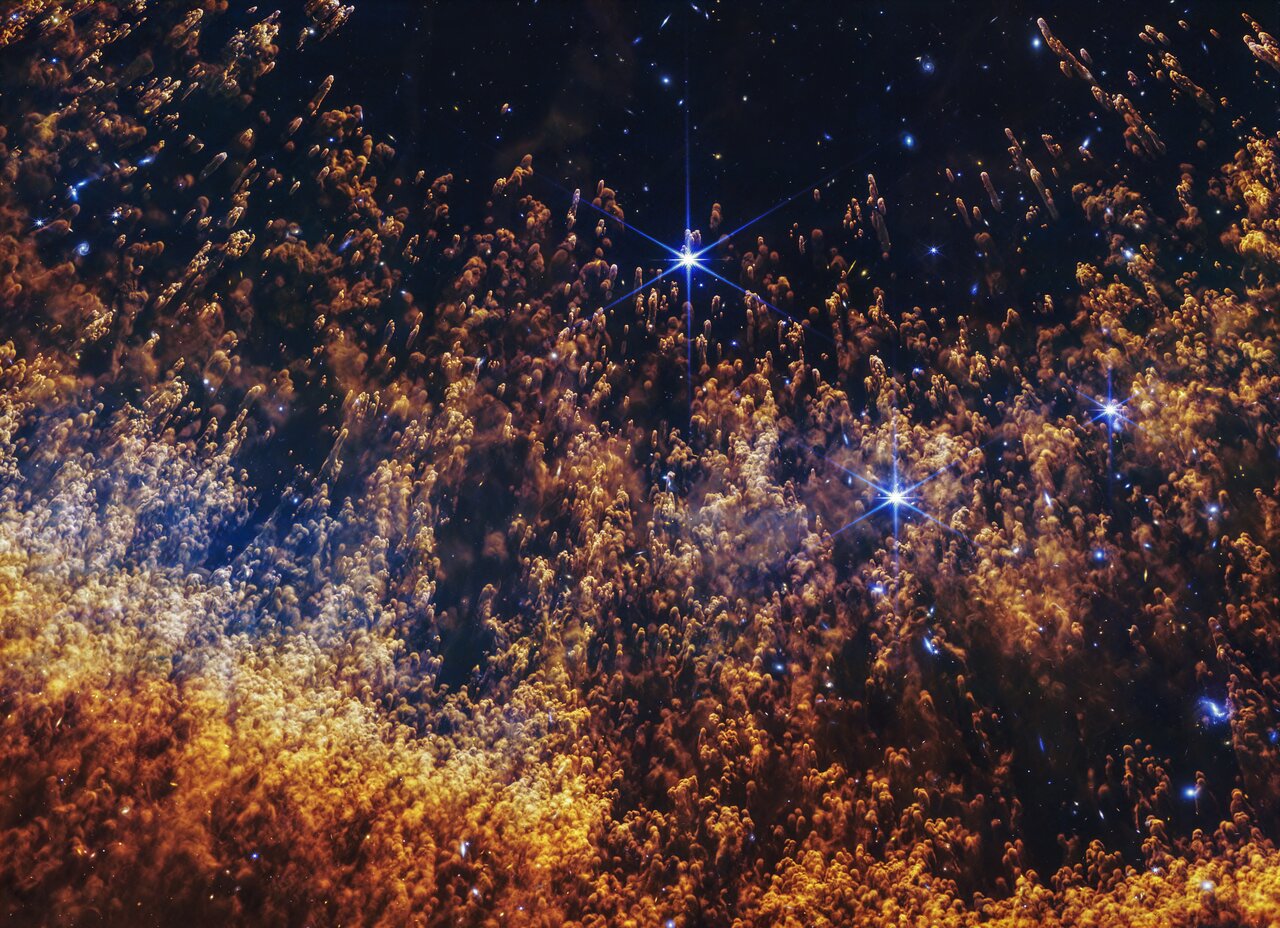
At the heart of the nebula lies the core of a dying star, transforming into a white dwarf. It remains outside the JWST image, but we can clearly see how it affects its surroundings. The intense radiation from the dying star illuminates the surrounding gas, creating a variety of features: hot ionized gas near the white dwarf, cooler molecular hydrogen further away, and protective pockets where more complex molecules can begin to form within dust clouds. This interaction is vitally important, as it is from this raw material that new planets in other star systems may one day form.
The colors in the image reflect the temperature and chemical composition of the nebula. The blue hue indicates the hottest gas, heated by intense ultraviolet radiation. Further away, it cools down to the yellow regions, where hydrogen atoms combine to form molecules. At the outer edges, reddish tones indicate the coldest material, where gas begins to thin out and dust can take shape. Together, the colors show how the last “breath” of a dying star becomes the raw material for a new generation of stars and planets.
Earlier, we reported on how a white dwarf in the center of the Helix Nebula destroyed a planet.
According to Esawebb

