

Scientists used data collected by the Juno spacecraft to refine Jupiter’s equatorial and polar radii. It turned out that the largest planet in the Solar System is much more flattened at the poles than previously thought.
Research of Jupiter
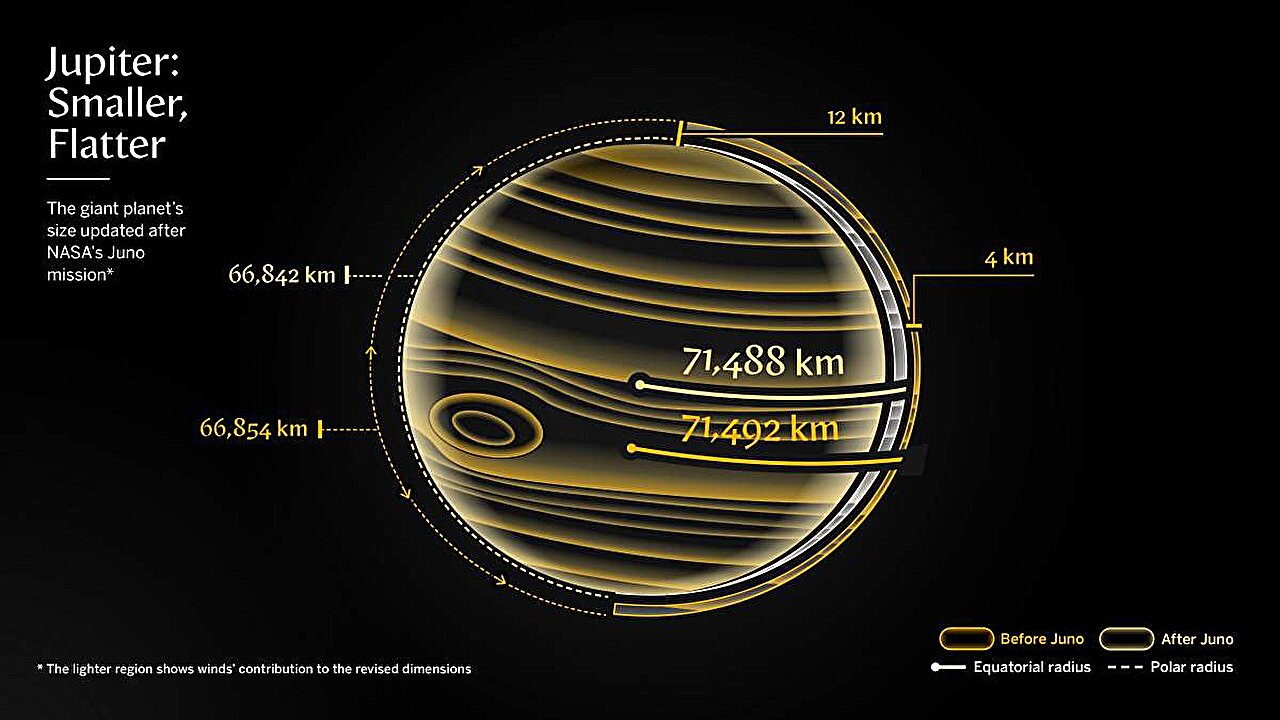
Jupiter is the largest planet in the Solar System. For 50 years, all textbooks have stated that its equatorial radius is 66,854 km and its polar radius is 71,492 km. However, a recent publication in Nature Astronomy may change this.
Until now, Jupiter’s dimensions had been estimated based on just five measurements taken by the Voyager and Pioneer spacecraft nearly five decades ago. However, in 2011, the Juno automatic station arrived at Jupiter. It took 26 measurements of the gas giant’s dimensions. Scientists analyzed these figures in detail.
“Juno’s passing behind Jupiter provides an opportunity for new science objectives. When the spacecraft passes behind the planet, its radio communication signal is blocked and bent by Jupiter’s atmosphere. This enables an accurate measurement of Jupiter’s size,” says Juno’s Principal Investigator Dr. Scott J. Bolton of the Southwest Research Institute in San Antonio, Texas.
The true size of Jupiter
The Juno team at the Weizmann Institute took advantage of this new opportunity. Scientists tracked how radio signals bend as they pass through Jupiter’s atmosphere, allowing them to turn this information into detailed maps of Jupiter’s temperature and density, providing the clearest picture yet of the giant planet’s size and shape.
New data shows that Jupiter is slightly smaller than previously thought: its width at the equator is about 8 km less, and at the poles it is 24 km flatter. In other words, it is more flattened than previous estimates suggested.
These few kilometers are of fundamental importance in calculations of Jupiter’s shape. Changing the radius by just a few kilometers allows models of the gas giant’s internal structure to agree much better with both gravitational data and atmospheric measurements. Using the most advanced models of Jupiter’s internal structure, astronomers have gained a unique opportunity to show that the refined shape of the planet helps to resolve discrepancies between theoretical models and observations.
This study has broader implications for understanding the structure of gas planets in general, as Jupiter serves as a standard reference for studying gas giants in the Solar System and beyond.
Winds, hurricanes, and the internal structure of Jupiter
Professor Yohai Kaspi said that previous measurements didn’t take into account Jupiter’s strong winds. By including these extreme winds in their calculations, Weizmann’s team cleared up some long-standing differences in previous measurements. “It’s difficult to see what’s happening beneath the clouds of Jupiter, but the radio data give us a window into the depth of Jupiter’s zonal winds and powerful hurricanes,” explains Kaspi.
The work on winds is related to recent research by Kaspi and Dr. Nimrod Gavriel, a graduate of Kaspi’s group, on Jupiter’s massive polar cyclones. This work, published in PNAS, uses data from the Juno mission on the motion of these cyclones to estimate how deep they extend into the planet’s interior.
In general, a better understanding of Jupiter’s winds allows scientists to determine the relationship between the planet’s atmosphere and its deep interior. Their prediction was recently confirmed by microwave measurements made by the Juno spacecraft.
This research helps astronomers understand how planets form and evolve. Jupiter was probably the first planet to form in the Solar System, and by studying what happens inside it, we are getting closer to understanding the formation of the Solar System and planets similar to ours.
In the future, the methods developed during this research will be useful to the team when analyzing data from the European Space Agency’s JUICE unmanned spacecraft, launched in 2023. The mission is equipped with an instrument developed by the Weizmann Institute that allows for a deeper look into the planet’s atmosphere.
According to phys.org

