

For centuries, astronomers have sought answers about the origin of one of the oldest and densest star systems in the Universe, known as globular clusters. Now, research conducted by the University of Surrey and published in the journal Nature has finally uncovered this mystery using detailed models and has also revealed a new class of objects that may exist in our Galaxy.
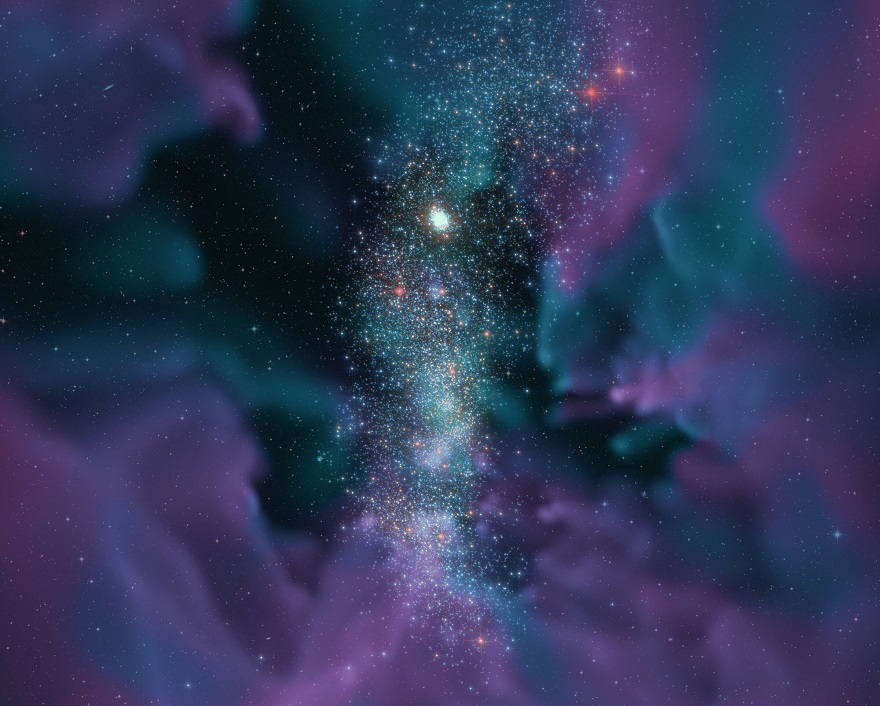
Modeling globular clusters
Globular clusters are dense clusters of hundreds of thousands to millions of stars that orbit galaxies, including the Milky Way. Unlike galaxies, they show no signs of dark matter, and their stars are unusually uniform in age and chemical composition – characteristics that have sparked debate among scientists about their origin since their discovery in the 17th century.
Researchers at Surrey used ultra-high-resolution simulations that can trace the 13.8-billion-year history of the Universe in unprecedented detail, allowing them to observe the formation of globular clusters in real time in their virtual cosmos, called EDGE.
Simulations revealed several ways in which they could have been formed and, unexpectedly, the emergence of a new class of star systems – “globular satellite clusters” – which occupy an intermediate position between globular clusters and dwarf galaxies in terms of their properties.
Large-scale simulation of the history of the Universe
Working in collaboration with Durham University, the University of Bath, the University of Hertfordshire, Carnegie Observatories and the American Museum of Natural History in the US, Lund University in Sweden, and the University of Barcelona in Spain, researchers used the UK’s national supercomputing facility, DiRAC, to run EDGE simulations over several years.
To give you an idea of the scale, if the largest simulations were run on a standard or powerful laptop, it would take decades to complete them. These simulations not only reproduced realistic globular clusters and dwarf galaxies, but also predicted a previously unknown class of objects.
Normal dwarf galaxies are usually dominated by dark matter, with its mass being approximately a thousand times greater than the total mass of stars and gas.
New class of galactic objects
However, recently discovered “dwarf galaxies similar to globular clusters” appear similar to ordinary star clusters when observed, but still contain a significant amount of dark matter – this means that telescopes may have already found them in the real Universe and classified them as ordinary globular clusters. This slight difference puts them in a unique position for studying both dark matter and cluster formation.
Several well-known satellites of the Milky Way, such as the “ultra-faint” dwarf galaxy Reticulum II, are likely candidates. If confirmed, they could become prime locations for searching for metal-free primordial stars born in the early Universe and new locations for testing models for the elusive “dark matter”.
Professor Justin Read, head of astrophysics at the University of Surrey, said: “The EDGE project aimed to build the most realistic simulation of the smallest galaxies in the universe – one that could track all 13.8 billion years of its history, while focusing on small details such as the explosion of a single star. It took years of work on the DiRAC National Supercomputer in the UK, but the result was extraordinary. With a resolution of just 10 light-years, sufficient to capture the effects of individual supernovae, we were able to show that globular clusters can form in at least two different ways, both without dark matter”.
The next step is to confirm the existence of these new objects through targeted observations using telescopes, including the James Webb Space Telescope and future deep spectroscopic surveys.
If they do, it could give astronomers new ways to test dark matter theories and provide some of the best chances yet to find the first generation of metal-free stars in the Universe.
Provided by: phys.org

