

Deep space hides many secrets, and it seems that one of the most important ones has just been revealed. A team of astronomers from the University of Missouri, using the world’s most powerful space telescope, James Webb (JWST), has discovered something truly unexpected: 300 objects whose brightness challenges current ideas about the formation of the Universe. The discovery was published in The Astrophysical Journal.
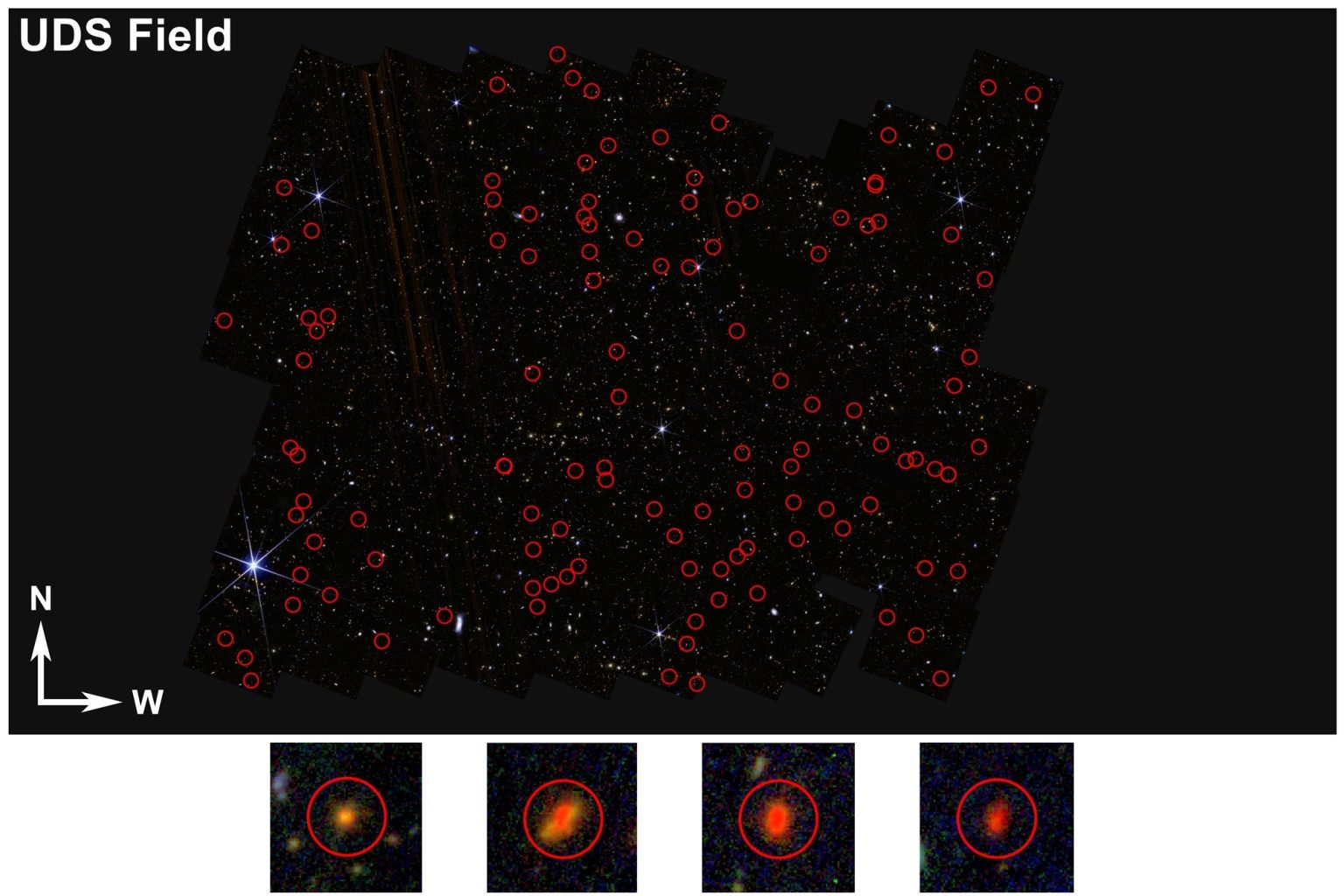
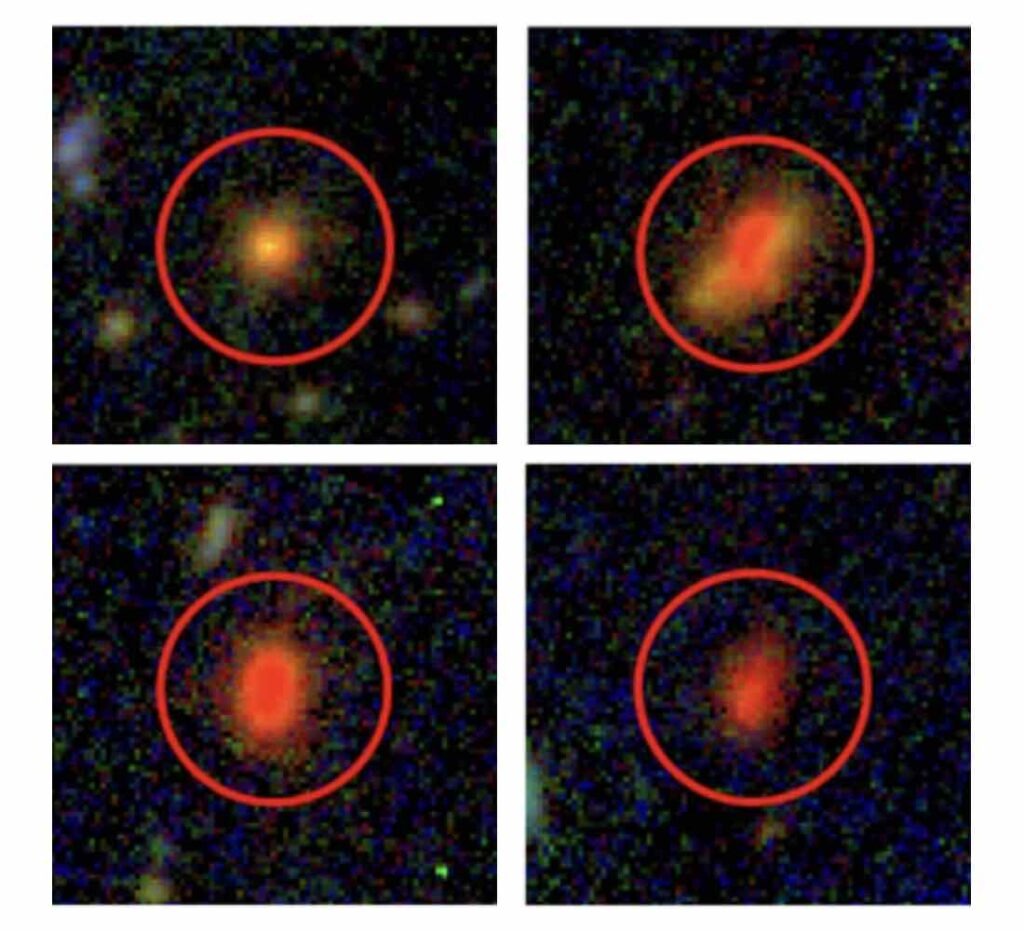
After analyzing infrared images, scientists identified three hundred mysterious light sources. They are extremely bright, much brighter than objects that existed in the early Universe should be.
“These mysterious objects are candidates for the very first galaxies in the young Universe,” explains Professor Haojing Yan, co-author of the study. If even a few of them are confirmed, it could call into question all our theories about the way the first stars and galaxies were born billions of years ago.
Hunting for light from the past
How was it possible to find something so ancient? The answer lies in the nature of light. The farther away an object is from us, the longer its light travels to reach us. During this time, due to the expansion of the Universe, light waves are “stretched,” moving from the visible range to the infrared range. This effect is called redshift. The higher the redshift, the farther away and, accordingly, the older the galaxy.
The team used a special technique called “ dropout.” It searches for objects that are visible in red (longer) wavelengths but disappear completely in blue (shorter) wavelengths. This indicates a characteristic feature — the Lyman Break, evidence of neutral hydrogen absorbing ultraviolet light. This feature reveals extremely distant galaxies.
On the edge of the impossible
To estimate the age and mass of the finds, scientists used the spectral energy distribution fitting method. The results are impressive: these candidate galaxies are incredibly bright and massive for their age. Previously, such objects were often perceived as errors or something closer to them, imitating them. But the JWST data is so high quality that the discovery can no longer be ignored.
“Even if only a few of these objects are confirmed to have existed in the early Universe, they will force us to revise existing theories of galaxy formation,” notes Professor Yan. This means that galaxies in the past could have formed much faster and more efficiently than we thought.
Spectroscopy is the final word
Final confirmation must be provided by spectroscopy — the “gold standard” of astronomical research. This method breaks down the light from an object into a spectrum, like a rainbow, allowing its redshift and composition to be measured accurately. One of the 300 objects has already been officially confirmed as a galaxy with an ultra-high redshift.
“But this one object is not enough. We will need to conduct additional confirmations,” says graduate student Bangzheng Sun.
Earlier, we reported on how the oldest galaxy appeared just 280 million years after the Big Bang.
According to sciencedaily.com

