

While studying data collected by the Gaia observatory, scientists discovered a giant wave in the Milky Way. It spreads from the center of our galaxy.
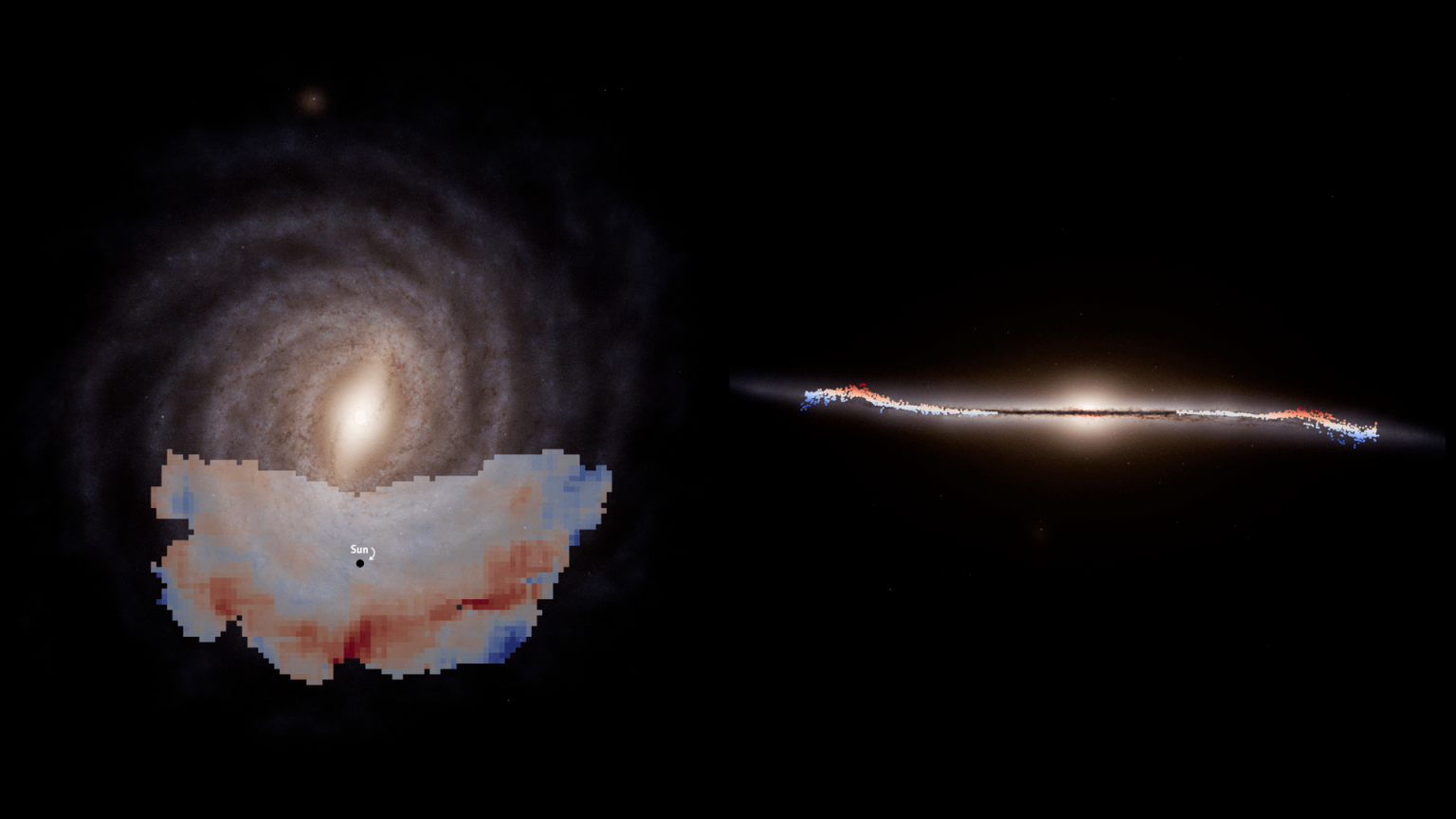
We cannot see our galaxy from the outside, which greatly complicates the study of its structure. Nevertheless, using various methods as early as the middle of the last century, astronomers established that the disk of our galaxy was curved.
However, a real wave of discoveries came after the launch of the Gaia observatory. During its operation, it observed 2 billion stars and other objects, measuring their brightness, distance, and direction of movement. This has enabled the creation of the largest and most accurate three-dimensional map of our galaxy, revealing its structure and evolution in unprecedented detail.
Among other things, in 2020, Gaia discovered that the Milky Way’s disk wobbles over time, similar to the motion of a spinning top. Now, however, a new analysis of its data has revealed that there is a giant wave in our galaxy that excites motion tens of thousands of light-years away from the Sun. Like a stone thrown into a pond, creating waves that spread outward, this galactic wave encompasses most of the outer disk of the Milky Way. It affects star systems located at least 30–65 thousand light-years from the center of the galaxy. Scientists figuratively compare the observed structure to a wave in a stadium frozen in time. Some people are standing upright, some have just sat down, and others are preparing to stand up.
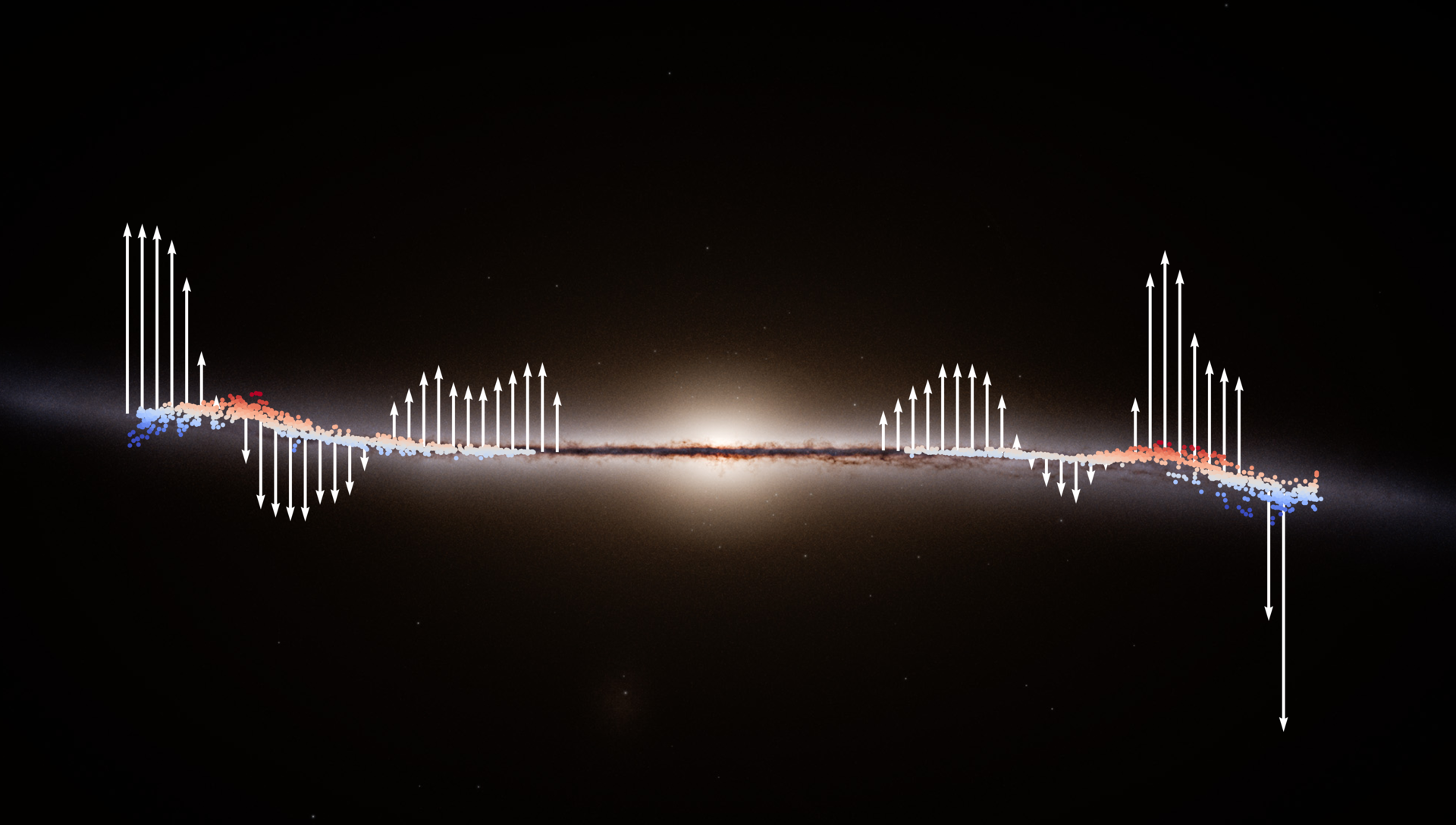
Astronomers were able to track these fluctuations by studying the detailed positions and movements of young giant stars and Cepheids. These are types of stars whose brightness changes in a predictable manner. Since young giant stars and Cepheids move along with the wave, scientists believe that gas in the disk may also participate in this large-scale ripple. It is possible that young stars retain memories of the wave from the very gas from which they were born.
Scientists do not yet know the source of these galactic oscillations. Scientists do not yet know the source of these galactic wobbles. Perhaps the reason for their appearance is a collision with a dwarf galaxy in the past, but further research is needed to confirm this hypothesis.
The wave may also be related to a smaller wobble observed 500 light-years from the Sun and extending 9,000 light-years, known as the Radcliffe wave.However, scientists currently have no evidence of a connection between them. They hope to get the answers they need after the fourth release of Gaia data, which will provide even more accurate information about the position and motion of stars in the Milky Way, including Cepheids.
According to ESA

