

Life on modern Earth is possible, among other things, thanks to the presence of a powerful magnetic field, which is caused by the presence of a solid core. However, in the early days of our planet, its core was liquid. Scientists have determined that this is not a problem.
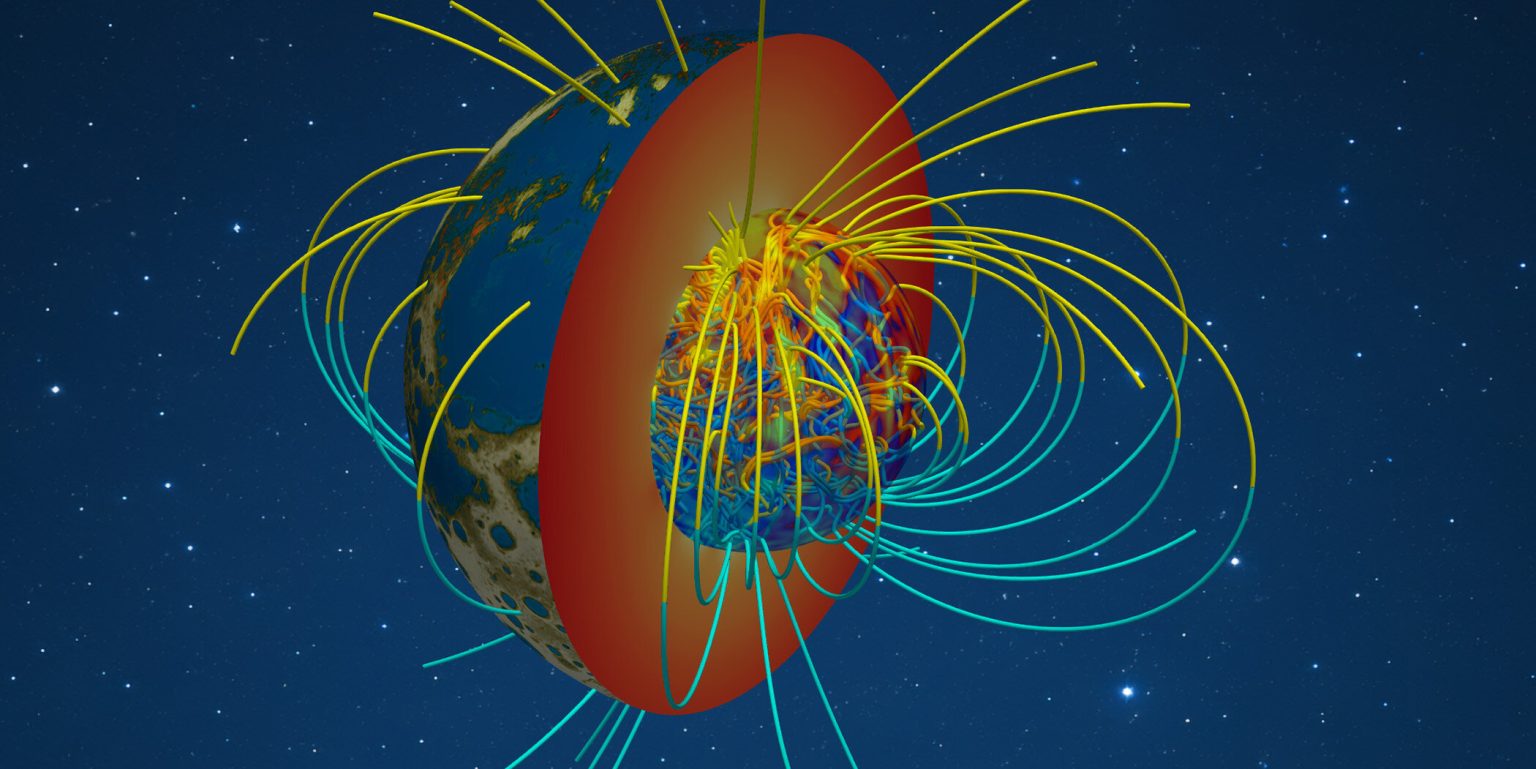
Earth’s magnetic field
A team of three geophysicists from ETH Zurich and SUSTech (China) has found the answer to the question about the Earth’s magnetic field in the past in a new study published in the journal Nature.
The magnetic field protects our planet from bombardment by high-energy particles that would otherwise threaten all life. Its source is the inner core of our planet and the layers surrounding it.
The inner core is a solid mass of iron and nickel, surrounded by an outer core, which also contains conductive materials, but these are in a liquid state. It generates currents that create a protective shell around our planet, like a giant dynamo.
Liquid core
The problem is that we’ve known for a while that Earth’s core used to be pretty rare during its first few billion years. It just hasn’t crystallized yet. However, according to paleontological data, primitive life already existed on the planet at that time.
Therefore, the question arises: could it have survived without a magnetic field? Or perhaps the liquid core did create it after all? Or do our ideas about early Earth need to be revised? Researchers have attempted to answer this question.
They developed a computer model of the Earth that can be used to simulate whether a completely liquid core can also generate a stable magnetic field. Conducted on the Piz Daint supercomputer at CSCS in Lugano, it showed that the viscous state of the Earth’s inner core did not affect the generation of its magnetic field.
According to phys.org

