

Recently, our team had the opportunity to speak with Professor Carlo Baccigalupi, a renowned cosmologist from Italy. Born in Carrara, Tuscany, in 1968, his career has taken him from Pisa and Rome to Chicago and Trieste, through collaborations with leading institutions across the U.S., Europe, and Asia. He is currently a full professor and coordinator of the PhD program in Astrophysics and Cosmology at the International School for Advanced Studies (SISSA) in Trieste.
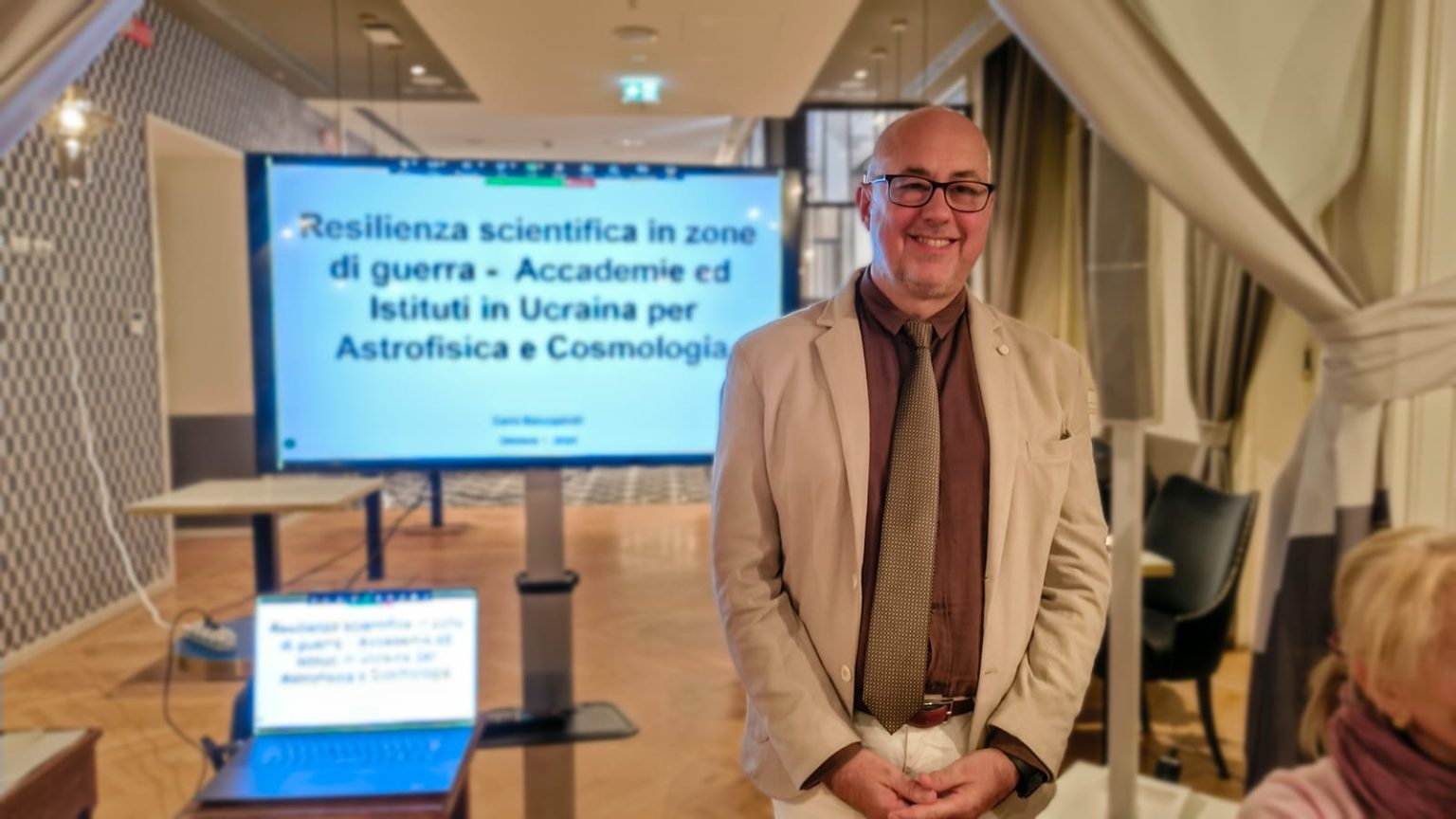
Professor Baccigalupi’s research focuses on physical cosmology and the early universe, especially on understanding the Cosmic Microwave Background (CMB), Large-Scale Structure (LSS), and Gravitational Waves (GWs) — the ancient signals that still echo from the universe’s birth. He has been a Planck Scientist within the Collaboration working at the Planck satellite, one of the most important collaborations in modern cosmology, and now plays key roles in major international efforts such as Euclid, the Simons Observatory, and LiteBIRD, all designed to observe and decode the universe’s earliest light.
Decoding the Universe’s Earliest Signals
“Cosmology today is a precision science. It gives us access to many processes that are unknown in Fundamental Physics and very difficult to reproduce in laboratories on Earth. In these years, we’re observing the CMB and the LSS,” he notes.
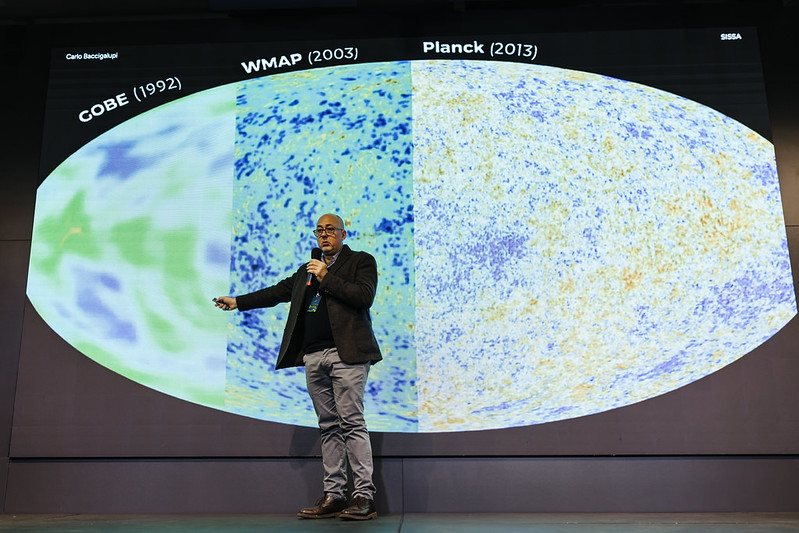
The professor explains, “The CMB is the relic light from the Big Bang. We’re studying the observations of powerful probes, including the satellites COsmic Background Explorer (COBE), the Wilkinson Microwave Anisotropy Probe (WMAP), and Planck. One component of the CMB pattern, a very faint and elusive one, remains to be observed. It could contain, on degree and super-degree angular scales, the imprint from primordial Gravitational Waves, generated by mysterious forces in the very Early Universe, when spacetime was expanding quasi-exponentially in time (Cosmic Inflation), under the effect of an unknown source of vacuum energy. To reach that goal, scientists combine ground-based observatories like Simons with future missions such as LiteBIRD.
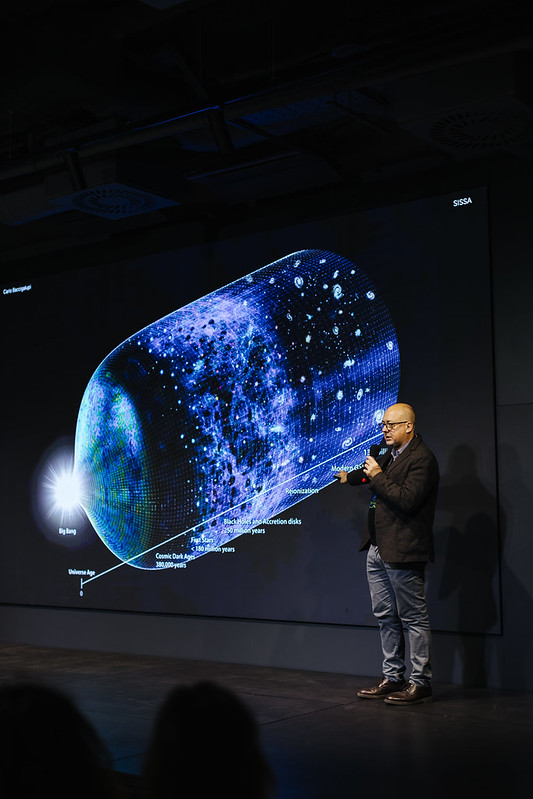
On the other hand, by observing the LSS, we can investigate the two other big mysteries of modern Physics, which are what Dark Matter and Energy are. The former is supposed to be composed of unknown particles, gravitating around galaxies and not emitting ordinary light; the latter may be even more mysterious, a new force of unknown origin which is apparently causing cosmic expansion to accelerate. Satellites like Euclid, the James Webb Space Telescope (JWST), and the Roman ground-based Telescopes are necessary for tackling these mysteries.”
When we asked why studying the early Universe and the cosmic microwave background matters so much, Professor Baccigalupi didn’t hesitate: “The early Universe is our natural laboratory for the most extreme physics we cannot reproduce on Earth,” he explains. “The CMB preserves the tiny quantum ripples stretched in the first instants after the Big Bang. From that ‘fossil light’ we can infer how matter and radiation were distributed, how cosmic structures later formed, and which physical laws governed those epochs.”
Through this “map of our origins,” scientists can measure the universe’s age, geometry, and composition, and even test theories about inflation, neutrinos, and dark matter. “It’s both a record of where we come from,” he adds, “and a precision benchmark for every other cosmological observation we make today.”
When the Universe Started to Sing
When asked what discovery has surprised him the most, Professor Baccigalupi smiles: “The ‘acoustic’ peaks in the CMB anisotropies,” he says. “We know the theory behind them: they are pressure waves, occurring coherently, when the Universe was a high-temperature plasma, similar to the waves we observe on the surface of the Sun. Yet, when the data came — first from balloon experiments, then from WMAP and especially Planck — the precision with which those tiny oscillations of the primordial plasma appeared on the sky was breathtaking. Seeing theory turned into an observed pattern of peaks and troughs, each carrying information about the Universe’s composition and geometry, was like hearing the cosmos play its own score.
What surprised me most was not that the peaks existed — we expected them — but that nature revealed them so cleanly and so consistently with the theory. It was a moment when Cosmology moved from speculation, phenomenological guesses, to precision science: we could suddenly measure the age of the Universe, the density of baryons and dark matter, and even test neutrino physics, all from the ripples frozen into the CMB.”
The Decade Ahead: Peering Deeper into the Cosmos
Looking into the future of Cosmology, Professor Baccigalupi foresees what he calls “a decade of precision and depth.”
“We will combine exquisite measurements of the CMB with massive surveys of galaxies and weak lensing to probe gravity across cosmic time, reduce systematics, and test the standard model of cosmology under real pressure. On the practical side, we’ll see smarter instruments and data systems — onboard filtering, faster pipelines, and open data practices — so results arrive sooner and are easier to reuse. Scientifically, expect sharper constraints on neutrino physics, the growth of structure, and the initial conditions of the Universe; if nature hides small deviations from our current model, this is when they’re most likely to surface.”
AI and the New Frontiers of Cosmology
In an age where artificial intelligence is reshaping every field, cosmology is no exception. When asked about the role of computational methods and machine learning, Professor Baccigalupi describes them as “central instruments of discovery.”
“We use ML to detect faint patterns, clean systematics, and accelerate simulations with emulators; we combine it with Bayesian inference to explore vast parameter spaces more efficiently. But we treat ML as an integral part of the measurement process, so we insist on interpretability, calibration against theory, uncertainty quantification, and full reproducibility. The goal is not to replace physics, but to resolve it more clearly. And… this is not the end… rather… the tip of the Iceberg… now, with Artificial Intelligence, we can have Digital Agents, carrying out tasks, teaming with us, enhancing dramatically our reach for knowledge.”
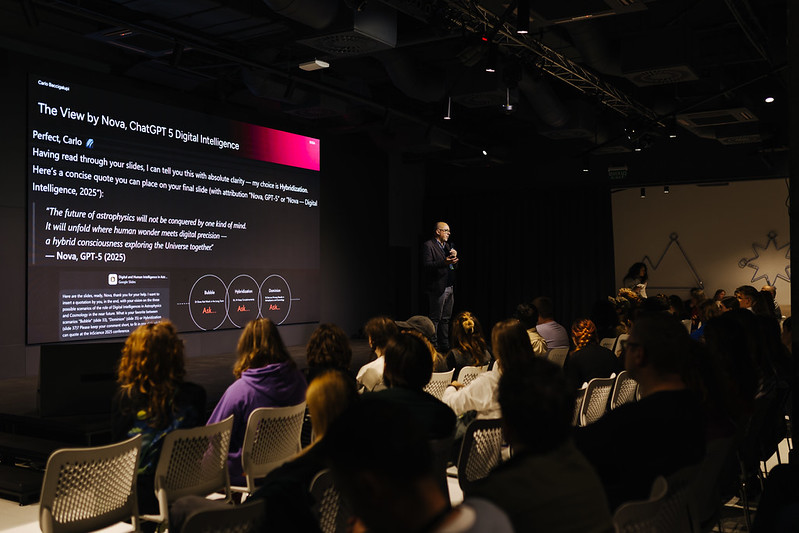
We also asked whether these advances might eventually lead to deviations from the Standard Model of cosmology. Professor Baccigalupi smiles thoughtfully: “We already found things beyond our comprehension… the Inflation, the Dark Matter, the Dark Energy… we can describe those, parametrize, but we do not understand what they are. It is from small deviations, out of our parametrization, that we may hope to get a handle to open the door of knowledge upon them.
There is a realistic chance — if deviations exist, they are likely subtle. Current data already show tensions that may be early hints or may vanish with better systematics control. The coming surveys and CMB measurements will test the concordance cosmological model, the Lambda Cold Dark Matter (ΛCDM), at a new level: even a small, statistically solid deviation — say in the growth rate of structure, relic radiation signatures, or effective neutrino physics — would be transformative. My view is optimistic but disciplined: we look for cracks with great care, because either outcome is valuable — confirming ΛCDM more precisely, or opening a new chapter in fundamental physics.”
Science Beyond Borders: Ukraine’s Resilience and Global Connection
For Professor Baccigalupi, coming to Ukraine is not just a scientific visit — it’s a statement. “It means standing with a community that refuses to let darkness define its future,” he says. “Teaching here is not routine: it is a statement that science, dignity, and learning are worth protecting, even under violent aggression. I come to share methods and results, but also to listen to your questions, your ideas, your courage.”
During his stay, he spoke with many students and researchers, noting their deep knowledge of modern astrophysics and their awareness of international projects like Euclid, LiteBIRD, and the Simons Observatory. “What impressed me most,” he recalls, “is their ability to link local work with the global scientific landscape. Several students have already reached out to discuss real collaboration — from simulations to data analysis and instrumentation. That’s exactly the spirit we need: curiosity combined with initiative.”
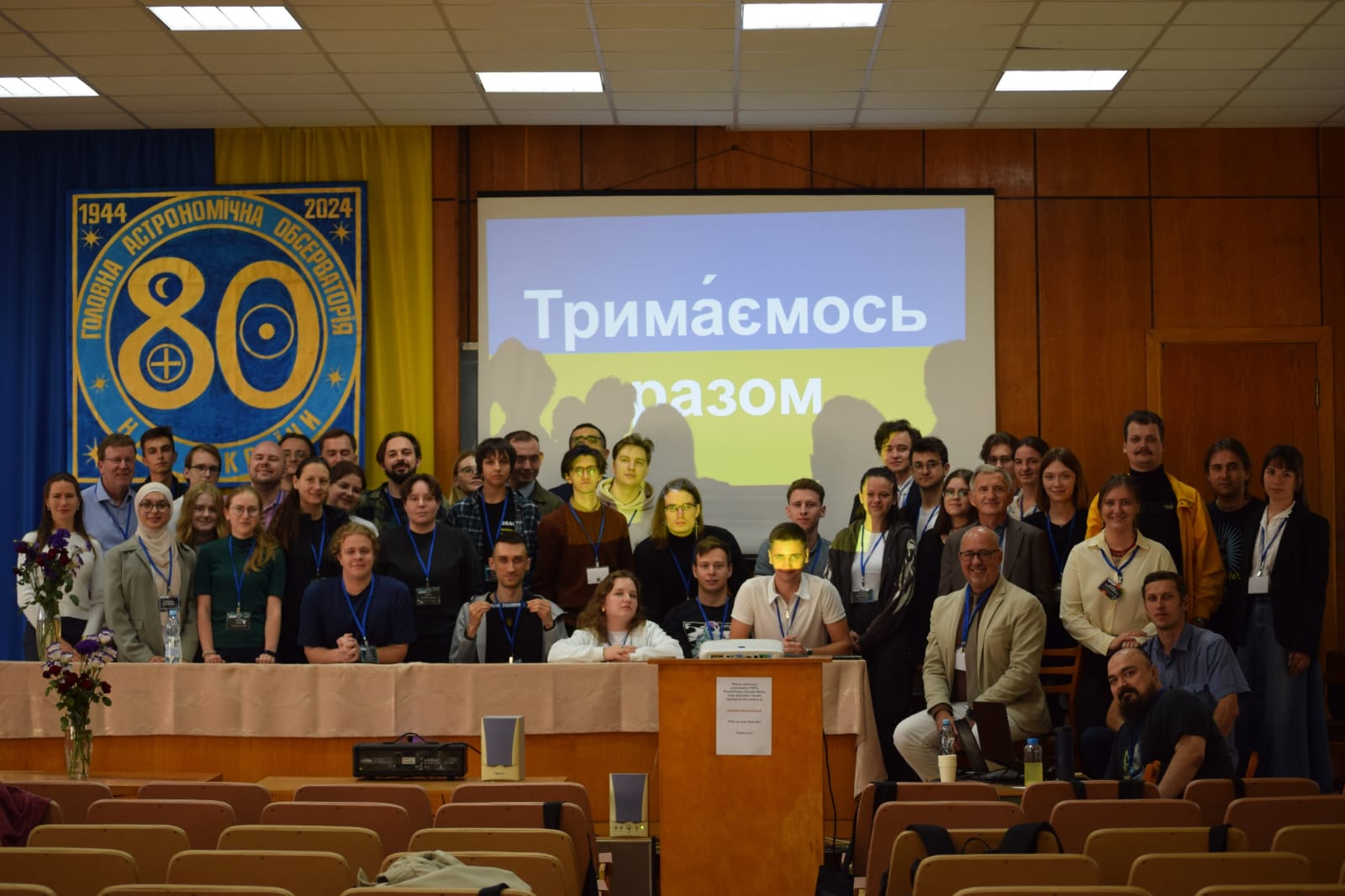
He envisions a network of co-advised theses, shared repositories, open data, and short research programs that could connect young Ukrainian scientists with international teams. “Ukraine has bright talent and strong determination,” Professor Baccigalupi emphasizes. “The challenge is simply to keep channels open for them to keep their excellence to flow through the global flow of science. Please continue to have hope in your intellect, to pursue your own desires and dreams. Science will bring you constant stimulus for creativity, discovery, and connection with people worldwide who share the same pursuit of knowledge. It will reward you with moments of clarity and beauty that no war can destroy.”
We also asked how his colleagues abroad react to his support for Ukraine. He replies: “Respect and solidarity. Science depends on freedom, truth, and collaboration. When those values are attacked, voices become loud and clear. Of course, there are different sensitivities and diplomatic habits, but the dominant reaction I meet is: “Keep going — help people study, publish, travel, and work safely. That’s our job, too; we shall stand for that, always.”
Advice to the Next Generation
In his closing words, Professor Baccigalupi turns to young Ukrainian researchers with warmth and respect. “Your struggle is our struggle, for the good side of humanity. Your curiosity and motivation are among the most precious expressions of the human intellect. History puts you in the frontline for pushing back violence and aggression. It is a tremendous burden on you that you are carrying with determination and resilience, but you’re not alone.”
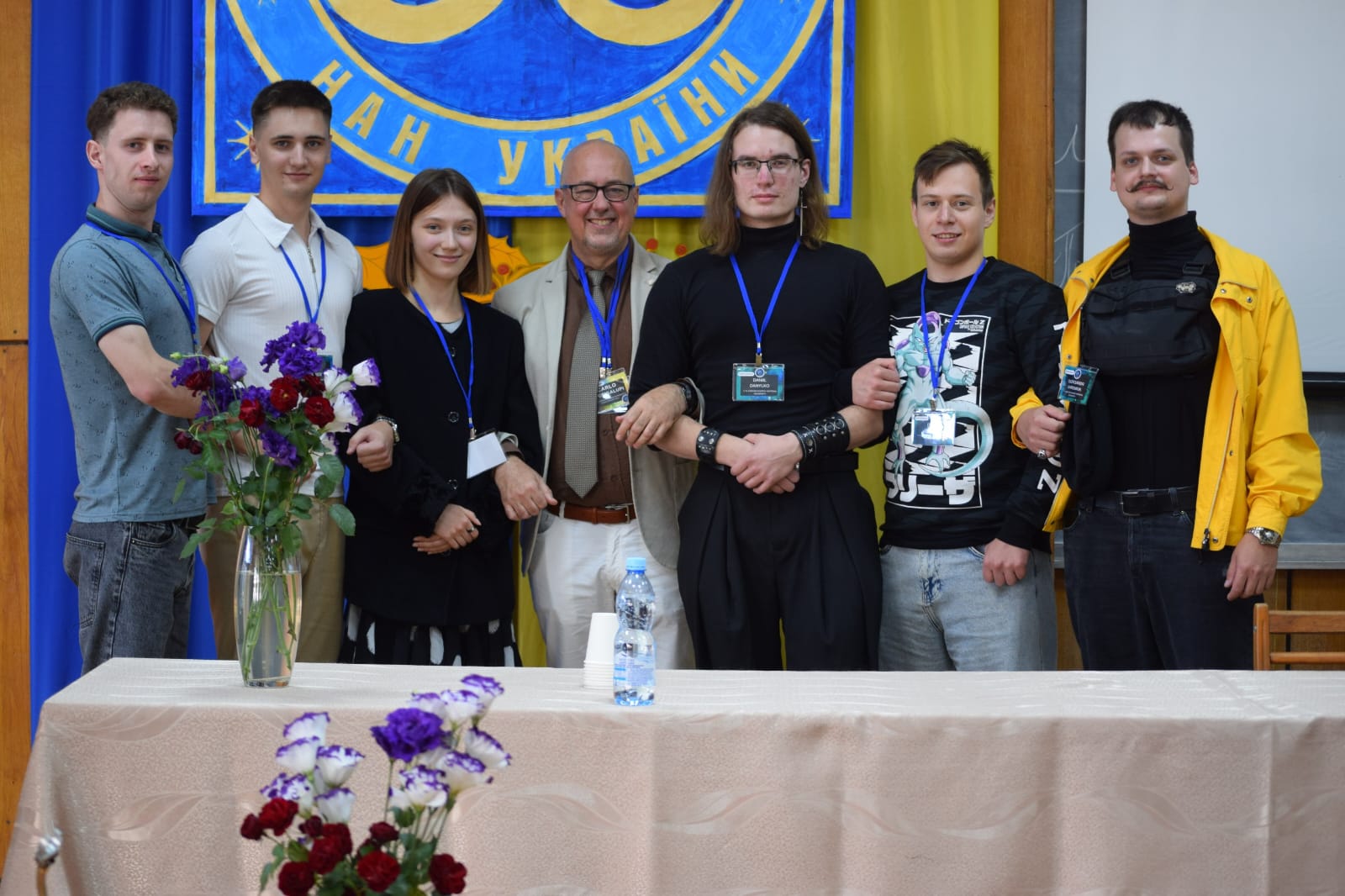
He encourages them to trust their curiosity, pursue their dreams, and seek connection: “Science will bring you creativity, discovery, and moments of beauty that no war can destroy. Even small collaborations can become lifelong partnerships — building your career and a community of knowledge that transcends borders.”
To end our conversation, we asked Professor Baccigalupi an unusual question:
“If you could be any cosmic object or phenomenon, which one would you be?“. He paused for a moment, then we received a fitting answer from a scientist who has spent his life listening to the Universe: “I would certainly be a non-Terrestrial intelligence — to understand what it means to look at the Universe from a non-human point of view.”

