

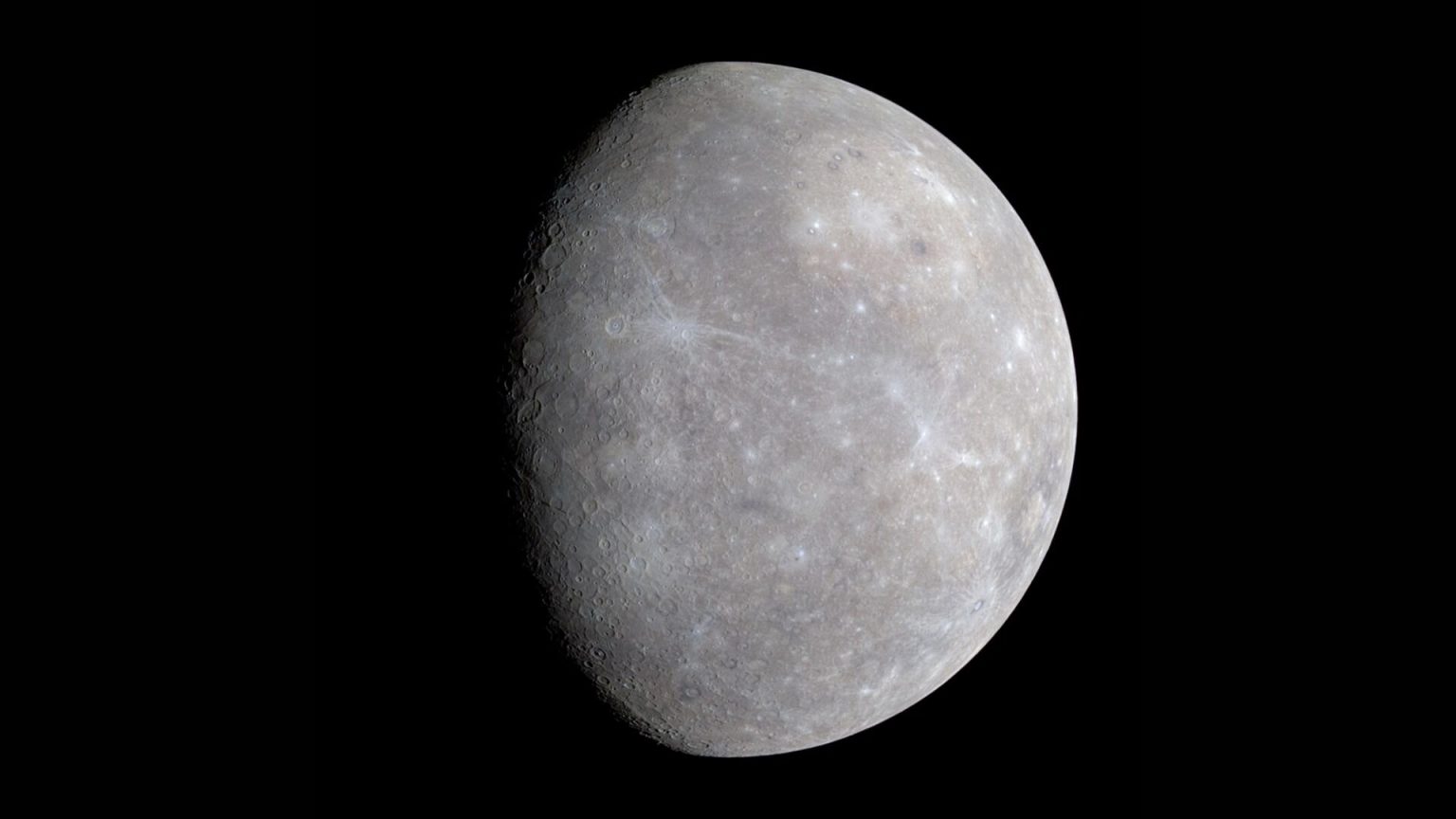
Mercury has virtually no atmosphere. However, a certain number of molecules still circle around it. Recently, scientists discovered the alkali metal lithium among them.
Discovery of lithium in the exosphere
Using the latest magnetic wave detection technology, a new study published in the journal Nature Communications has detected lithium in Mercury’s exosphere for the first time.
Mercury’s exosphere is an unstable environment where gas molecules are sparse and rarely interact with each other. Since the 1970s, spacecraft such as Mariner 10 and later MESSENGER have orbited Mercury, collecting data.
The discovery of alkali metals such as potassium and sodium led scientists to speculate that, based on current understanding of planetary formation, other alkali metals, such as lithium, should also exist.
For many years, most attempts were unsuccessful, suggesting that lithium may be present in the exosphere in very low concentrations.
A research team led by Daniel Schmid from the Austrian Academy of Sciences approached the search from a new angle. Instead of directly searching for lithium atoms, they used magnetic field measurements to detect an electromagnetic wave called an “ion cyclotron wave” (ICW), indicating the presence of lithium.
Ionization of lithium atoms and measurement of magnetic field
ICWs are formed as a result of numerous physical processes occurring on the surface of Mercury and in its atmosphere.
When neutral lithium atoms rise from Mercury’s surface into space, they encounter intense ultraviolet radiation from the Sun. This radiation strips electrons from lithium atoms, turning them into charged lithium ions.
These newly formed ionized particles are picked up by the solar wind — a constant stream of charged particles emanating from the Sun. When the solar wind picks up these fresh lithium ions, it creates instability in the surrounding plasma. The difference in speed between newly formed lithium ions and solar wind particles causes electromagnetic waves to propagate in space.
Waves produce a characteristic signal. They oscillate at the frequency of the lithium ion cyclotron — a characteristic frequency that is entirely determined by the unique ratio of lithium’s mass to charge and the strength of the local magnetic field. It seems that each element has its own electromagnetic fingerprint.
The research team analyzed magnetic field data collected over four years of Messenger’s operation and identified 12 independent instances of ICW occurrence. Each of these events lasted only a few tens of minutes, but provided an opportunity to briefly observe the release of lithium into Mercury’s thin atmosphere.
Meteorite bombardment
The sporadic and short-lived nature of these manifestations provided important clues about the origin of lithium. Researchers ruled out slow processes, including thermal heating and constant bombardment by solar wind. All signs pointed to short-lived explosive events, such as meteorite impacts.
When meteoroids strike Mercury’s surface at speeds of around 110 kilometers per second, they create explosive impacts that vaporize both the incoming rock and Mercury’s surface material. The impacts create clouds of vapor heated to 2,500–5,000 Kelvin, which is high enough to lift lithium atoms into Mercury’s exosphere.
Researchers estimated that the meteoroids responsible for the detection of lithium had a radius of 13 to 21 cm and a mass of 28,000 to 120,000 grams. It is noteworthy that these impacts can vaporize approximately 150 times more surface material than the meteorite’s own mass.
A new look at the history of Mercury
These discoveries call into question traditional ideas about how Mercury acquired its composition. Early models suggested that Mercury’s proximity to the Sun should have caused volatile elements to evaporate during the planet’s formation, leaving behind a relatively barren world.
“Mercury has an unusually high mass density, with an oversized iron core relative to its rocky mantle,” explained Schmid. “One hypothesis suggests that a massive early collision, combined with the planet’s proximity to the sun, stripped away much of the mantle and its volatiles. However, MESSENGER detected significant amounts of volatile elements, contradicting this idea.”
The study offers a different version. Mercury’s surface has been constantly enriched over billions of years as a result of meteorite bombardment. This opens up new perspectives on the evolution of rocky planets under the influence of constant bombardment.
In addition to Mercury, this approach could help scientists study thin atmospheres throughout the Solar System, especially in places where direct data collection is difficult.
According to phys.org

