

Research on minerals from Jezero Сrater on Mars has shown that water flows appeared there repeatedly. At the same time, their acidity and temperature varied at different times. And along with them, the conditions for life also changed.
Water and minerals in Jezero Сrater
Jezero Crater on Mars is the very location that the Perseverance rover has been studying for many years. Thanks to its operation, scientists have long argued that at the beginning of the planet’s existence, there was a lake into which small rivers flowed and, possibly, life. But recently they have been able to discover that this place is actually quite important.
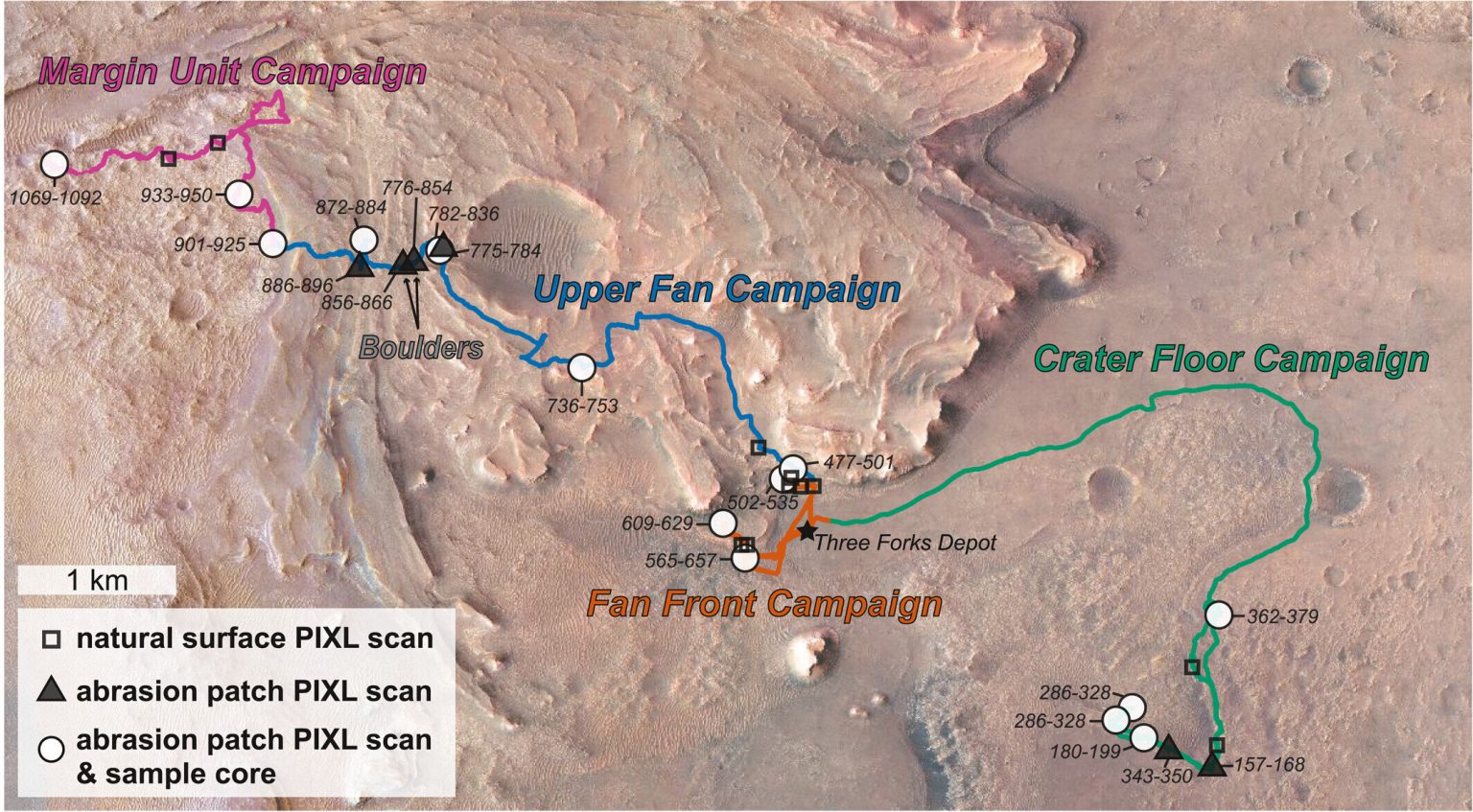
The rover is equipped with X-ray Lithochemistry (PIXL). It can determine the chemical composition of minerals in the surrounding rocks. Recently, scientists have developed the MIST algorithm, which allows minerals formed in the presence of water flows with different properties to be identified.
After all, the concept of “water” in everyday life is indeed very broad. Liquids that once flowed on the surface of Mars may have had different properties. And now, thanks to an article in the Journal of Geophysical Research: Planets, we know exactly what happened there.
Minerals and history of Jezero Crater
In total, scientists have discovered 24 minerals in the rocks of Jezero Crater that may reveal information about the interaction between its volcanic surface and liquids. Scientists have divided them into three main groups, reflecting different types of this interaction.
The first group includes greenalite, hisingerite, and ferroaluminoceladonite. They were formed in hot and highly acidic waters. Judging by the fact that they are only present in samples from the bottom of the crater, these were local volcanic sources that were not widespread. Life on Earth can totally exist in these conditions, but they’re pretty extreme, so the chances of finding traces of organisms in this early period of Mars’ existence are pretty low.
The second group includes minnesotaite and clinoptilolite, which formed in water flows with significantly more moderate temperatures and acidity. They are present not only at the bottom of the crater, but also in the upper fan region — where water flowed out of it. This indicates that later this depression was much more heavily covered with water and conditions in it were more favorable for life.
The third group of minerals consists of minerals formed in low-temperature, slightly alkaline environments. These include, for example, sepiolite. It is found throughout the crater and indicates that at one time it was covered by a fairly thick layer of water that was quite suitable for life.
Thus, Mars indeed had several different episodes when bodies of water existed in Jezero Crater in one form or another. Details about them will be revealed when samples of its rocks are delivered to Earth.
According to phys.org

