

The Trump administration has announced that in the future, information from military weather satellites will be transmitted to civilian services with a delay of several days. For services that predict hurricane activity, this could prove critical.
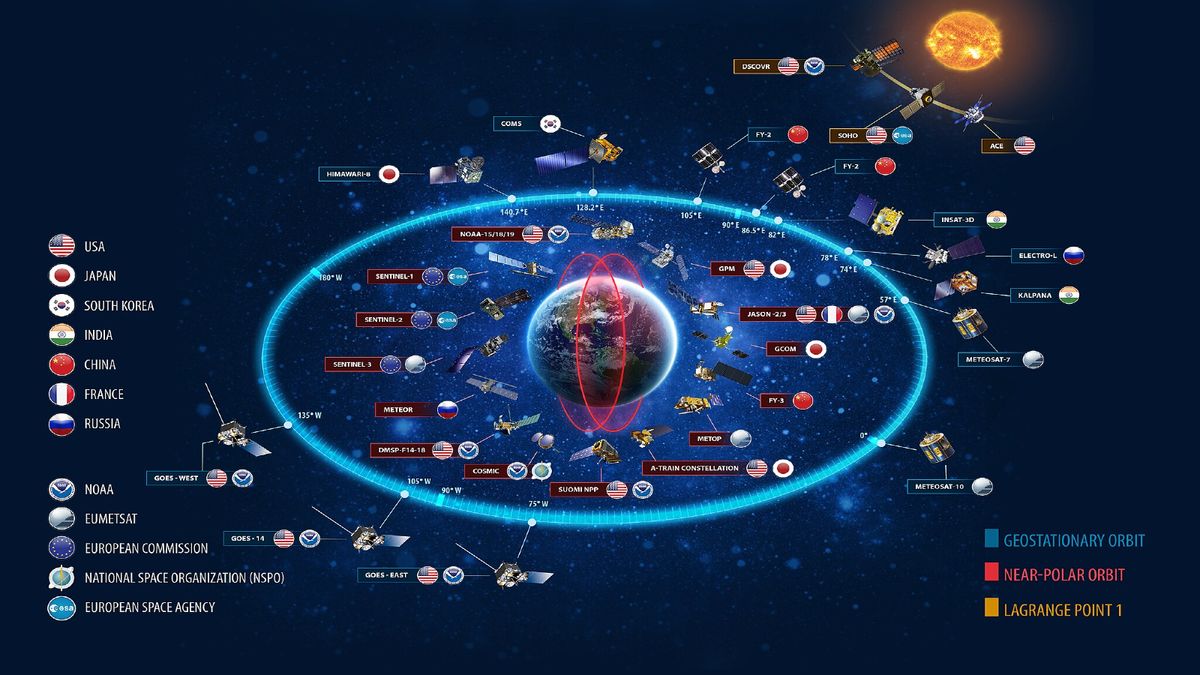
Discontinuation of data collection by weather satellites
Approximately 600 miles off the west coast of Africa, large clusters of thunderstorms begin to develop into tropical storms each hurricane season. They are not yet within range of Hurricane Hunter aircraft, so forecasters at the National Hurricane Center rely on weather satellites to monitor these storms and report on their location, structure, and intensity.
Satellite data helps meteorologists create weather forecasts that ensure the safety of aircraft and ships and prepare countries for possible hurricane hits.
On June 25, 2025, the Trump administration issued a service change notice announcing that the Defense Meteorological Satellite Program (DMSP) and the US Navy’s Digital Meteorological and Oceanographic Center would cease collecting, processing, and distributing all DMSP data no later than June 30. The termination of data collection was postponed until July 31 at the request of the head of NASA’s Earth Sciences Division.
Looking inside the clouds
At its core, a meteorological satellite is a high-resolution digital camera located in space that takes pictures of clouds in the atmosphere. These are the satellite images you see in most weather forecasts. They allow meteorologists to see the location and some details of the hurricane’s structure, but only during daylight hours.
Meteorologists can use infrared satellite data, similar to a thermal imaging camera, at any time of day to find the coldest temperatures at the top of clouds, highlighting areas where high wind speeds and precipitation intensity are observed. But although visible and infrared satellite images are valuable instruments for hurricane forecasting, they provide only a basic picture of the storm.
For more accurate diagnostics, meteorologists rely on DMSP satellites.
Three satellites orbit the Earth 14 times a day, equipped with special microwave sensors/probes or SSMIS. They allow meteorologists to look inside clouds, just as an MRI in a hospital allows us to look inside the human body. With the help of these, meteorologists can accurately determine the center of low pressure of a storm and identify signs of its intensification.
Accurate determination of the hurricane’s center improves forecasts of the storm’s future movement. This allows meteorologists to make more accurate forecasts regarding hurricanes, warnings, and evacuations.
About 80% of major hurricanes — those with wind speeds of at least 179 kilometers per hour — rapidly intensify at some point, increasing the risks to people and property on land. Determining when storms will begin to intensify allows meteorologists to warn the population about these dangerous hurricanes.
DMSP satellites and their alternatives
The DMSP satellites were launched between 1999 and 2009 and were designed to operate for five years. They have now been in operation for more than 15 years. The US Space Force recently concluded that the DMSP satellites would reach the end of their operational life between 2023 and 2026, so data would likely soon cease to be available.
Three other satellites in orbit — NOAA-20, NOAA-21, and Suomi NPP — have a microwave instrument known as the Advanced Technology Microwave Sounder.
The advanced technology microwave sounder, or ATMS, can provide data similar to that of a special microwave imager/probe, or SSMIS, but with lower resolution. It provides a more blurred image, which is less useful than SSMIS for accurately determining the location of a storm or assessing its intensity.
The US Space Force began using data from the new ML-1A defense meteorological satellite at the end of April 2025.
ML-1A is a microwave satellite that will help replace some of the functions of DMSP satellites. However, the government has not announced whether ML-1A data will be available to forecasters, including those working at the National Hurricane Center.
Why does satellite replacement happen instantly?
Satellite programs are planned for many years, even decades, and they are very expensive. The current geostationary satellite program launched its first satellite in 2016 with plans to operate until 2038. Development of the planned successor to GOES-R began in 2019.
Similarly, plans to replace DMSP satellites have been in development since the early 2000s.
Delays in the development of satellite instruments and funding cuts led to the cancellation of the National Polar-orbiting Operational Environmental Satellite System and Defense Weather Satellite System in 2010 and 2012, respectively, before any of their satellites could be launched.
NOAA’s budget request for 2026 includes increased funding for the next-generation geostationary satellite program so that it can be restructured to reuse spare parts from existing geostationary satellites. The budget also provides for the termination of contracts for devices to measure ocean color, atmospheric composition, and advanced lightning mapping devices.
Potential threat from satellite loss
The 2025 Atlantic hurricane season, which runs from June 1 to November 30, is forecast to be above average, with six to ten hurricanes. The most active part of the season will last from mid-August to mid-October, after which the DMSP satellite data will be turned off.
Hurricane forecasters will continue to use all available instruments, including data from satellites, radars, weather balloons, and probes to monitor the tropics and issue hurricane forecasts. However, the loss of satellite data, as well as other reductions in data, funding, and personnel, could ultimately put more lives at risk.
According to www.space.com

