

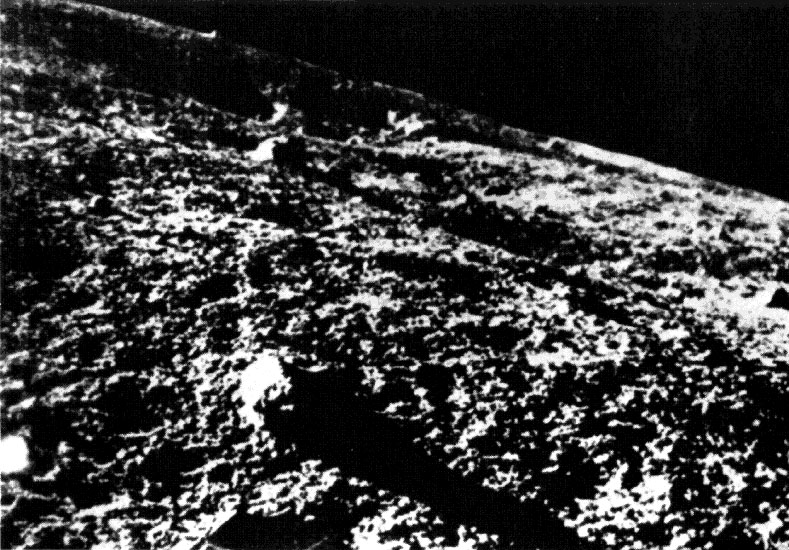
The landing site of the Soviet Luna 9 station, which in 1966 became the first in history to make a soft landing on the Moon and transmit panoramic images from the surface, can finally be identified with high accuracy thanks to machine vision. The research team presented a simple computer vision algorithm called YOLO-ETA (You-Only-Look-Once — Extraterrestrial Artefact), adapted to search for artificial objects in images captured by the LROC NAC camera on the Lunar Reconnaissance Orbiter.
The model was trained on data from Apollo landing sites. In tests on images unknown to it, it demonstrated balanced quality (F1 ≈ 0.60) and an average accuracy of about 80% for detecting landing modules, and also correctly identified Luna 16 — an important test of its ability to generalize based on Soviet technology of a different design.
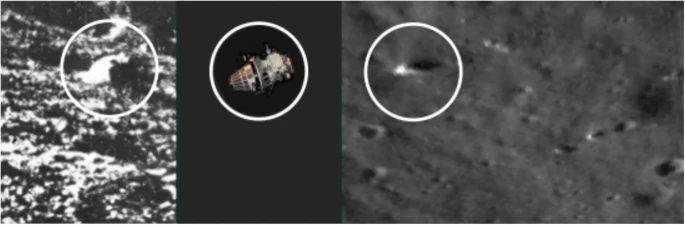
Next, YOLO-ETA was applied to a 5×5 km area around the historically uncertain landing site of Luna 9. The algorithm produced several confident hits near coordinates approximately 7.03° N, 64.33° E, where orbital photos show signs of objects/soil disturbances consistent with the presence of equipment. The next step is independent verification of the candidates through more detailed observations (in particular, they mention the Chandrayaan-2 flyby over the area in March 2026).
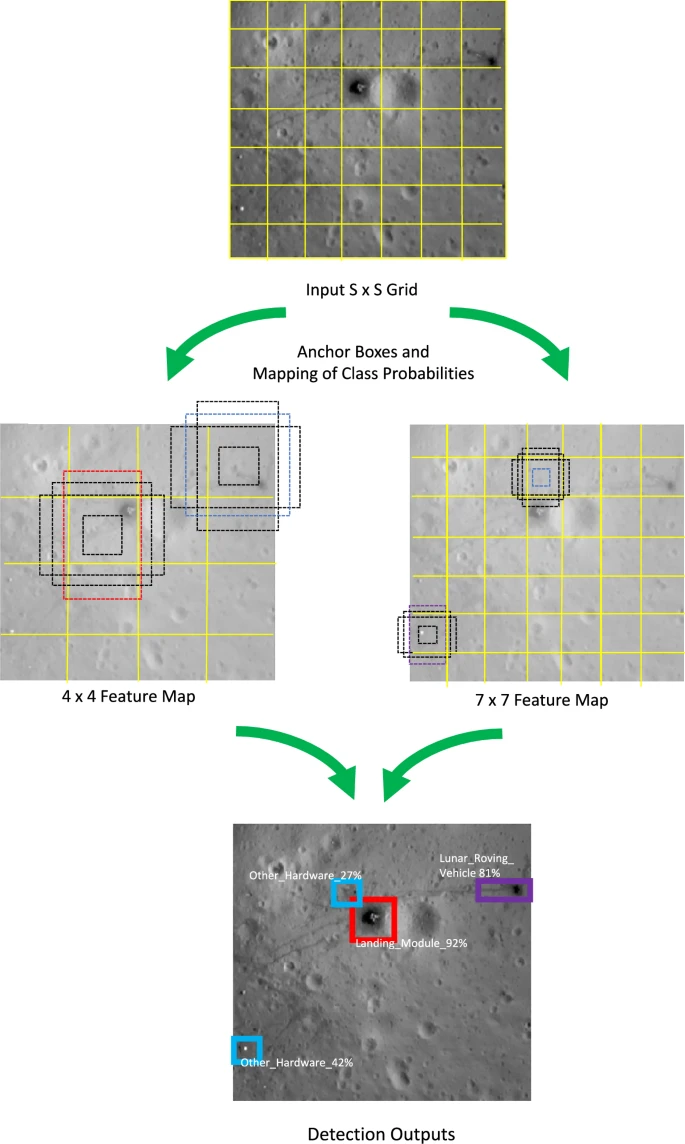
How does it work? The algorithm functions as an object detector on satellite images. First, the YOLO-ETA model is trained on LROC NAC images, where known landing sites (e.g., Apollo modules) are manually marked: rectangles covering the spacecraft and characteristic traces (regolith disturbance, tracks, shadows) are indicated on each frame. Next, the neural network, viewing a new image, breaks it down into regions and calculates the following in a single pass: (1) where there are suspicious spots with geometry/contrast that do not resemble natural relief; (2) the coordinates of the frame around them; (3) the probability that it is indeed an artificial object. After this trigger, the data is filtered according to a confidence threshold, checked on several adjacent frames/with different lighting, and compared with relief maps and historical trajectory estimates to leave the most plausible candidates for the landing site.
Why is this important? Such models transform the ocean of orbital images into a manageable search: they can quickly catalog artifacts, track surface changes, assist in planning robot landings and routes, and relieve scientists of the routine task of reviewing data. For astronomy and planetary science, this means more time for interpretation — from regolith geology to lighting/shadow analysis and observation conditions — as well as better preparation for long lunar missions with large image streams.
According to nature

