

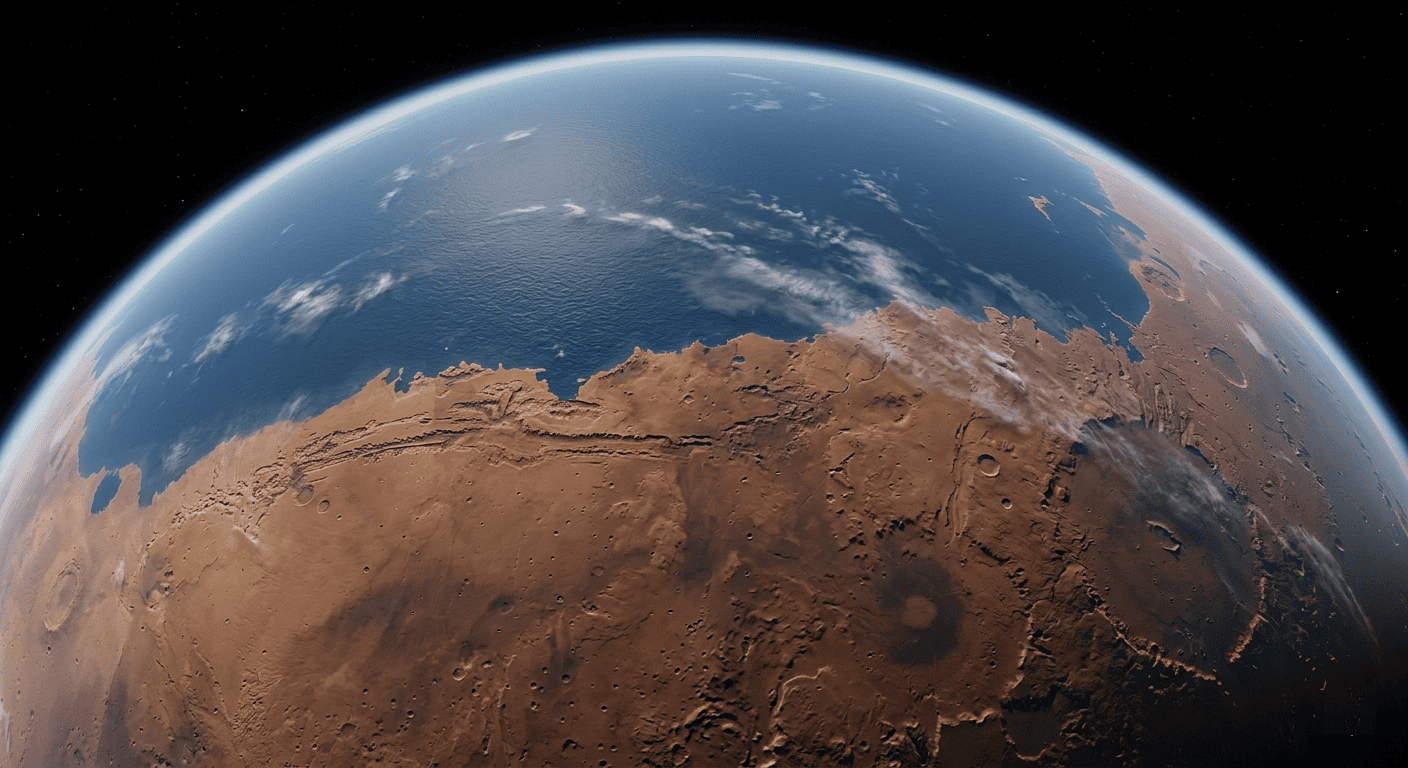
According to scientists, Mars once had liquid water and a dense atmosphere, but later turned into a cold, dry desert. Its history could hold the key to studying similar rocky worlds in other star systems.
A planet on the brink
Researchers at the University of California, Riverside, have published a study in the Journal of Planetary Science in which they examine Mars as a model for the comparative analysis of exoplanets. Lead author Stephen Kane describes Mars as a planet “on the edge of habitability.” It is large enough to have temporarily favorable conditions on the surface, but too small to retain an atmosphere and a stable climate for long.
Habitability, the researchers emphasize, is not a static characteristic but the result of competing processes that change over time. Early Mars was volcanically active, so it released volatile substances that formed a dense atmosphere and trapped heat. When the inner core cooled and the magnetic field stopped, the atmosphere gradually dissipated into space, and the planet cooled.
Size isn’t everything
A comparison with other planets in the Solar System shows that Venus, Earth, Mars, and even the Moon have evolved in completely different ways, despite sharing a similar stellar environment. A planet’s size sets the starting point, but it does not determine the outcome.
This means that when studying exoplanets, we need to take into account a much wider range of parameters, including mass, tectonics, atmospheric composition, magnetic fields, the influence of the host star, and even the history of collisions with other celestial bodies. Mars serves as a testament to just how fine the line can be between a world that is habitable and one that is not.
What’s next?
At present, there are relatively few confirmed exoplanets with masses comparable to Mars’s, due to the limitations of current instruments. This situation will change with the launch of the Nancy Grace Roman Telescope, which will survey the sky using the gravitational microlensing method and detect planets of precisely this class.
At the same time, future direct-observation telescopes will help determine whether such planets retain thin carbon dioxide atmospheres or have already lost them. Researchers are convinced that the more we learn about Mars from missions within the Solar System, the more accurately we will be able to interpret data about rocky worlds beyond its boundaries.
According to phys.org

