

A new study has been published based on data from the InSight spacecraft, which recorded more than 1,300 Marsquakes during its mission. It indicates that the planet’s core is not rare, but at least partially solid like Earth’s.
Marsquakes
Scientists reported on Wednesday that Mars’ inner core appears to be a solid piece of metal, similar to Earth’s.
The Chinese research team based its conclusions on seismic data obtained from NASA’s InSight Mars lander, which recorded more than 1,300 Marsquakes before it stopped operating in 2022. The spacecraft landed on a vast plain near the equator of Mars in 2018.
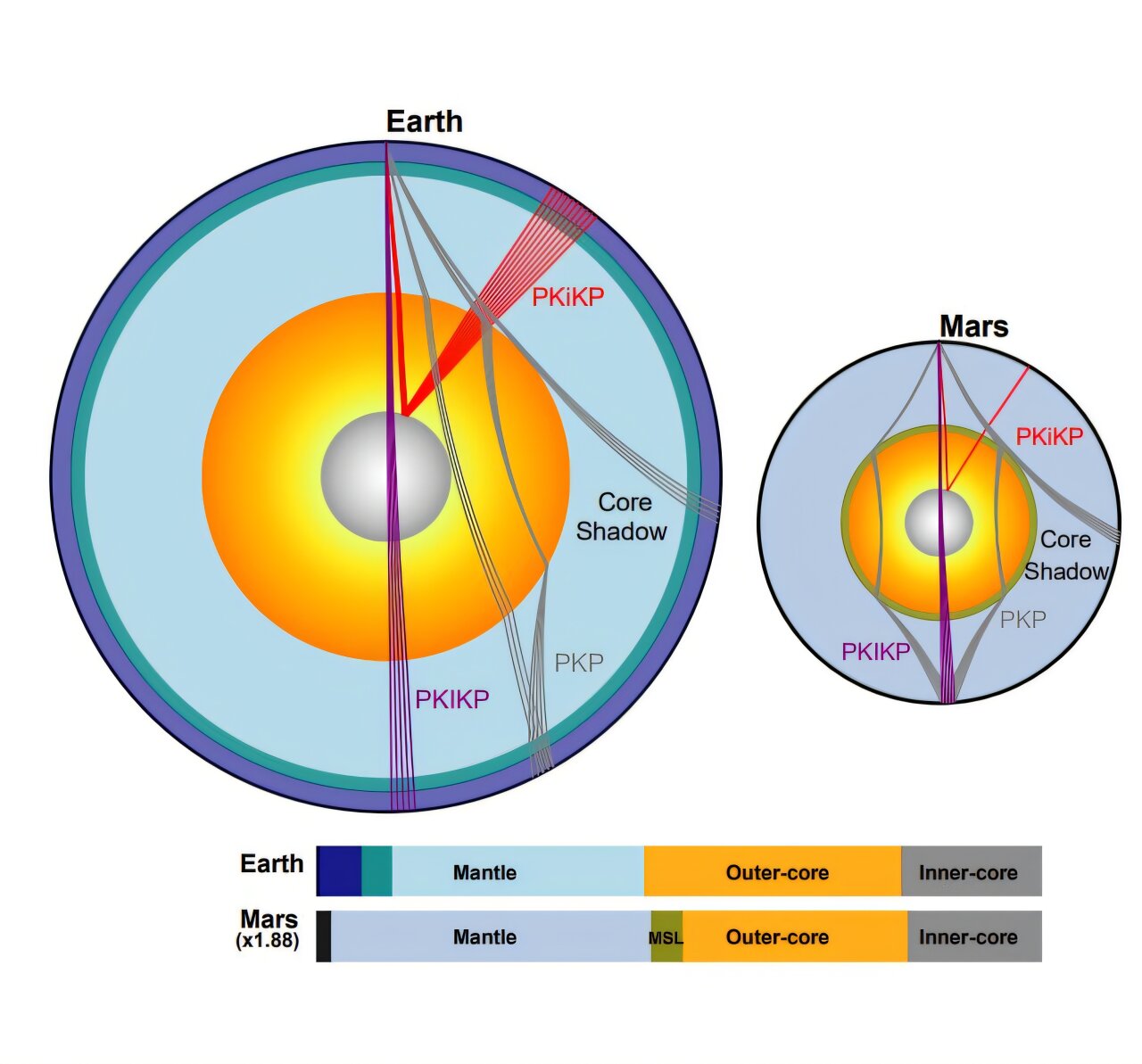
Previous studies have pointed to liquid in the heart of the red planet. The latest results indicate that the inner core, although small, is indeed solid and surrounded by molten metal — a liquid outer core.
Internal structure of the red planet
The inner core of Mars extends from the center of the planet to a radius of approximately 613 km, according to scientists whose findings were published in the journal Nature.
It probably consists of iron and nickel, the same elements as in the Earth’s core, but it may also be enriched with lighter elements such as oxygen. The liquid outer part of Mars’ core is larger, extending from 613 to 1,800 km from the center of the planet.
The crystallization of Mars’ inner core may have occurred in the past and is still occurring today, noted one of the leading researchers, Daoyuan Sun, from the University of Science and Technology of China.
The core of Mars was probably quite rarefied at first. It is unclear whether the liquid outer core contains solid materials such as droplets, or whether there may be a “mushy zone” near the boundary between the inner and outer cores.
InSight data analysis
For their study, Sun and his team relied primarily on 23 Marsquakes recorded by InSight, all of which were relatively weak. The epicenters were located between 1,200 and 2,360 km from the descent vehicle.
The scientists’ findings indicate that Mars has a solid inner core comprising approximately one-fifth of the planet’s radius — roughly the same percentage as Earth’s inner core. However, this similarity may be just a coincidence.
Despite the outstanding achievements of Chinese scientists, questions about the structure of Mars’ core are still far from being resolved. Since InSight is out of commission, there will be no new recordings of Marsquakes, which could have revealed even more about the internal structure of the red planet.
Researchers believe that more detailed modeling can help develop a clearer picture of how Mars’ inner core formed and shed light on the history of Mars’ magnetic field. At present, the red planet has no magnetic field, possibly due to the slow crystallization of the planet’s solid core.
According to phys.org

