

The interior of Mars is not smooth and uniform, as depicted in the familiar illustrations in textbooks. New research shows that it is more like an uneven cake than a glazed cookie, as it is usually depicted. The reason for this is traces of ancient collisions.
InSight mission data
We often imagine rocky planets such as Earth and Mars as having a smooth, layered internal composition — with a crust, mantle, and core stacked on top of each other like the biscuit base, caramel center, and chocolate coating of a Millionaire’s Shortbread cookie. But the reality for Mars is somewhat less neat.
Seismic vibrations detected by NASA’s InSight mission revealed minor anomalies, prompting scientists from Imperial College London and other institutions to uncover a more chaotic reality: Mars’ mantle contains ancient fragments up to 4 km wide, preserved since its formation, like geological fossils.
History of Giant Collisions
Mars and other rocky planets formed about 4.5 billion years ago when dust and rocks orbiting the young Sun gradually coalesced under the influence of gravity.
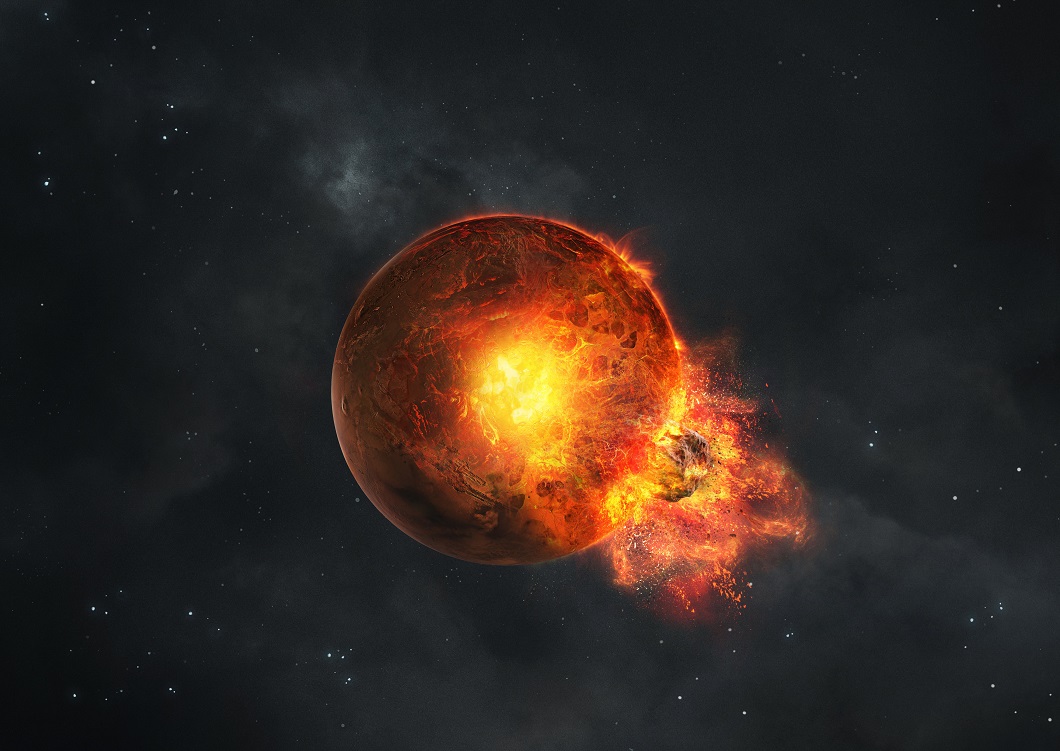
When Mars was almost fully formed, giant objects the size of planets fell onto it as a result of a series of near-catastrophic collisions — the kind that probably also formed Earth’s moon.
“These colossal impacts released enough energy to melt large parts of the young planet, turning them into huge magma oceans,” said lead researcher Dr. Constantinos Charalambous from the Department of Electrical Engineering and Electronics at Imperial College London. “When these magmatic oceans cooled and crystallized, they left behind pieces of material with an excellent composition — and we believe that this is what we are now discovering in the depths of Mars.”
These early impacts and their aftermath scattered and mixed fragments of the planet’s early crust and mantle — and possibly debris from fallen objects — into the molten inner core. As Mars slowly cooled, these chemically diverse chunks became stuck in the slowly stirring mantle, like ingredients added to a Rocky Road chocolate chip cookie mix, and the stirring was too weak to completely mix everything together.
Unlike Earth, where tectonic plates constantly reshape the crust and mantle, Mars closed early under a fixed outer crust, preserving its inner core as a geological time capsule.
Listening to Mars
The evidence comes from seismic data recorded by NASA’s InSight lander, specifically from eight particularly clear Martian quakes, including two caused by two recent meteorite impacts that left craters 150 meters wide on the surface of Mars.
InSight detects seismic waves passing through the mantle, and scientists were able to see that higher-frequency waves took longer to reach its sensors from the impact site. These signs of interference, they say, indicate that the interior of the planet is rough rather than smooth.
“These signals showed clear signs of interference as they traveled through Mars’s deep interior,” said Dr. Charalambous. “That’s consistent with a mantle full of structures of different compositional origins—leftovers from Mars’s early days.”
Differences between the geological structure of Mars and Earth
By comparison, the Earth’s crust is constantly shifting slowly and recycling material from the surface into the mantle of our planet — on tectonic plates such as the Cascadia subduction zone, where part of the plates forming the bottom of the Pacific Ocean are subducting beneath the North American continental plate.
The debris found in the mantle of Mars has a striking shape: several large fragments — up to 4 km wide — are surrounded by many smaller ones. Scientists have discovered that the so-called “fractal distribution” of debris in the mantle of Mars occurs when the energy of a catastrophic collision exceeds the strength of the object. In this case, the object breaks into several large fragments and a large number of smaller pieces, as, for example, when a meteorite falls on a planet.
This discovery may be significant for our understanding of how other rocky planets, such as Venus and Mercury, have evolved over billions of years. This new discovery of Mars’ preserved interior composition provides a rare opportunity to glimpse what may lie beneath the surface of immobile worlds.
According to phys.org

