

Which planet in the Solar System is best for astronomical observations from its surface? Experienced planetary scientists say it is Mercury, thanks to the almost complete absence of atmosphere and nights lasting 88 Earth days (which is the length of a Mercurian year). But we will probably reach Mars first. What will astronauts see in the Martian sky?
Evening on the Red Planet
Let’s imagine that we are preparing for astronomical observations somewhere near the Martian equator. The glass of our spacesuit’s helmet hardly distorts the surrounding world and is completely transparent to visible light. The sun gradually sinks below the horizon, overhead… someone will say, “the red Martian sky”, someone will argue that it is orange. But in fact, the sky on Mars during the day has a pleasant blue-green color, and only after dust storms, when a large number of solid particles still float in the atmosphere, does it become yellow-green or yellow.
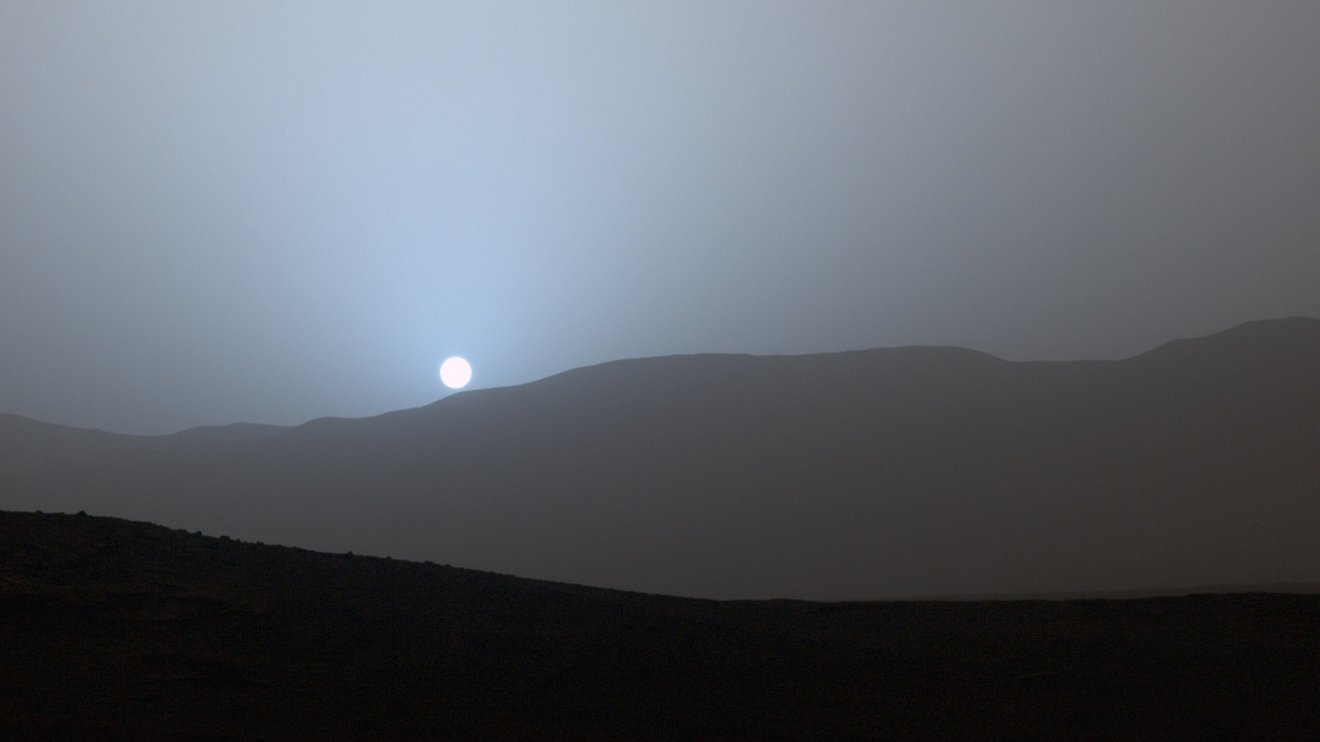
The Martian sky turns orange when our sun descends to the horizon. Unlike on Earth, it does not turn red; on the contrary, the sun and the surrounding sky turn blue due to fine dust, which is almost always present in the atmosphere. A similar phenomenon, known as kalima, can be observed in the Canary Islands when the east wind carries sand from the Sahara Desert over them – then the Sun appears blue-white at sunrise and sunset.
And then the solar disk touched the horizon. How quickly will it disappear completely? On Earth, near the equator, this takes a little over two minutes. On Mars, however, it all depends on the position in orbit: at perihelion, it is almost 20% closer to the Sun than at aphelion, and the Sun appears to be that much larger. Therefore, it sets 16 seconds longer: 1 minute 35 seconds at perihelion and 1 minute 19 seconds at aphelion.
Strange Martian natural satellites
Even before sunset, two natural satellites of the Red Planet – Phobos and Deimos – can be seen in the Martian daytime sky.
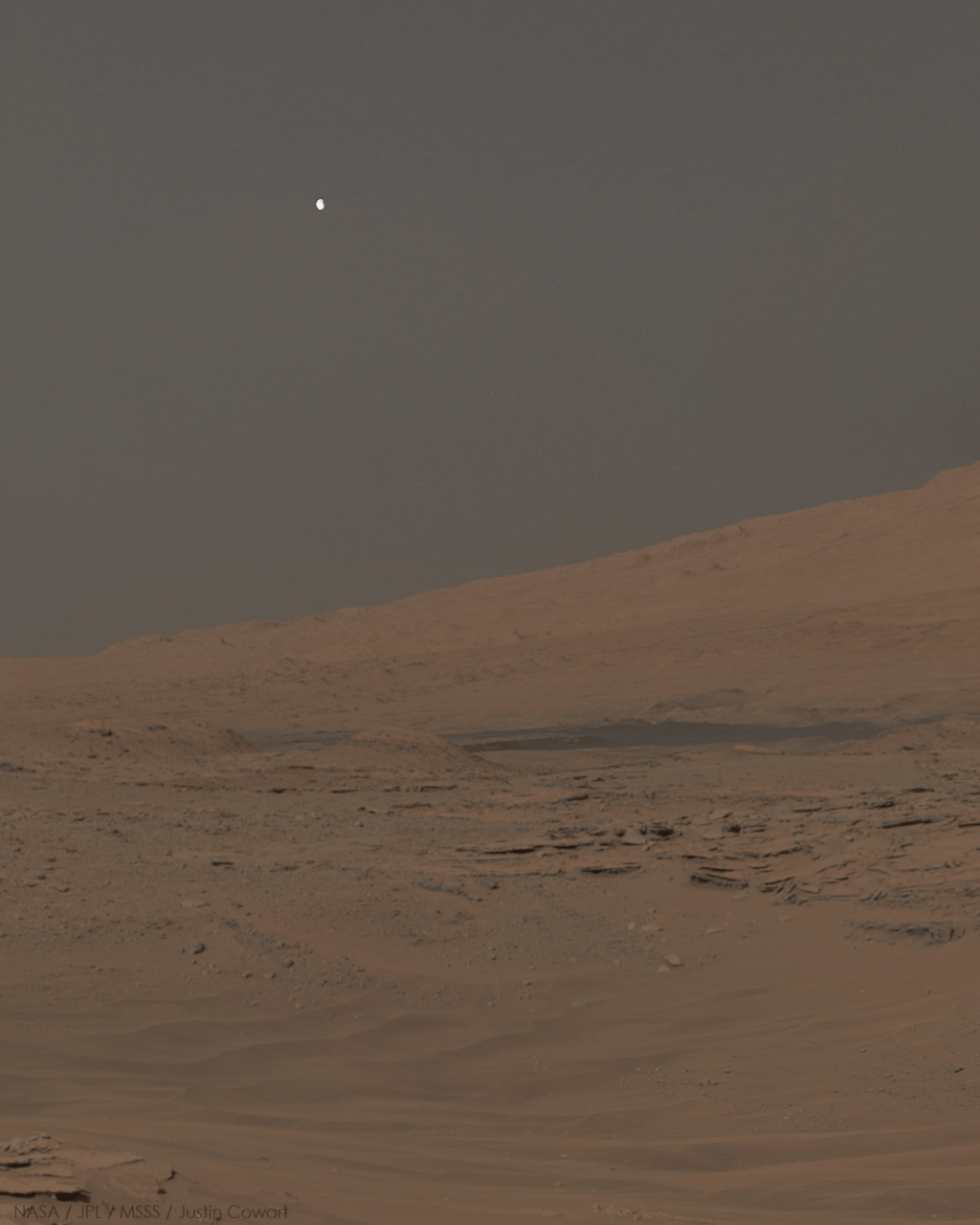
Phobos resembles a bizarre, irregularly shaped fragment. It completes one orbit around Mars in just 7 hours and 39 minutes, which is about three times faster than the planet’s rotation around its axis. Therefore, in the Martian sky, this satellite rises in the west and sets in the east. Its maximum brightness can reach -8.5m, approximately the same as the Moon when it is in its narrow crescent phase four days after new moon.
Phobos’ orbit lies almost in the plane of Mars’ equator, so it is at the equator that it is closest to observers when it passes overhead. At this point, its altitude can be as low as 5,838 km. But even then, it appears almost three times smaller than the lunar disk visible from Earth and one and a half times smaller than the minimum size of the Sun visible from Mars. Therefore, this satellite will not be able to cause total solar eclipses. They will begin in about 5 million years, when its orbit will decrease sufficiently under the influence of Martian tidal forces. Still, they will only be visible in the equatorial regions of the planet near the equinox.
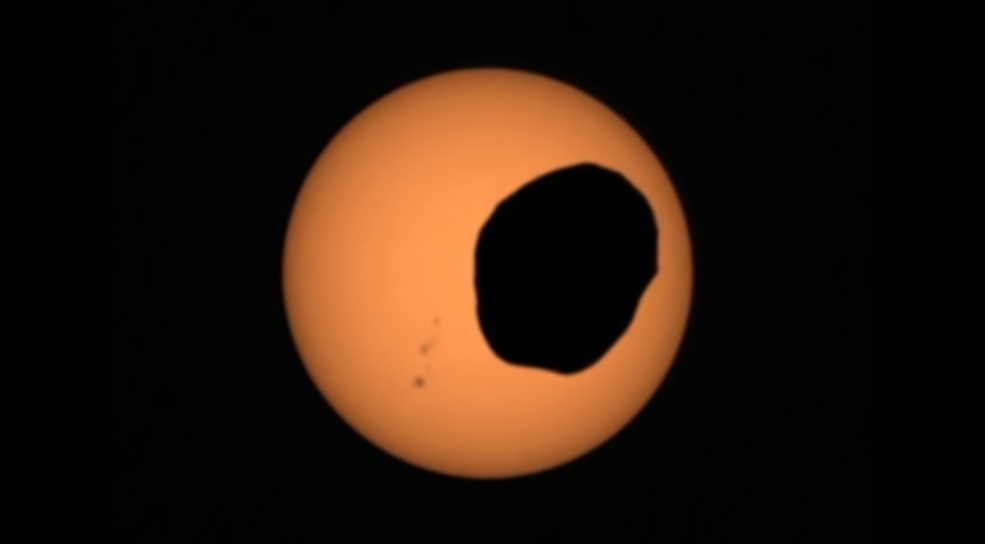
Incidentally, due to Phobos’ relatively low altitude, there are circular areas with a radius of approximately 1,150 km around the Martian poles where this satellite never appears above the horizon. For the same reason, geostationary satellites cannot be used for communication at the Earth’s poles.
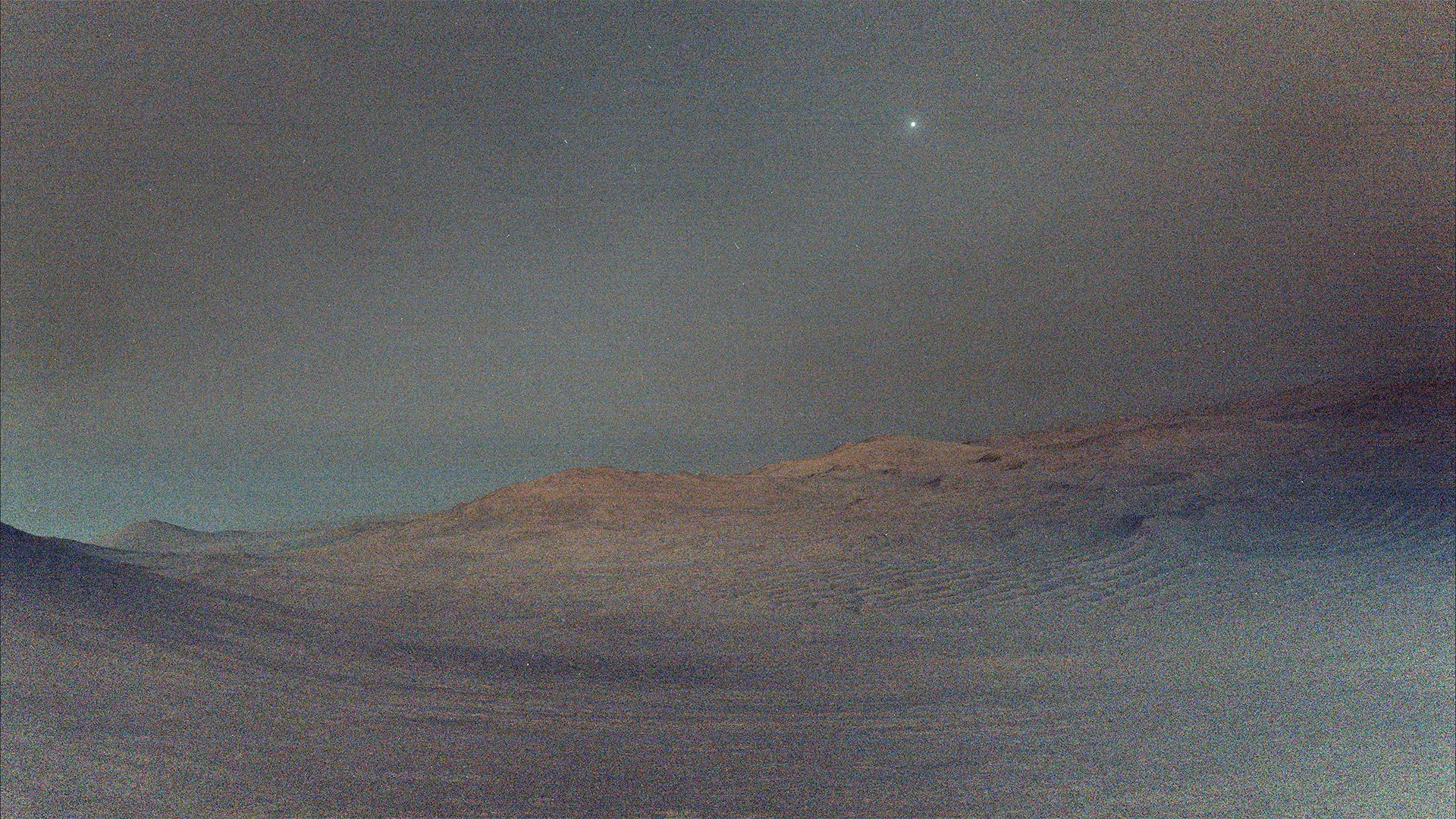
The situation is somewhat better with Deimos, whose orbit is 2.5 times larger. Its irregularly shaped disk is less than three arcminutes in size, meaning that only astronauts with perfect vision would be able to see any details there with the naked eye. The satellite’s maximum brightness reaches -4.5m (which is close to the corresponding indicator for Venus in the Earth’s sky). Its period of rotation around Mars relative to the stars is slightly less than 30.5 hours. Therefore, Deimos’ speed relative to the horizon is low – almost 60 hours pass between its rise and set.
Planets, comets, asteroids…
Finally, the Sun sets, and Martian twilight (slightly shorter than Earth’s) sets in, with stars and planets gradually appearing before it ends. The next brightest object in the sky of the Red Planet after Deimos will be… No, not Earth! Surprisingly, on Mars, as on Earth, the brightest star-like object is Venus. However, it is not always so bright there, but only near its upper conjunction with the Sun, i.e., when the largest illuminated part of its disk is visible. In this configuration, its brightness will reach -3.7m for Martian observers. In general, it varies quite significantly, approximately like the brightness of Mercury when observed from Earth. The maximum angular distance of Venus from the Sun (elongation) from the point of view of “Martians” does not exceed 23°. Its passage across the solar disk from Mars can also sometimes be observed; the closest one will occur on August 20, 2030, according to the “Earth” calendar.
Jupiter is the second brightest of the large planets in the Martian sky. It also has the largest apparent size – during great oppositions, when the distance to Mars is reduced to the minimum possible, the equatorial diameter of the Jovian disk reaches almost one arcminute. The brightness of the gas giant in such conditions exceeds -3.0m. Near it, you can try to see the largest Galilean satellites with the naked eye: Ganymede will have a brightness slightly less than 4th magnitude and will be six minutes away from Jupiter, Callisto will be one magnitude weaker, but it will be separated from the planet by as much as 12′.
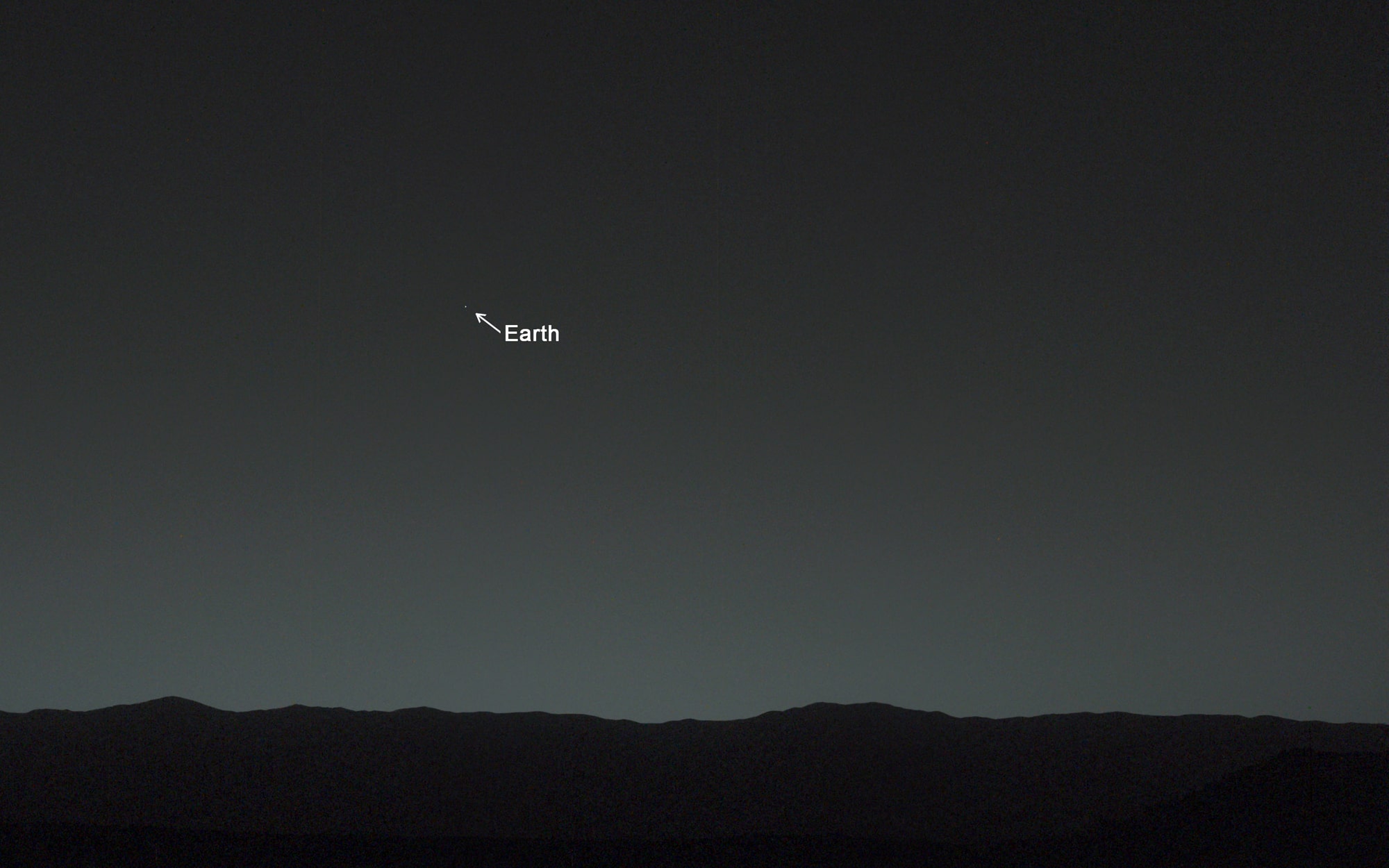
Next in the brightness ranking is our Earth – under the best conditions, its brightness reaches -2.8m. However, we must not forget that this is the maximum value, and this indicator depends not only on the relative position of the planets and the Sun, but also, for example, on how much of the visible illuminated crescent of the Earth’s disk from Mars is covered by clouds. The Moon is easy to spot near Earth – its brightness sometimes exceeds 2nd magnitude, and the maximum possible visible distance from our planet when observed from the Martian surface is 23 arcminutes. However, this only happens when both celestial bodies are located somewhere near the Sun in the sky. Usually, they are visible at a distance of about 10-15′ from each other.
Like Venus for Earth astronomers, Earth changes phases when observed from Mars and never reaches opposition, moving away from the Sun by a maximum of 47°. It also occasionally passes across the solar disk. The next such event is expected in 2084. Our planet will appear as a black circle with a diameter of 37 arc seconds against the background of the Sun.
The maximum brightness of Mercury visible from Mars can reach -1.7m. This also occurs only when the smallest planet is located in the sky near the Sun. Even in the most favorable configuration, it does not move more than 20° away from it (on Earth, this figure reaches 28°). However, ground-based astronomers successfully observe it at elongations of 15-16°.
The brightest objects in the Main Asteroid Belt – Ceres and Vesta – are visible to the naked eye from Mars in almost every opposition, with the latter having a brightness greater than magnitude 4 in major oppositions. The visibility conditions for Saturn, Uranus, and Neptune from the Martian surface are practically the same as from Earth, except that their orbital configurations occur about half as often.
It may seem that due to the proximity of the asteroid belt, bright meteors will fly more often in the Martian sky, but this is not entirely true. First of all, their brightness depends on the speed of entry into the atmosphere, which is largely determined by the gravity of the planet itself. Mars is almost ten times lighter than Earth and attracts everything around it much more weakly, meaning it “concentrates” fewer meteor particles, and their speed before collision averages less than 15 km/s (for meteors entering Earth’s atmosphere, this figure exceeds 20 km/s). In addition, the Martian atmosphere is very thin and does not provide effective resistance to objects, so many celestial stones reach the planet’s surface, leaving a relatively inconspicuous trace in its sky. However, some research vehicles have already managed to observe meteor showers on Mars.
Bright comets are also less visible on the Red Planet, as most of them become bright near the Sun when their nuclei heat up, ejecting large amounts of dust and gaseous matter, and sunlight most effectively illuminates the ejected matter. Of course, when observed from Mars, such a comet will appear weaker than when viewed from Earth due to the greater distance to it. And from a “Martian” point of view, it will almost always be at a smaller elongation, which will further worsen visibility conditions.
Which stars to use for navigating on Mars
Deep space objects – stars, nebulae, the Milky Way, other galaxies – appear the same in the night sky on Mars as they do on Earth. The only difference is that they will appear slightly brighter due to the thinner Martian atmosphere, which absorbs less light. Even the Sun will move through the same zodiacal constellations – the Martian orbit is inclined to the ecliptic by less than 2°. But the daily rotation of the celestial sphere is slightly different.
While Earth has a fairly bright North Star (its brightness exceeds the second magnitude) near the intersection of the northern end of the axis of rotation with the imaginary celestial sphere, Mars has no such notable star. Of all the stars brighter than magnitude 4 closest to the north pole, there is Deneb (α Cygni), located 9° from it. And this will continue for a very long time, because the Red Planet does not have such a massive satellite as the Moon, so the precession of its axis occurs much more slowly than that of Earth. Scientists have not yet been able to measure this speed. The only thing that could radically affect Mars’ rotation is its collision with a large asteroid. However, nothing like this is expected yet.
The south pole is much better “marked” in the Martian sky. It can be found with the help of an asterism called the False Cross, formed by the 2nd magnitude stars Avior, Aspidisca (both from the constellation Carina), as well as δ and Vela. The latter is located only 2°45′ from the point of the conditional intersection of Mars’ axis of rotation with the celestial sphere. This is almost three times greater than the distance from the North Star to the “true” North Pole on Earth, but it can still serve as a guide.
In general, the Martian sky offers many opportunities for astronomical observations, especially given that it is much clearer most of the time – except for fairly rare periods of large-scale dust storms, which can last for several months. The giant extinct volcanoes of the Red Planet would be an excellent location for an astronomical observatory. All that remains is to equip an expedition to Mars and build a permanent human settlement there.
This article was published in issue No. 1 (190) of Universe Space Tech magazine in 2024. You can purchase this issue in electronic or printed form from our store.

