

Yale University student Donglin Wu is leading a new study showing that some of the largest stars in the Universe eject tiny dust particles. Wu’s first major article in a scientific journal as lead author is devoted to stardust — tiny solid grains formed from stellar winds that drift through interstellar space and may eventually become part of new planets.
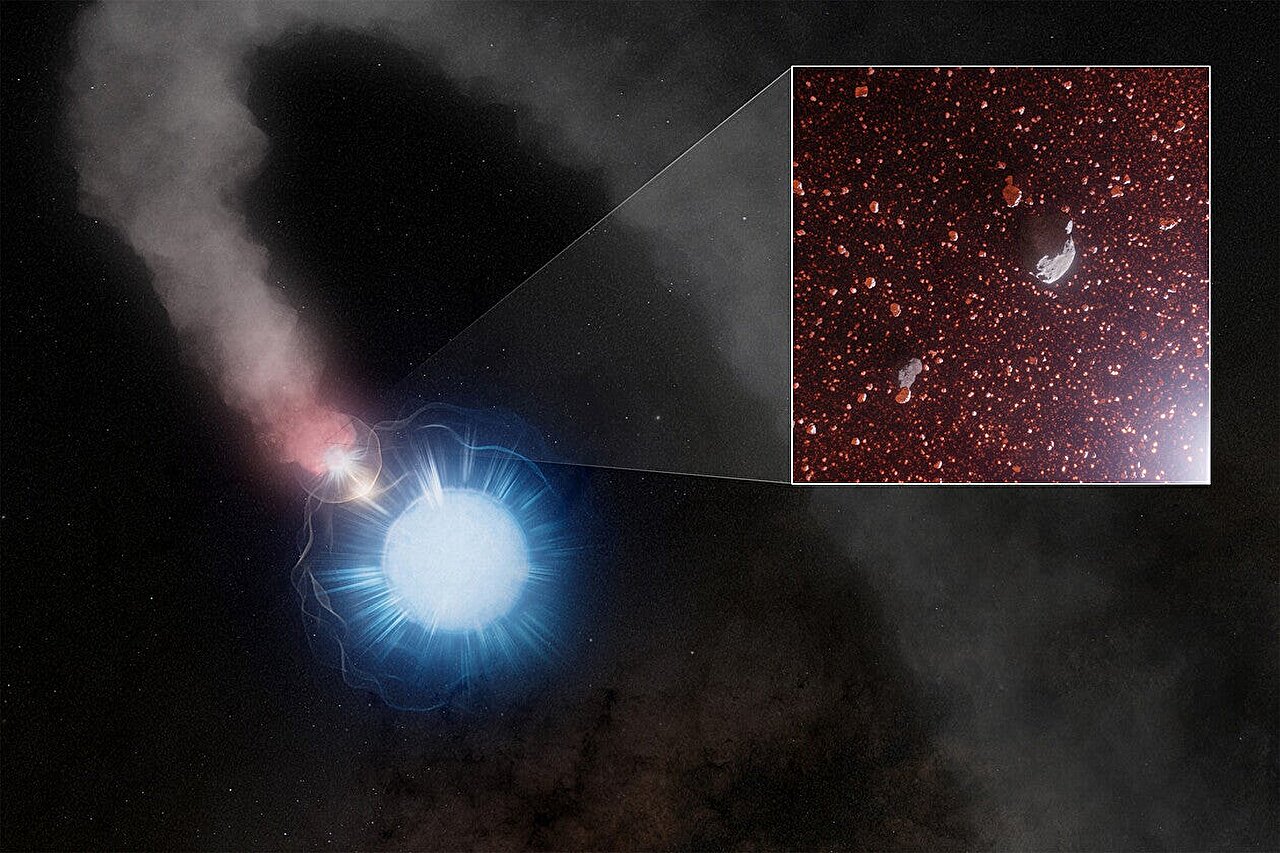
Study of a rare binary star system
Wu analyzed observational data on WR 112, a binary system containing a rare massive Wolf-Rayet star, which is known for its unusual spectrum and relatively short lifetime. In this case, this very hot dying star orbits around another.
Together, these stars emit powerful streams of particles that collide and create dense, cooling regions. There, before they scatter into space under the influence of radiation from other stars, dust is formed.
Dust particle sizes near WR 112
By analyzing combined data from the James Webb and ALMA telescopes, researchers found that dust grains in extended spiral structures are likely less than one micrometer in size, with most measuring only a few nanometers (or billionths of a meter).
“It’s amazing to know that some of the most massive stars in the universe produce some of the tiniest dust particles before they die,” said Wu, who conducted his research as part of a summer research program for students at the California Institute of Technology. The difference in size between a star and the dust it produces is approximately one quintillion to one.
The international team also found evidence that WR 112 dust has two different sizes: a large group of nanometer-sized grains and a smaller group of grains with a diameter of about 0.1 micrometers. This discovery reconciled decades of conflicting measurements of such binary systems, which had detected only very small grains or only larger ones.
Physics of dust grains in massive binary stars
The researchers also examined several physical processes that could, in principle, break up or evaporate dust grains near the harsh radiation fields of stars. They stated that under certain conditions, these processes tend to destroy medium-sized grains.
Since WR 112 is one of the most productive dust producers of its kind, producing dust equivalent to three Earth months in volume each year, the new grain size measurements are important for determining how much carbon dust massive binary stars can contribute to the galaxy as a whole.
According to phys.org

