

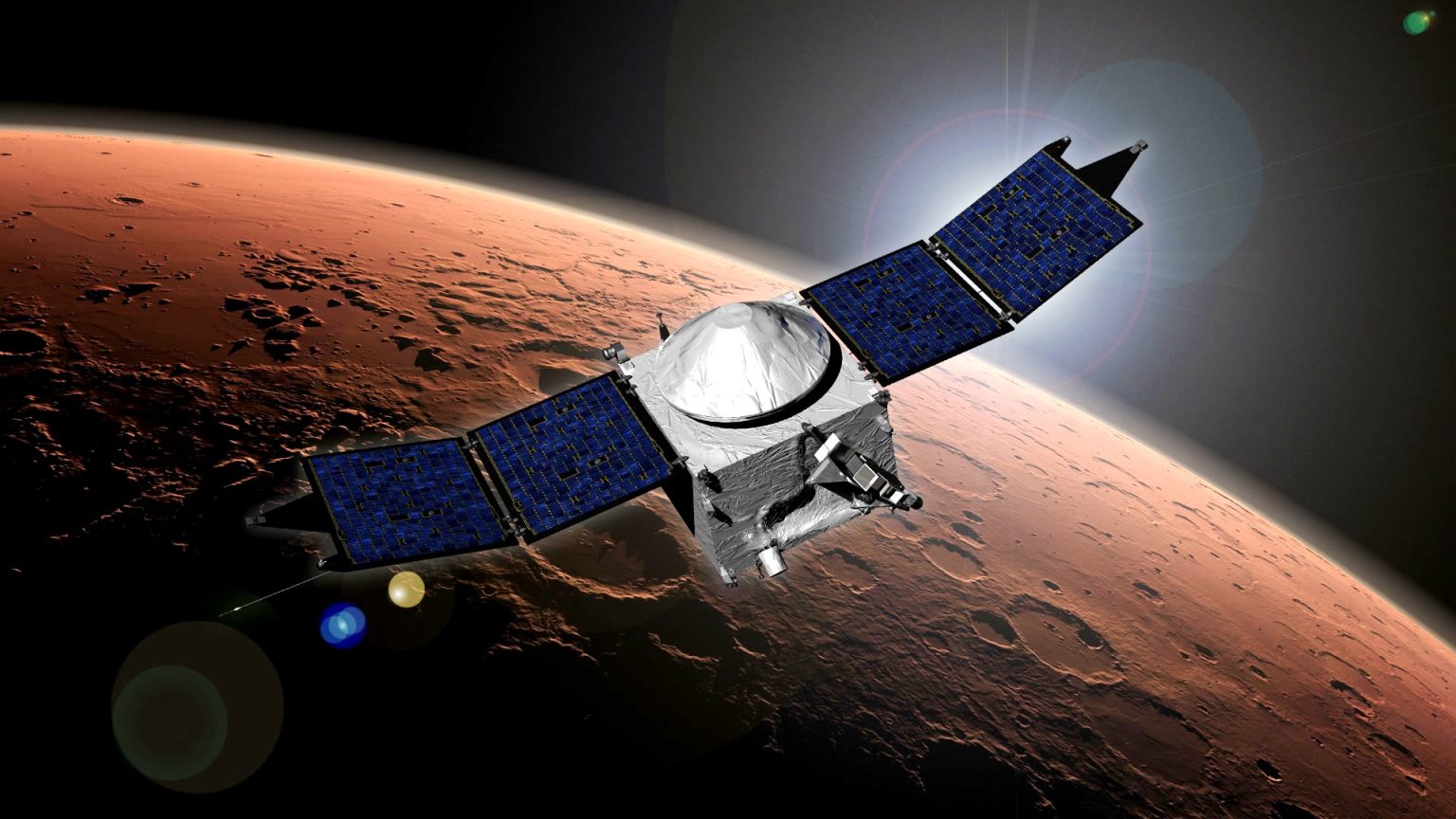
While reviewing a vast array of data collected by NASA’s Mars Atmosphere and Volatile Evolution (MAVEN) spacecraft over the past decade, scientists discovered a familiar type of electromagnetic signal typically caused by lightning. This rare discovery is the first direct evidence of lightning activity on Mars.
Whistle waves for detecting Martian lightning
Whistling waves are low-frequency radio wave signals generated by lightning that create a pulse that propagates through the planet’s magnetosphere, following the lines of the magnetic field. Whistling waves dissipate due to the lower speed of low frequencies in the plasma of the ionosphere and magnetosphere. These waves are typical for Earth, but have also been observed on Jupiter, Saturn, and Neptune. All these planets have strong magnetic fields and corresponding magnetospheres, which contribute to the movement of whistling waves.
Mars, on the other hand, does not have a global magnetic field similar to Earth’s. This is because the internal activity that generates these magnetic fields ceased on Mars billions of years ago. This may contribute to the fact that lightning-like discharges have not yet been observed in the atmosphere of Mars. But lightning activity on Mars is impossible.
Dust storms generating charges
“Simulations and laboratory experiments suggest that electric discharges are likely to occur in Martian dust storms similar to those observed in terrestrial volcanic eruptions and dust devils. During dust storms, dust grains become electrically charged through collisions,” the authors of the study explain.
The team claims that, when combined with certain atmospheric conditions, these dust storms can generate electrical discharges. This has been proven in laboratory experiments. Although Mars does not have a global magnetic field, localized magnetic fields of the Earth’s crust are scattered across its surface. They are generally much stronger in the Southern Hemisphere than in the Northern Hemisphere. Consequently, whistle waves can potentially propagate along these lines of force when they are generated by lightning-like activity in dust storms.
Extremely unlikely detection
From more than 108,000 measurements obtained by MAVEN, the team discovered a single wave with a scattered frequency in the Martian ionosphere. The image showed a clear whistling phenomenon lasting 0.4 seconds and covering a range of up to 110 Hz. The team conducted theoretical modeling, confirming the likelihood of wave propagation from the surface to the spacecraft. Although the team notes that it cannot precisely determine the location of the discharge or whether it originated from a dust storm, it asserts that these data are very similar to data on whistling waves generated by lightning on Earth.
Since only one such phenomenon has been detected so far, it is clear that lightning-like phenomena on Mars are difficult to detect. In order to record even one such phenomenon, several conditions had to be met. For example, the local magnetic field should be strong and vertical enough to be detected by an orbital device. Certain ionospheric conditions were also required. In addition, the measurement had to be taken from a very specific location (on the side of Mars where night conditions prevailed) at a specific time (when the magnetic field was oriented vertically).
Thanks to MAVEN being in the right place at the right time, scientists now know more about conditions on Mars. This information can help in planning future missions and contribute to our understanding of planetary atmospheres and comparative planetology.
According to phys.org

