

Physicists at the Vienna University of Technology have discovered why some charged particles easily stick to surfaces while others do not. The reason lies in how water molecules arrange themselves around an ion. Even a fleeting order that lasts for a billionth of a second significantly alters the behavior of the particles.
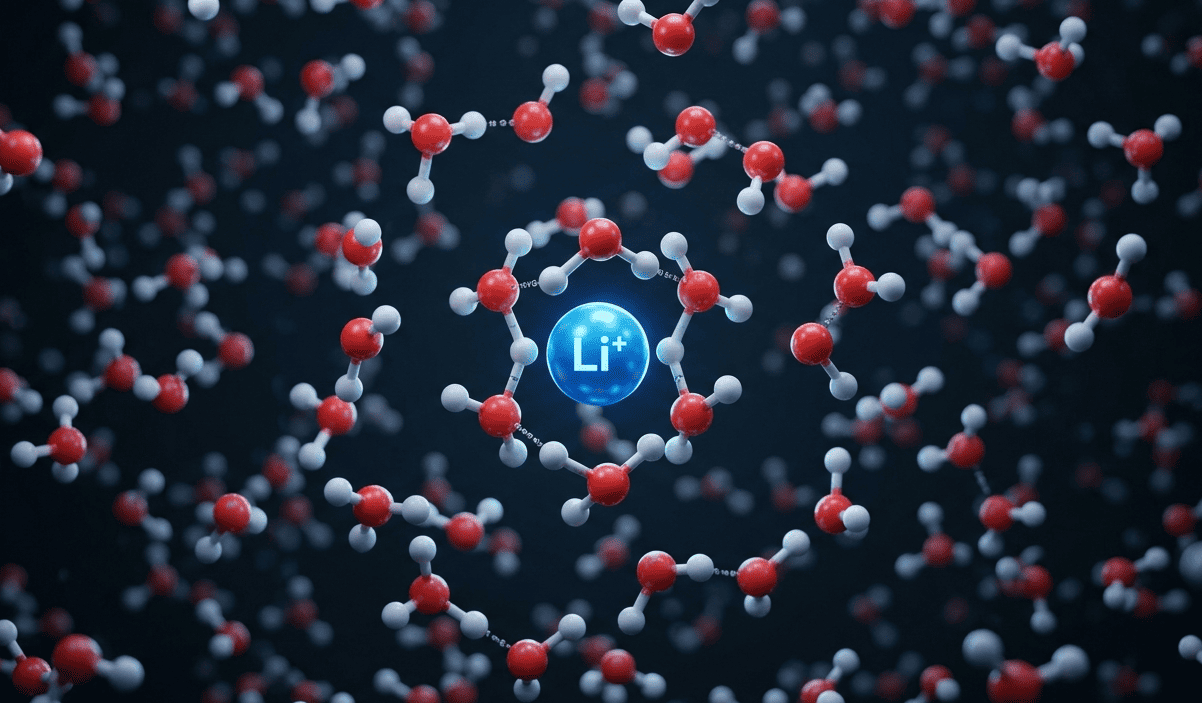
Charged particle does not move on its own
When a charged particle moves through an aqueous solution, it drags a whole “train” of molecules along with it. These molecules do not remain stationary; they are constantly vibrating, rearranging themselves, forming weak bonds, and breaking them.
The extent of this ordering depends on the ion itself. The small lithium ion strongly orders the water around it, while the large cesium ion does so only slightly.
What does “ordered water” mean?
In thermodynamics, entropy is a measure of disorder: the more chaotic a system is, the higher its entropy. When an ion strongly organizes the water around it, it reduces this measure.
Systems naturally tend toward greater chaos, so ordered states occur less frequently. Ions that tightly structure the water shell adhere less effectively to the surface: their attachment would require even greater restructuring of the shell, which is thermodynamically unfavorable.
Charge plus entropy
Previously, it was believed that the main factor driving an ion’s attraction to a surface was simple electrostatic force: opposite charges attract each other. The researchers combined atomic force microscopy, molecular dynamics simulations, and spectroscopic measurements.
Using these methods, they developed a thermodynamic model that, for the first time, quantitatively describes how ions settle on a surface—that is, how they are adsorbed. The model takes into account electrostatic forces, entropy, and interactions with water molecules simultaneously.
Where is this important?
The new model allows for more accurate predictions of which ions and how they will behave on different surfaces. This is important for the development of batteries, fuel cells, electrodes, catalysts, and biological membranes.
The study, published in the journal Science Advances, once again debunks the idea of “water memory,” which is still promoted by proponents of homeopathy. Water really forms temporary structures around ions, but this is physics, not some magical storage of information.
According to phys.org

