

Scientists have developed a new theory about the formation of Mercury that could explain its incredibly large iron core. It suggested that the planet was formed after the collision of two bodies of approximately the same size, rather than different sizes, as had been believed until then.
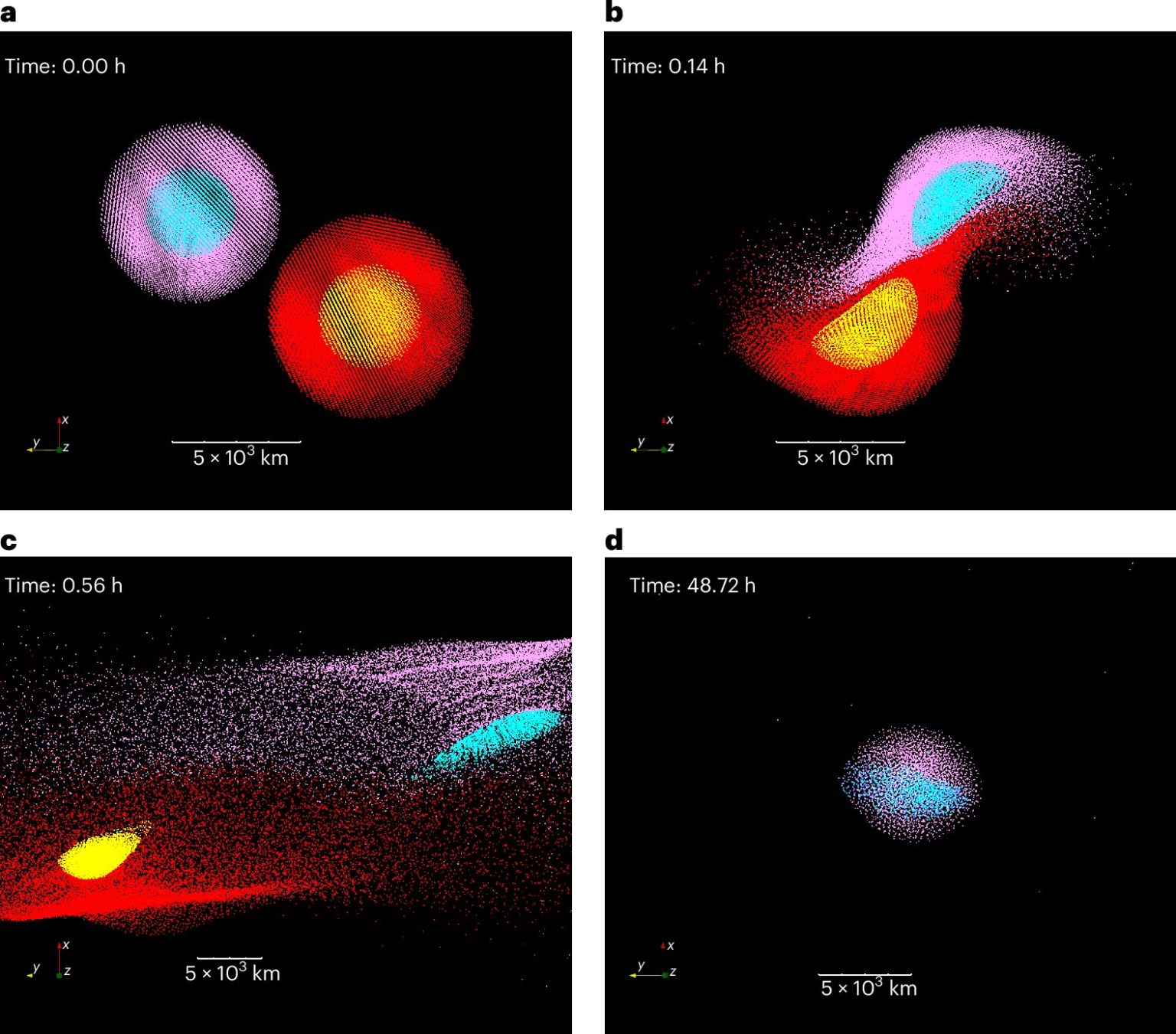
Formation of Mercury
Mercury’s core is incredibly large. It accounts for 70% of the planet’s mass. For Earth or Venus, this ratio is significantly lower. Recently, an international group of scientists published a study explaining how such a planet was supposed to form. An article about this has been published in the journal Nature Astronomy.
In general, scientists have long had a theory that explains how Mercury got its large core. She suggests that at an early stage of its formation, it collided with a much smaller, but still large, body. The impact knocked down some of the light elements, while some of the heavy ones, on the contrary, increased.
The problem with this theory is that collisions between bodies of different sizes were actually quite rare in the early Solar System. Considerably more likely is the scenario that Mercury collided with something roughly the same size as itself.
What the simulation showed
But can the collision of two identical bodies really result in the formation of a large core? Computer modeling based on smooth particle hydrodynamics was used to verify this assumption.
This method has been used in astrophysics for a very long time. It consists in the fact that physical bodies are viewed as a collection of individual small particles, which together behave like a liquid in zero gravity: they can collide or come together.
Modeling confirmed that in a situation where there was a large population of protoplanets in the early Solar System, the formation of Mercury through the collision of two of them is quite likely. And it could even have formed a large, heavy core.
Moreover, this model provides a much better explanation of where the debris containing most of the mass of the lighter components of the two bodies disappeared to. Due to the high energy of the explosion and the close proximity of their orbits, they could all have fallen onto Venus.
According to phys.org

