

How big are the rockets that fly into space? Recently, an eyewitness shared a video on social media that provides an opportunity to assess the scale of Blue Origin’s giant New Glenn launch vehicle. This giant is currently undergoing flight preparations, so the launch vehicle is being assembled in parts. In the footage, a powerful truck carrying space cargo looks like a toy car against the backdrop of this colossus.

A veritable race of giants continues in the world of space technology. The fully assembled New Glenn rocket is truly an outstanding work of engineering. It stands over 98 meters tall, just 4 meters shorter than the Motherland statue in Kyiv. New Glenn is taller than SpaceX’s workhorse Falcon 9, but it is surpassed by the world’s most powerful rocket, Starship, from the same company, which reaches a height of 122 m. Therefore, New Glenn is not the absolute record holder, but it certainly remains one of the largest and most modern launch vehicles in the world, which is still in the active testing phase.
Mission and challenges
Driving past a 90-ton rocket crawling down the highway
byu/SystematicApproach inmegalophobia
The first launch of New Glenn in January this year was a major step forward for the project, which has been in development for over a decade. The mission was considered a success, as the second stage of the rocket reached its target orbit. However, the main goal—reusability—was not achieved: the first stage was lost during landing.
Blue Origin is now preparing for its second, even more important launch. This flight should demonstrate not only the rocket’s power, but also its usefulness for science. In addition to testing its systems, New Glenn will deliver two NASA EscaPADE mission spacecraft into space. They will travel to Mars to study how solar wind interacts with the Red Planet’s magnetic field and atmosphere.
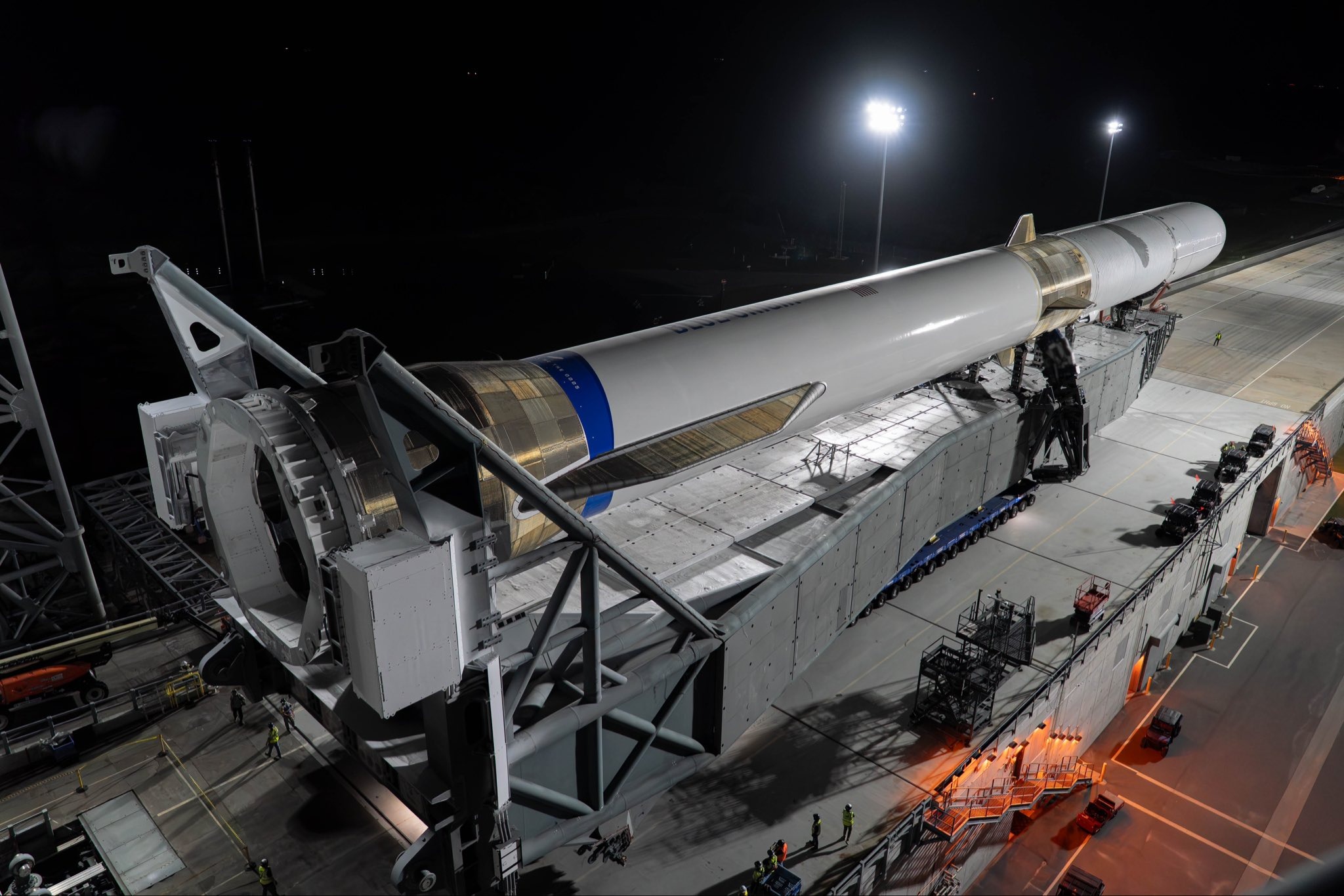
Like its direct competitor SpaceX, Blue Origin designed New Glenn as a reusable system. After separation, the first stage must return to Earth independently and make a soft landing on a special platform. Its successful return is a key goal of the future launch. The stage even got its own name — Never Tell Me the Odds.
If the stage is destroyed during descent, the company is unlikely to be able to quickly build a replacement. If successful, however, the same part of the rocket could fly into space again next year, opening a new chapter in the history of private space exploration.
Earlier, we reported on how a NASA astronaut photographed the New Glenn rocket from space.
According to Futurism

