

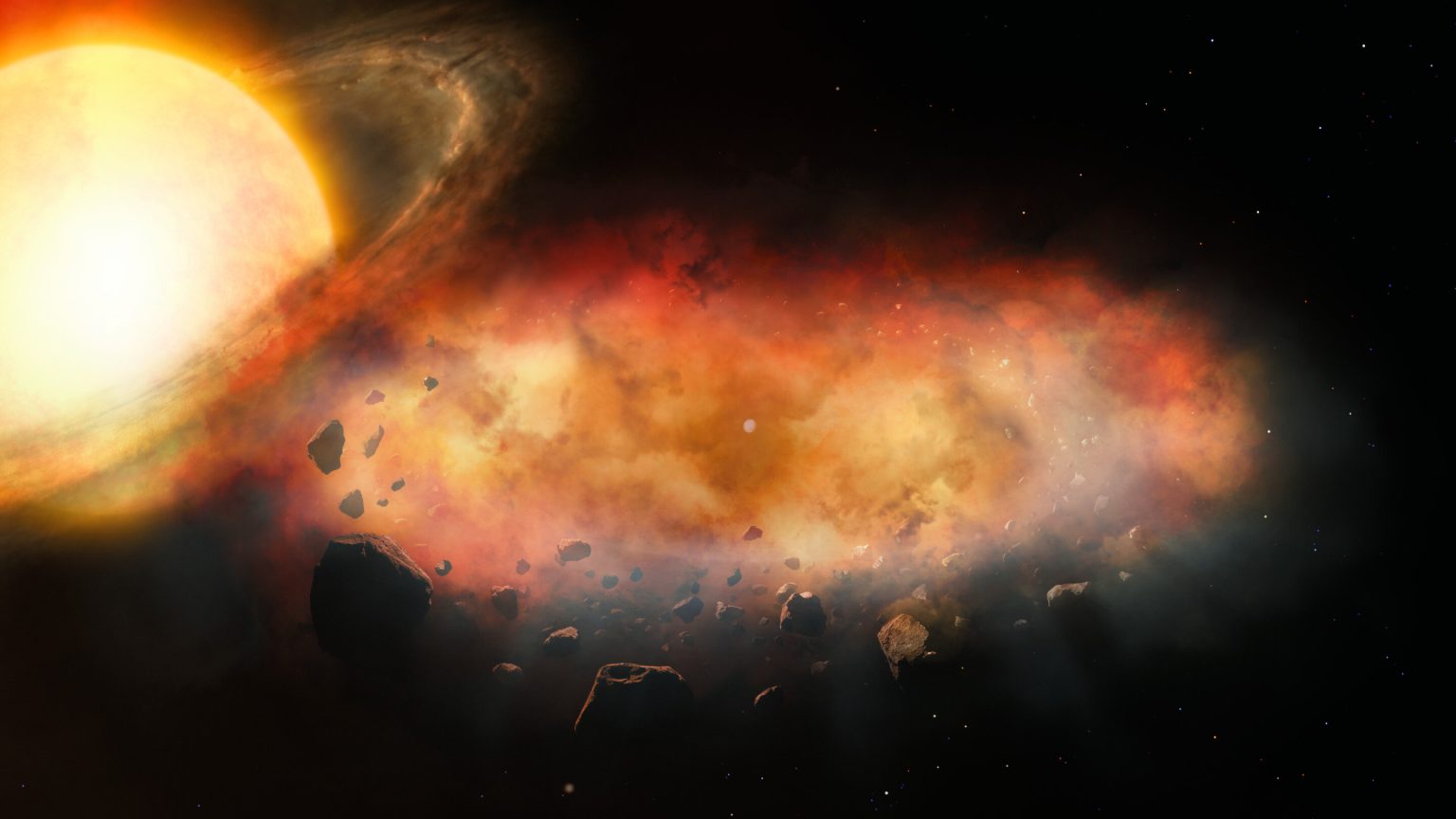
The star J0705+0612 was a mystery to scientists for some time. Similar to our Sun, it suddenly dimmed. Now scientists know that the reason for this is a dust cloud containing large amounts of metal and orbiting this star.
Unexpected occultationof a star
Strong winds of evaporated metals were discovered in the enormous cloud that obscured the star’s light for nearly nine months. This discovery, made using the Gemini South telescope in Chile, part of the Gemini International Observatory, provides a rare glimpse into the chaotic and dynamic processes that still shape planetary systems long after their formation.
In September 2024, a star 3,000 light-years away suddenly became 40 times dimmer than usual and remained so until May 2025. The star J0705+0612 is similar to our Sun, so the sharp decline in its brightness caught the attention of Nadia Zakamska, a professor of astrophysics at Johns Hopkins University. “Stars like the sun don’t just stop shining for no reason,” she says, “so dramatic dimming events like this are very rare.”
Identifying the cause of dimming
Recognizing the opportunity to study this phenomenon over many months, Zakamska and her team began observations using the Gemini South telescope located on Cerro Pachón in Chile, as well as the 3.5-meter Apache Point Observatory telescope and the 6.5-meter Magellan telescope.
By combining their observations with archival data on J0705+0612, the team determined that the star was occulted, or temporarily obscured, by a huge, slow-moving cloud of gas and dust. They estimate that the cloud is about two billion kilometers from its parent star and has a diameter of about 200 million kilometers.
The data indicate that this cloud is gravitationally bound to a secondary object, which itself orbits the star at the outer limits of the planetary system. Although the nature of this object remains unknown, it is thought to be massive enough to hold the cloud together. Observations limit its mass to at least several times that of Jupiter, although it may be larger. Possibilities range from a planet to a brown dwarf to a very low-mass star.
If the mysterious object is a star, the cloud will be classified as a secondary disk — a disk of debris orbiting around the less massive member of a binary system. If the object is a planet, it will be a circumplanetary disk. In any case, direct observation of a star obscured by a disk surrounding a secondary object is an extremely rare phenomenon, with only a few known examples.
Cloud composition analysis
To study the cloud’s composition, the team used Gemini South’s most advanced instrument, the Gemini High-resolution Optical Spectrograph (GHOST). In March 2025, GHOST observed the occultation for just over two hours, breaking down the star’s light into a spectrum that revealed the chemical elements present in the intervening material.
GHOST data detected several metals — elements heavier than helium — in the cloud. More remarkably, the high precision of the spectra allowed the team to directly measure how the gas moves in three dimensions. This is the first time astronomers have measured the internal motions of gas in a rotating disk around a secondary object, such as a planet or low-mass star. The observations reveal a dynamic environment with winds of gaseous metals, including iron and calcium.
“The sensitivity of GHOST allowed us not only to detect gas in this cloud, but also to actually measure how it moves,” says Zakamska. “This is something we have never been able to do before in such a system.”
How did the dust cloud form?
Precise measurements of wind speed and direction show that the cloud is moving separately from its parent star. This, combined with the duration of the occultation, further confirms that the occulting object is a disk around a secondary object and that it is orbiting outside the parent star’s stellar system.
The source emits excess infrared radiation, usually associated with disks around young stars. However, J0705+0612 is more than two billion years old, which means that the disk is unlikely to be the remnants of debris from the early stages of planet formation in the system. So how did it form?
Astronomers suggest that it was formed after two planets collided at the outer edges of this star’s planetary system, ejecting dust, rocks, and debris that formed a massive cloud passing in front of the star.
This discovery highlights how new technologies can provide new insights into the Universe. GHOST has opened a new window for studying hidden phenomena in distant star systems, and the data obtained provide valuable clues about the long-term evolution of planetary systems and how disks around old stars may form.
Scientists say that the case of star J0705+0612 shows that even in mature planetary systems, dramatic, large-scale collisions can still occur.
According to phys.org

