

An international team of astronomers has published the results of a study of a very young exoplanet. It has an unusually clean and inflated atmosphere.

The exoplanet studied is known as V1298 Tau b. It orbits a young orange dwarf star located 354 light-years from Earth. It is only 10–30 million years old and is a mini-Neptune. This is the name given to bodies that occupy an intermediate position between rocky super-Earths and larger planets, with characteristics similar to Neptune.
Based on previous observations by the Hubble Telescope, astronomers had speculated that the atmosphere of V1298 Tau b contained water vapor and methane. However, when they used the more powerful James Webb Space Telescope (JWST) to study the exoplanet, the results surprised the researchers.
JWST observations have revealed that V1298 Tau b has an unusually pure and bloated atmosphere. Astronomers have detected strong absorption signals from molecules such as water vapor, methane, carbon dioxide, carbon monoxide, and even signs of complex photochemical processes, such as preliminary detections of sulfur dioxide (SO₂) and carbonyl sulfide (OCS).
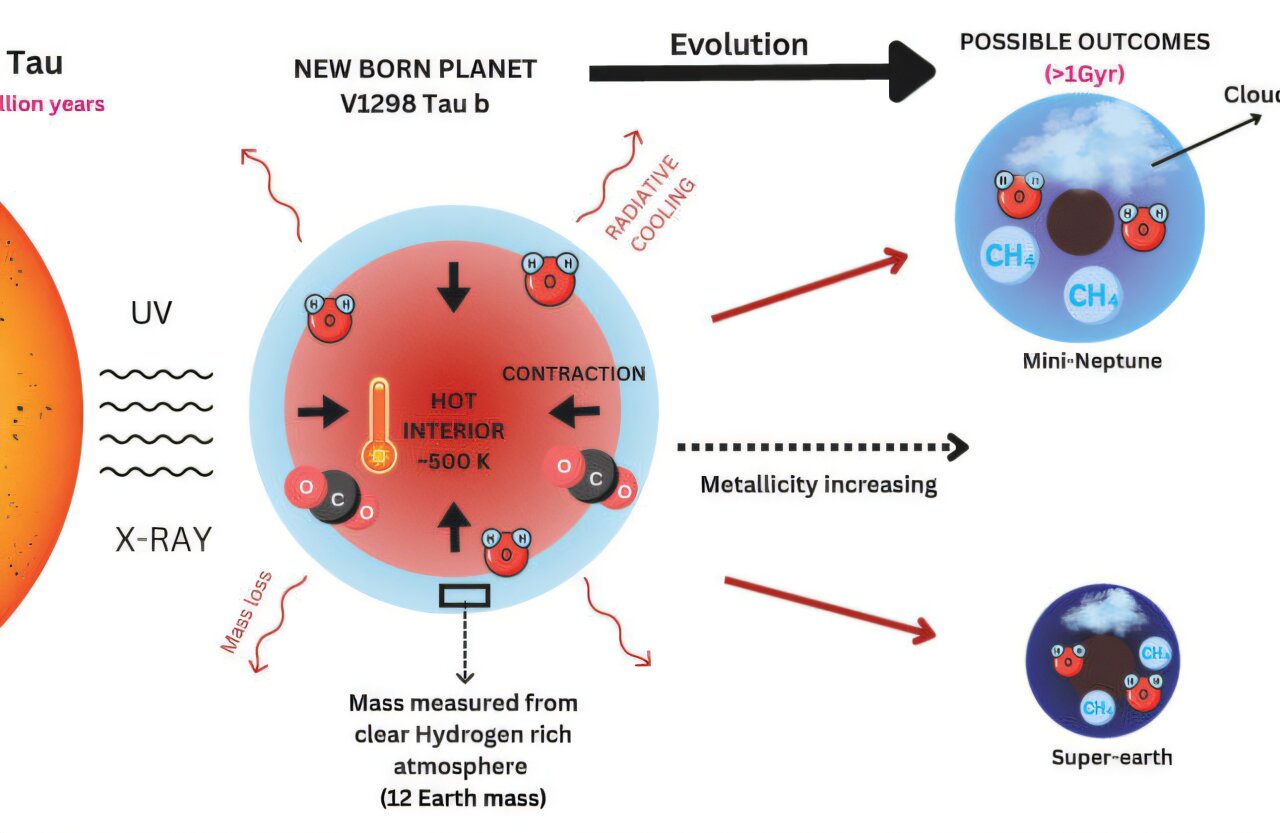
At the same time, despite its rich spectrum, the atmosphere of V1298 Tau b is surprisingly poor in metals — approximately 100 times less enriched than that of mature mini-Neptunes. This indicates that the planet is still evolving and may become richer in metals over time. Another surprise is the fact that the spectrum of V1298 Tau b contains 100 times less methane than expected. This may be the result of extreme internal heat and strong vertical mixing in the atmosphere.
According to researchers, the JWST results cast doubt on current ideas about the formation and early evolution of mini-Neptunes. They provide a strong incentive for further research into the atmospheres of young planets in order to study changes in their composition over time.
Earlier, we reported on another mini-Neptune studied by the James Webb Telescope.
According to Phys.org

