

Miranda is Uranus’ icy moon, scarred by deep ravines that give it a very unusual appearance, even from a distance. For many years, scientists have been racking their brains trying to figure out what it went through in the past to acquire such a strange shape.
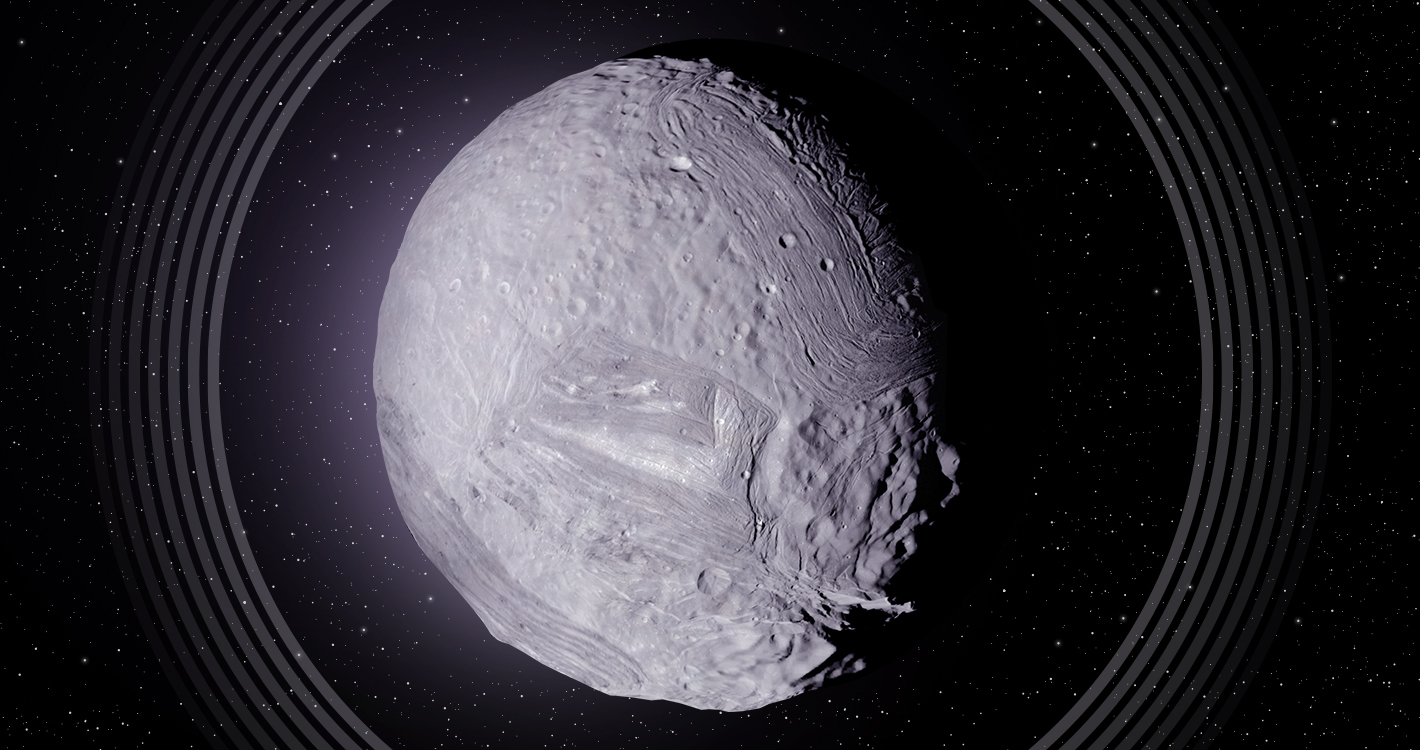
A ball made of crushed ice
There are plenty of strange natural objects in the Solar System. But when people see a photo of Uranus’ moon Miranda, few can contain their surprise. At first glance, it looks like a scoop of ice cream with uneven lines revealing the filling.
However, closer examination may reveal even stranger things. These structures turn out to be crevices several kilometers deep, which seems quite unusual considering that the diameter of the satellite itself is only 470 km. How can all this be explained? The story behind it is long and complicated.
Firstly, until 1948, no one had heard of Miranda. It was discovered by Dutch astronomer Gerard Kuiper, the same man who postulated the existence of an outer asteroid belt in the Solar System, which is now named after him.

As for the name Miranda itself, the satellite was traditionally named after one of the characters in Shakespeare’s plays – Miranda, the daughter of the sorcerer Prospero from The Tempest. At the time of its discovery, it was already clear that this celestial body was quite unusual.
First, Miranda was about 500 km in size, which is transitional between small icy bodies, whose gravitational force is usually insufficient to give them a perfect spherical shape, and large ones, which resemble icy spheres.
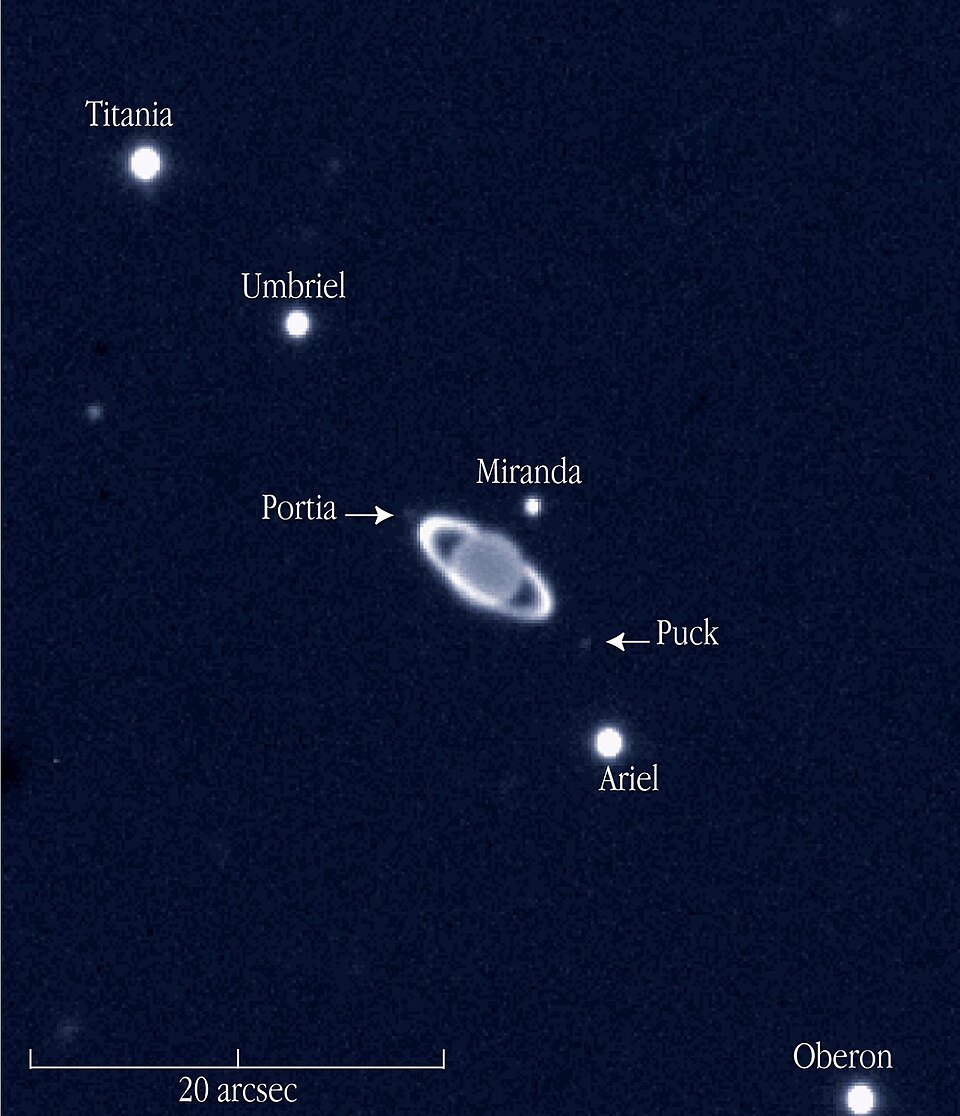
Secondly, Miranda orbited Uranus closer than the four previously known satellites. Its distance from its nominal surface is only 129,900 km, which is only one-third of the distance from Earth to the Moon. At the same time, unlike Titania, Oberon, Ariel, and Umbriel, Miranda’s orbit is almost circular.
Mysterious cliffs
However, until 1986, no one paid much attention to these features. That is, until the Voyager-2 spacecraft approached Uranus. Miranda turned out to be the closest of the planet’s large moons to its flight path. It is not surprising that it was able to see it best. It is one of the few moons that automatic probes have photographed from almost all sides, so that we can more or less talk about a map of the planet.
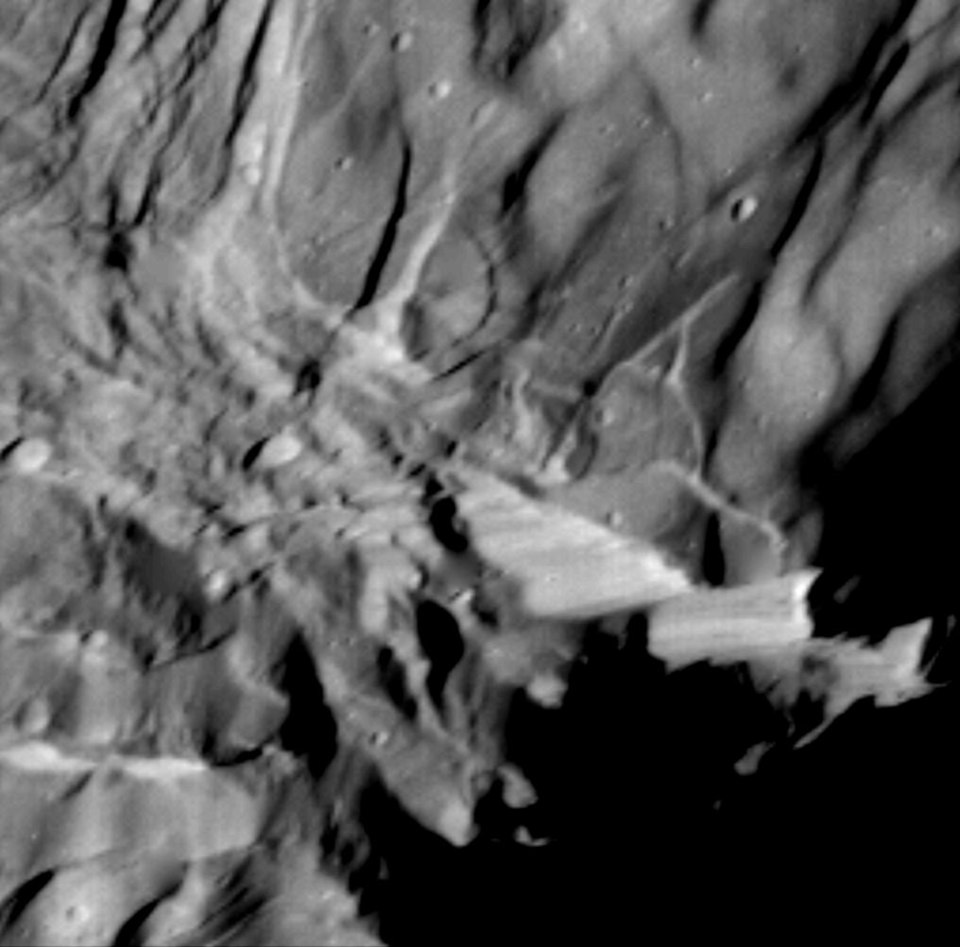
And it was this map that caused scientists to argue for many years. The fact is that on it, Miranda looked as if it had been assembled from different pieces that were poorly glued together. Huge cliffs stretch across the surface of the satellite. The largest of these is the Verona escarpment, named after the city where the events of Romeo and Juliet took place. According to various estimates, its height ranges from 5 to 20 km.
Some cliffs form an enormous graben. This is the name given to narrow valleys where the earth seems to have collapsed.
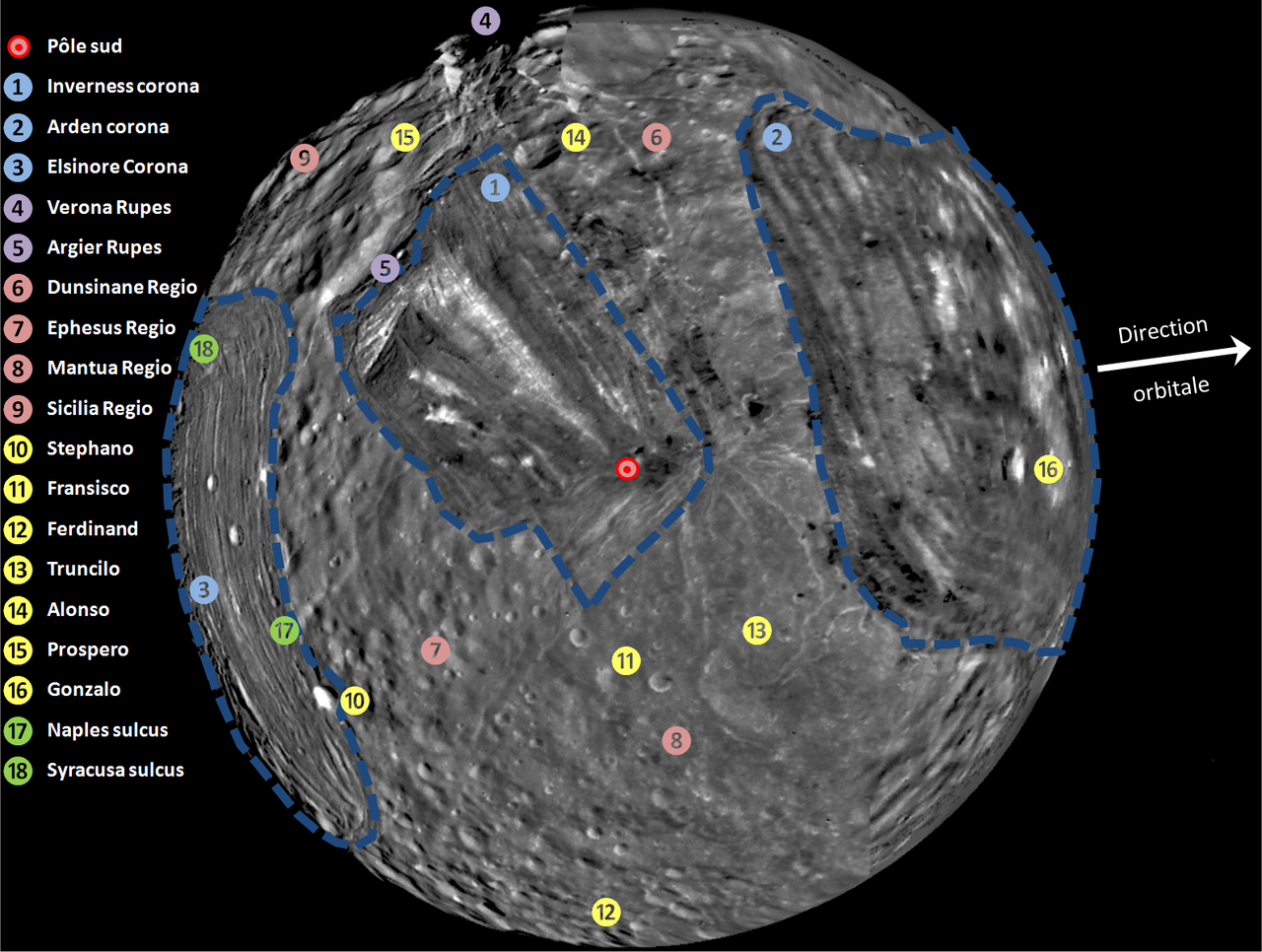
Miranda also has plains covered with hills, but the most impressive features are the unique landforms known as crowns. These giant areas of the surface appear to have been raised above the surrounding terrain by unknown forces, with the same cliffs located along their edges. In total, there are three crowns on Miranda: Inverness, Arden, and Elsinore. Again, they got their names from places mentioned in Shakespeare’s plays.
The ridges and other relief features are impressive not only for their shape but also for their scale, especially considering that Miranda’s diameter is only 470 km.
Complex geological history
The situation is made even more mysterious by the fact that a count of craters on Miranda’s surface showed that there are significantly fewer of them than on other Uranus moons. What is worse, some areas are much younger than others. For example, the Inverness ring has a surface age of only 500 million years, the Elsinore ring is between 400 million and 3.1 billion years old, and most of the moon’s surface is 3.5 billion years old.
All this leads some researchers to suggest that Miranda’s surface has been renewed at least several times. What processes led to this remain a mystery. For several decades, a popular hypothesis was that at some point, Miranda was split into pieces by a powerful impact, and then the fragments came back together again. However, a 2011 study refuted this possibility.
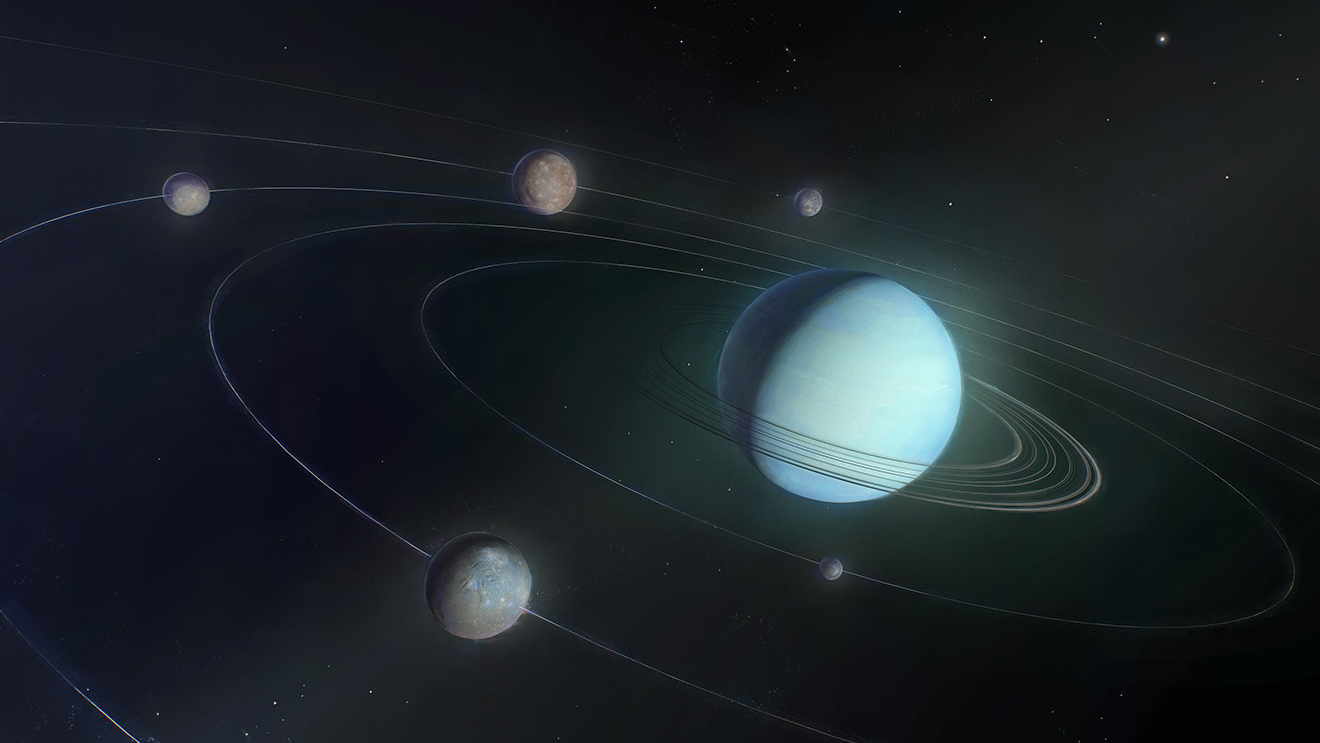
Currently, most researchers are focusing on two factors: Miranda’s proximity to the surface of the gas giant and its interaction with other satellites. The first factor is indeed capable of creating amazing landforms, because bodies orbiting gas giants are mainly composed of water ice, which can temporarily turn into liquid in the presence of heat and form a smooth surface in place of old craters.
And there is such a source of heat – tidal heating, which the satellite could have experienced in the past. The gravitational gradient deforms satellites close to giant planets, and mechanical energy is converted into heat. Thus, Jupiter’s satellite Io also has canyons and table mountains. And on Enceladus, which is very similar in size to Miranda, there are giant cracks from which geysers shoot into space.
Therefore, surface renewal because the ice inside Miranda heated up, melted, cracked on the surface, and then everything froze is more than likely. As for the influence of other satellites, scientists are paying attention to Miranda’s orbit. It is quite possible that it previously rotated in a slightly more elongated orbit, was in resonance with other icy bodies, and they also contributed to its deformation, so it is quite possible that its surface was molten for some time. Then something happened, and Miranda moved into its current orbit, and its surface froze in its present state.
Unique conditions
Be that as it may, the combination of small size and huge vertical cliffs creates truly unique conditions on Miranda. It is the best place in the Solar System for rock climbing. The acceleration of free fall here is only 7.9 cm/s2. That is 140 times less than on Earth. In such conditions, you can climb vertical cliff walls for hours.
Or fall from them. Miranda is the only place in the Solar System where you can fall from cliffs for several minutes. However, you will still need to stop your fall somehow, for example, with a jetpack, because parachutes do not work on Miranda due to the lack of atmosphere.
However, overall, we still know very little about this moon. Voyager 2’s flyby remains the only one to date. So we do not really know if Miranda’s icy cliffs are truly dead, or if we were just unlucky not to see any local geysers. If liquid water still exists beneath the surface, that could explain a lot, and this tiny world would not seem so mysterious.

