

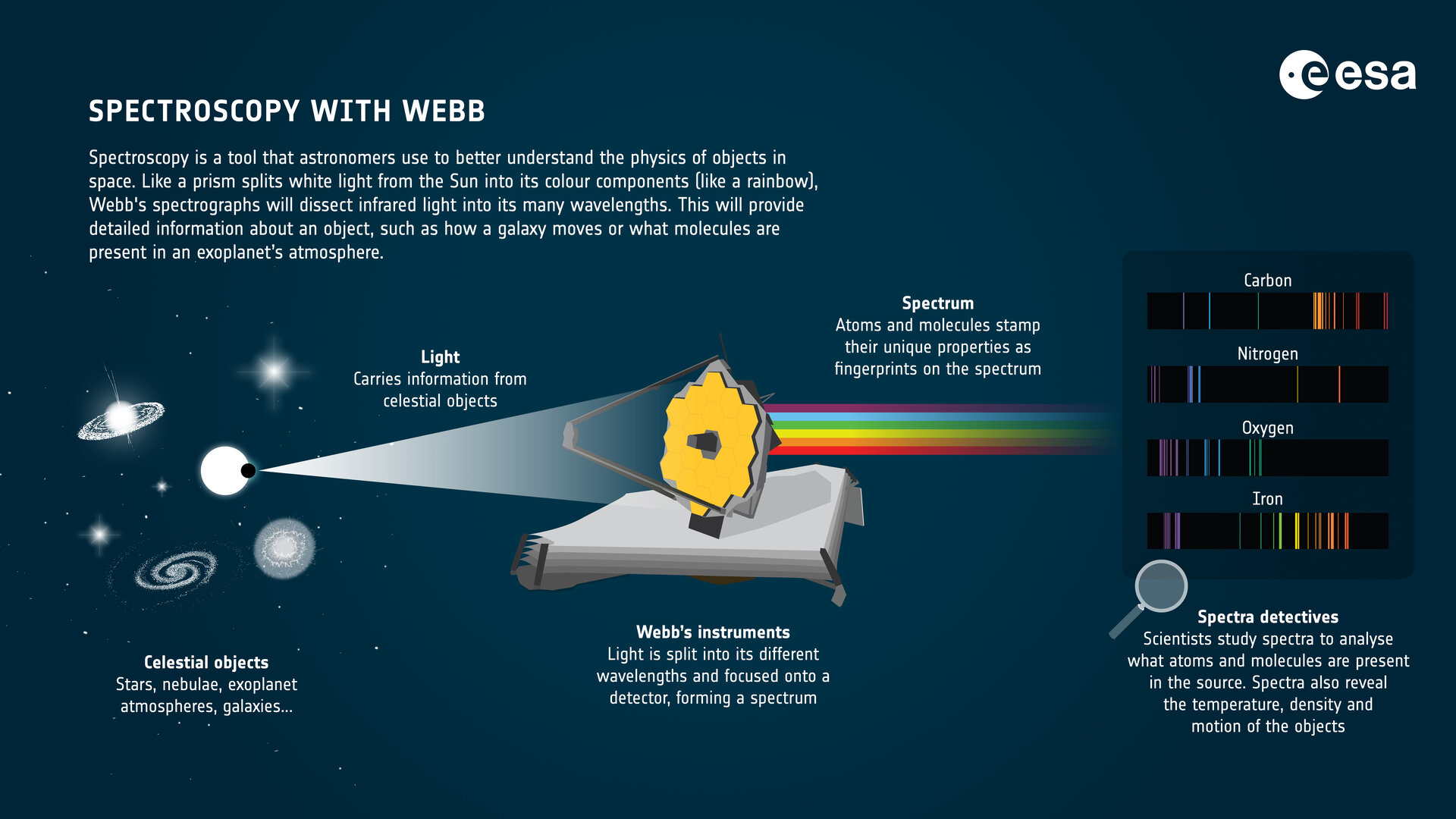
In his book Auguste Comte in Course of Positive Philosophy, published in 1835, the French philosopher argued that the stars will always remain “mechanical objects” for us. We will be able to determine their position in the sky, measure the distance to them, and learn the patterns of their movement. But what this or that bright speck in the sky is, what it is made of, what its temperature is, will remain a mystery to us forever. The philosopher lived only a couple of years before the publication of articles by Gustav Kirchhoff and Robert Bunsen, who proposed to determine the elemental composition of a radiating body by the characteristic lines in its spectrum. Since then, spectral analysis has been virtually the only tool that allows astronomers to analyze distant objects. No wonder scientists want to use it to search for life on other planets.
Of course, spectral analysis has some limitations. First, it is best suited for detecting substances in a gaseous state. That is, for example, the presence of liquid water can be detected only by the “spectral signatures” of water vapor. Secondly, habitable planets usually orbit quite close to their stars, and it is extremely difficult to separate them when observing them from Earth. In the future, this problem will probably be solved by improving astronomical instruments and imaging technologies, but for now, it has to be circumvented by other means, which are not always effective.
One way or another, the spectra of some exoplanets – or rather, their atmospheres – have already been recorded. None of the bodies studied by spectroscopy orbits in the habitable zone, where the surface temperature allows liquid water to exist; however, spectral data will be obtained for such objects sooner or later. What do scientists looking for signs of life hope to see in them?
In the image and likeness
It should be noted that modern science is aware of only one type of living organism, the one we encounter on Earth all the time. It is based on carbon chains and biochemical reactions in aqueous solutions. There are many explanations for why this combination seems to be the best for life. A separate article could be devoted to them, but one of them must be mentioned. Water is one of the most widespread chemical compounds in the universe, and it is also one of the most efficient solvents, remaining in a liquid state over a wide temperature range. This means that water provides the optimal conditions for the chemical transformations necessary to build the molecular structures of living organisms and supply them with energy.
Of course, no one can completely rule out the existence of exotic life forms based on ammonia or even rarer fluorine. Similarly, carbon does not necessarily have to be the main component of biological molecules. But the manifestations of such life are likely to be so different from what scientists are used to seeing around them that they will simply be impossible to recognize as inanimate nature. Therefore, astrobiologists are now focusing on the search for water as the most likely habitable environment. Hence, the concept of the habitable zone. This term sounds quite promising, but in fact, it only means a favorable temperature regime on the exoplanet’s surface and does not imply any “population”.
What will we see in the spectrum of an exoplanet potentially habitable for Earth-type life? First of all, of course, scientists will look for water vapor lines. However, there should not be much of it in the atmosphere: on Earth, even in the wettest jungles, its concentration reaches a maximum of a couple of percent. But our air has a lot of oxygen – more than 20%. It would seem that this is a sign of life! At least, the one we are most familiar with.
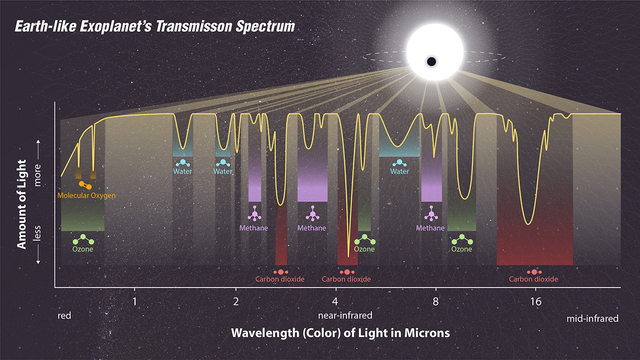
For a long time, experts have been carefully compiling a list of biomarkers, which are simple molecules that living organisms need to sustain their vital functions or are released during them. Oxygen is considered one of them, with many caveats. First, it became an essential component of the Earth’s biosphere about 2 billion years ago. Earlier, life on our planet managed quite well without it, and even now, there are many bacteria and fungi (the most famous example is yeast) that do not need it at all and even harm it. And secondly, this gas can occur, in particular, during the decomposition of water molecules under the influence of high-energy radiation. This is the so-called abiogenic oxygen, which is quite capable of confusing astronomers.
Heavier and more complex molecules, such as ethyl and methyl alcohol, formic and acetic acid, are considered more reliable signs of life. However, not everything is so simple with them. As it turned out, they can also be synthesized without any participation of living organisms, and not even on planets, but in interstellar gas and dust clouds, if there is a star nearby that can warm them up a bit. Nowadays, compounds such as amino acids, which are essential for life, are also found in these clouds. This has led to the assumption that they did not appear on Earth as a result of the vital activity of primitive cells, but were brought here from space.
On the other hand, a substance that we are used to considering a terrible poison – hydrogen cyanide, or hydrocyanic acid (HCN) – may well be associated with life. Its danger is not least determined by its high reactivity, but it is thanks to this that this substance is quite easily converted into organic molecules (the same amino acids). Hydrocyanic acid and its derivative cyanide are also quite common outside the Earth – they are almost an essential component of cometary nuclei and have been repeatedly detected in the gases that evaporate from them.
Perhaps it is easier to say which molecules are practically incompatible with Earth-type life, and thus their presence would mean that it is not worth looking for it on this particular planet. These are primarily the highly reactive halogens fluorine and chlorine, as well as some of their compounds with silicon, sulfur, and phosphorus. They quickly enter into chemical reactions with biological molecules that are familiar to us and turn them into something completely unfit for life.
So, we already know a lot of potential biomarkers. But none of them, if discovered in the spectrum of a celestial body, is unequivocal proof of the existence of life there. So how can we prove its presence using spectral methods?
Unnatural combinations
After analyzing all possible data in detail, a team of scientists led by University of Washington professor Victoria Meadows concluded that in search of life signs, it is not necessary to focus on any one universal molecule. It is much more effective to track combinations of substances that are not usually found together. The best example is oxygen and methane. Both gases are present in the Earth’s atmosphere, but in the absence of living organisms, this would be impossible: they would have reacted with each other long ago, and only the one that was initially present in excess would remain. The reaction products would be water and carbon dioxide, substances that are not directly related to life. In other words, for the planet’s gas membrane to contain oxygen along with methane, there must be a constant source of replenishment of both. The likelihood that this source is of a biological nature is not so small.
Other examples of such “incompatible pairs” are oxygen and ammonia, or oxygen and hydrogen sulfide. The latter, however, is difficult to detect spectroscopically, but with improved observational techniques, this will not be a big problem. By the way, this is also the reason why scientists were so inspired by the recent discovery of phosphine (a compound of hydrogen and phosphorus) in the Venusian atmosphere: while on Jupiter and Saturn, where it was also observed, this gas is formed as a result of abiogenic processes and can exist for a relatively long time, on Venus it would have to disappear very quickly. However, further research has shown that phosphine is present in concentrations that can also be explained by natural causes.
The development of infrared astronomy has opened up new perspectives for astronomers, allowing them to search for quite exotic molecules, such as chlorofluorocarbons (CFCs). In their case, the most interesting thing is that they are not formed in the course of any natural processes, but are exclusively the product of artificial chemical synthesis. Also, these molecules or their closest derivatives are quite resistant to decomposition and can stay in the atmosphere for a long time. If we encounter such “exotics” in the spectrum of an extrasolar planet, it is likely to mean that there is not just life, but an advanced technological civilization.
However, to find CFCs in the atmospheres of even the closest exoplanets using the available astronomical instruments, their concentration there must be ten times higher than what we currently have on Earth. It is clear that the observational technique is not standing still – perhaps in a few years, this obstacle will be overcome. The prospect of detecting brothers in mind by the spectral characteristics of only one type of molecule at once is very attractive. Therefore, it is time for scientists to expand the list of biomarkers by adding “technomarkers” or “technosignatures” – volatile substances that can only be produced and released into the air artificially. And here, not only astronomers and biologists, but also ecologists and chemists should have a say.
This article was published in Universe Space Tech magazine #1 (189) 2023. You can buy this issue in the electronic version in our store.

