

Planets that wander through interstellar space far from any stars are known as rogue planets. They are generally considered unlikely candidates for hosting life. However, a recent study suggests that this may not be the case.
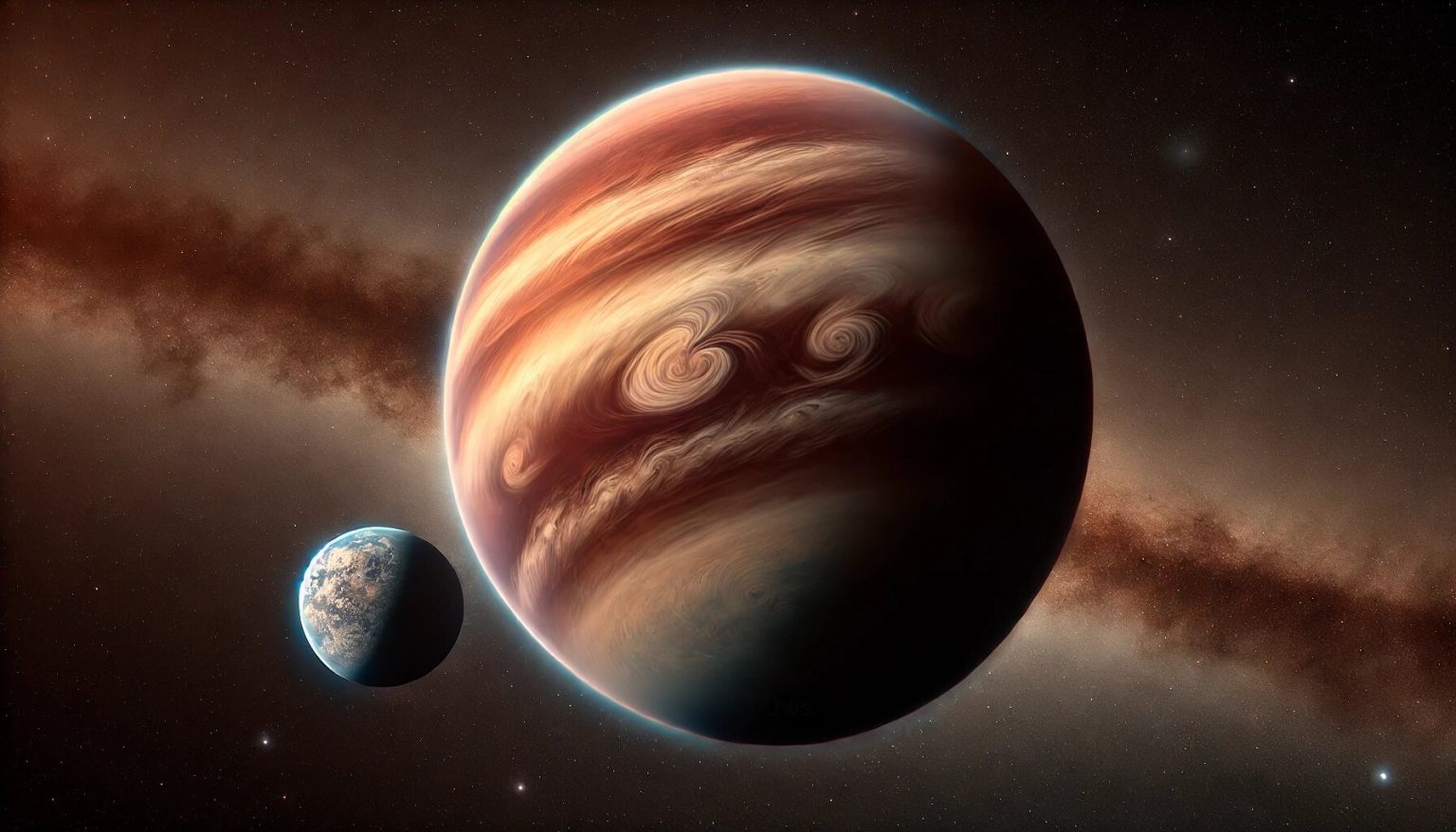
Heat absorption mechanism in hydrogen atmospheres
Astronomers have discovered hundreds of exoplanets drifting through interstellar space; most of them were likely ejected from their parent systems due to violent gravitational collisions in the distant past. After being ejected, these wandering worlds likely became very cold and dark—according to some astronomers, their moons may have met a more interesting fate.
On the condition that they have dense, hydrogen-dominated atmospheres, moons orbiting free-floating exoplanets could retain most of the heat generated deep within their interiors by tidal forces. Led by David Dahlbüdding of the Max Planck Institute for Extraterrestrial Physics and Giulia Roccetti of the European Space Agency, a new study predicts that hydrogen could act as a powerful greenhouse gas—potentially sustaining habitable conditions for billions of years after their host planets first form.
During the chaos of the ejection, the moon’s orbit can become highly elongated, causing it to continuously stretch and compress the host planet’s gravitational field. Similar to Europa and Enceladus in our Solar System, these tidal forces could generate large amounts of internal heat. If the atmosphere of such a moon were unstable enough for gases to condense into a liquid state, most of that tidal heat would simply be radiated into space. But the situation could have been quite different for high-pressure atmospheres dominated by hydrogen.
In Earth’s current atmosphere, hydrogen molecules (simple pairs of bonded hydrogen atoms) contribute almost nothing to heating—but under high pressure, they can absorb heat through a process known as collision-induced absorption. During brief collisions, hydrogen molecules form supramolecular complexes: temporary structures held together by weak, noncovalent bonds.
These complexes absorb infrared radiation much more effectively than the bonds within isolated hydrogen molecules, and their absorption capacity is comparable to that of potent greenhouse gases such as carbon dioxide and methane.
As a result, some preliminary studies have examined how much of the energy generated within a moon—or even a planet—can be effectively trapped in a dense hydrogen atmosphere. If this were possible, these atmospheres could heat up without large-scale condensation, which was a problem for earlier models dominated by carbon dioxide.
“Such an exomoon could have surface temperatures sufficient to keep water liquid without a nearby star, significantly expanding the possibilities for life to emerge in the universe,” Dahlbüdding explains.
Simulations show conditions suitable for life
The best way to explore these exotic environments at present is through simulation. As Dahlbüdding explains, these simulations allow researchers to track how a moon’s atmosphere and orbit change over the course of a billion years after it is ejected by its planet.
“We combined accurate calculations of atmospheric temperatures with feedback on the chemical composition, mainly through condensation,” he says. “This results in the most realistic—albeit still approximate—simulations of such moons to date.”
In addition, the researchers took into account the latest theoretical insights into how the orbits of exosatellites change over time. Thanks to their research, scientists were able to calculate the maximum length of time a moon can remain in the habitable zone.
The team’s calculations show that in the densest atmospheres, where hydrogen predominates (reaching 100 times Earth’s surface pressure), the absorption effect caused by collisions creates conditions that are warm and stable enough to sustain liquid water. In some cases, these habitable conditions may persist for up to 4.3 billion years after the host planet is ejected, compared to Earth’s current age.
Parallels with the early Earth
Beyond modeling distant exomoons, the researchers suggest that their findings may also shed light on Earth’s own past. Before life emerged, our planet’s atmosphere may have been much richer in hydrogen than it is today and may have been periodically subjected to pressure from frequent asteroid impacts—conditions that could have intensified the absorption caused by the collisions.
Such environments may have facilitated the formation and replication of RNA molecules, ultimately helping to set in motion the process of life’s evolution on Earth.
According to phys.org

