

Firefly Aerospace has announced its intention to launch a new version of its Alpha rocket. Changes made to the launch vehicle’s design will increase its reliability and payload capacity.
Firefly Aerospace was founded in 2014. Just three years later, the company filed for bankruptcy and put its assets up for sale. It was saved from ruin by Ukrainian entrepreneur and philanthropist Max Polyakov. According to media estimates, over the next four years, he single-handedly financed it with more than $200 million. The financial investments allowed Firefly Aerospace to get back on its feet. In 2025, it became the first private company in history whose spacecraft managed to land on the Moon without any problems and complete all of its tasks.
Unfortunately, not all of the company’s projects are developing as successfully. The reliability of the Alpha small rocket created by the company leaves much to be desired. Of its six launches, only two were completely successful. Two more missions were classified as partially successful, and the remaining two ended in rocket losses, including the last launch.
To improve the situation, the company’s engineers developed a modified version of the carrier, designated Block 2. The changes made to its design should increase the reliability of the rocket and its payload capacity.
“The Block II upgrade has been part of Firefly’s strategic growth plan to meet the evolving needs of the growing global launch market and further supports Firefly’s culture of continuous improvement with a focus on enhanced safety, quality, and reliability,” said Jason Kim, CEO of Firefly Aerospace. “Firefly worked closely with customers and incorporated data and lessons learned from our first six Alpha launches and hundreds of hardware tests to make upgrades that increase reliability and manufacturability with consolidated parts, key configuration updates, and stronger structures built with automated machinery.”
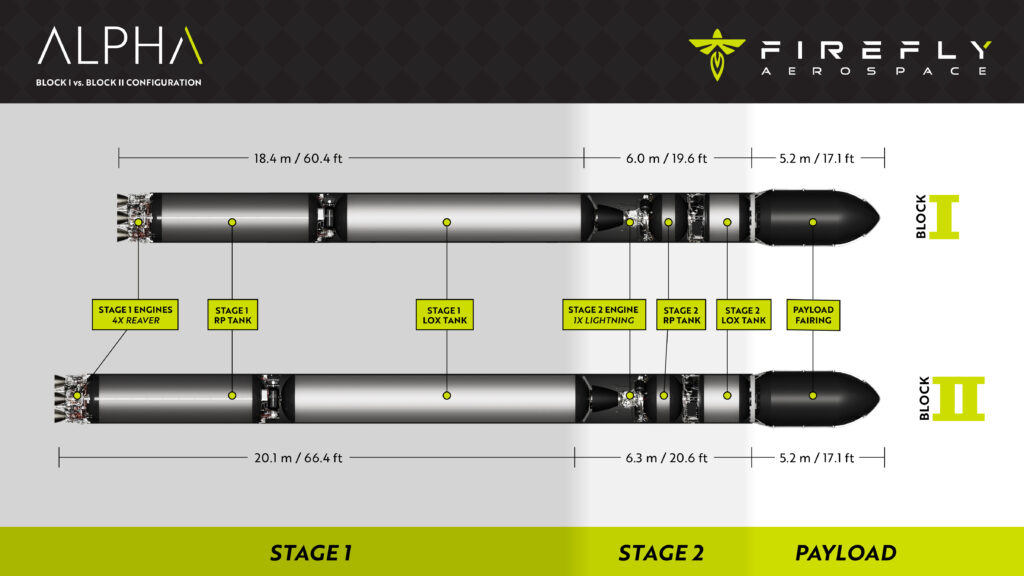
The most noticeable change in Block 2 is the increase in the rocket’s size. The length of the first stage has grown from 18.4 meters to 20.1 meters, and the second stage from 6.0 meters to 6.3 meters. The battery and avionics in Block 2 will be replaced with a consolidated system developed in-house by the company. Firefly has also modified the rocket’s fuel tanks, optimizing their configuration and improving the thermal protection system.
The company has not yet disclosed how much these changes have affected the rocket’s payload capacity. The Block 1 modification was capable of delivering 1,030 kg of cargo to low orbits and up to 630 kg to sun-synchronous orbits.
Block 2 will debut as part of the company’s eighth mission. According to Firefly, the seventh Alpha mission will take place in the “coming weeks.” The rocket will be launched from the US Air Force’s Vandenberg Air Force Base.
According to Firefly

