
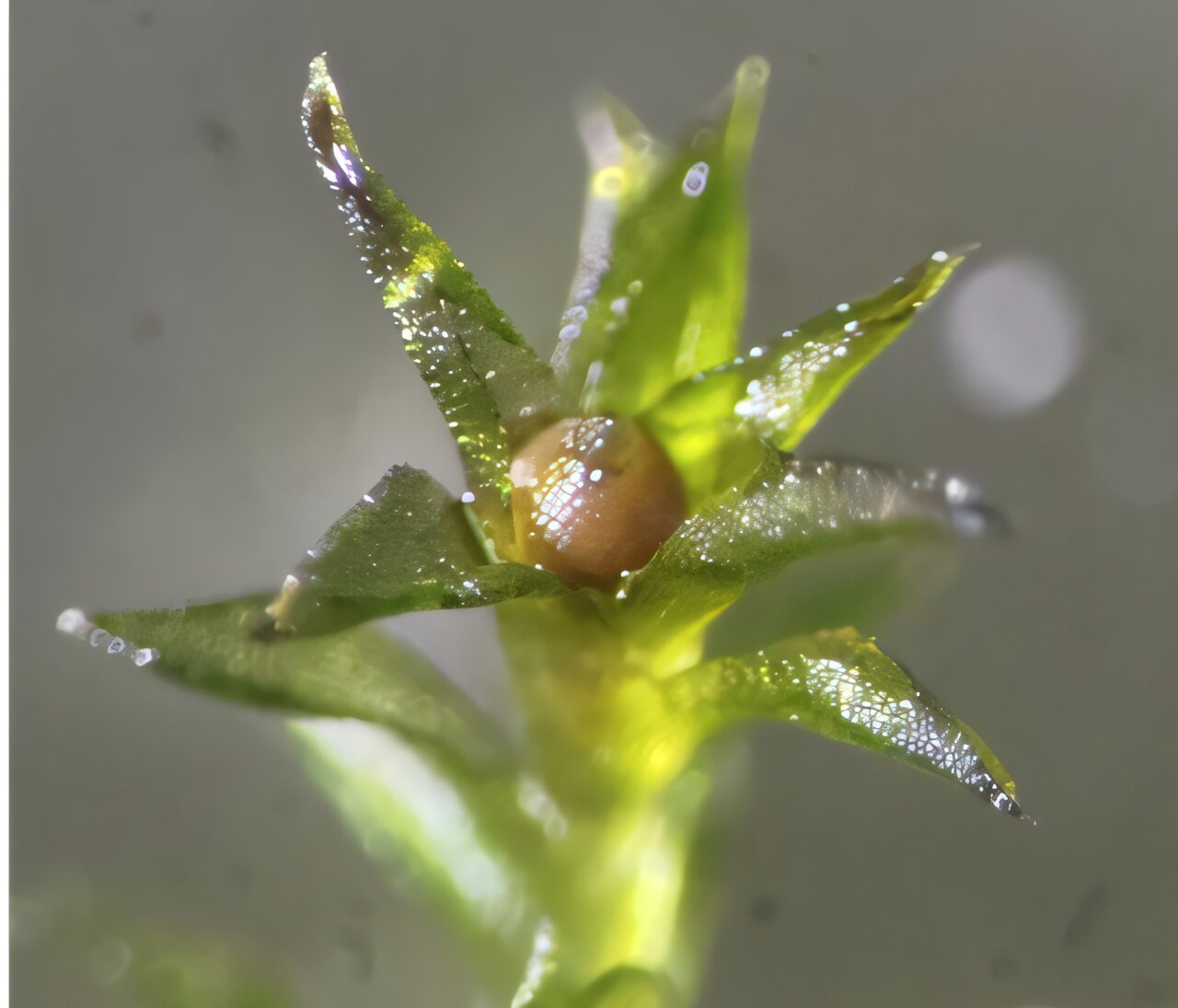
Recently, scientists have confirmed the incredible resilience of living organisms to space conditions. Moss spores, which spent nine months outside the International Space Station in a vacuum and under intense radiation, were successfully grown into full-fledged plants.
Moss survival ability
Mosses thrive in the most extreme conditions on Earth: from the peaks of the Himalayas to the sands of Death Valley, from the Antarctic tundra to the lava fields of active volcanoes. Inspired by the resilience of moss, researchers sent moss sporophytes—reproductive structures containing spores—to the most extreme environment: space.
The results of the study, published on November 20 in the journal iScience, show that more than 80% of the spores survived for nine months outside the International Space Station (ISS) and returned to Earth while retaining their ability to reproduce. This is the first time that early terrestrial plants can survive after prolonged exposure by space elements.
“Most living organisms, including humans, cannot survive even briefly in the vacuum of space,” says lead author Tomomichi Fujita of Hokkaido University. “However, the moss spores retained their vitality after nine months of direct exposure. This provides striking evidence that the life that has evolved on Earth possesses, at the cellular level, intrinsic mechanisms to endure the conditions of space.”
Simulation of space conditions
To find out whether a plant such as moss could survive in space, Fujita’s team subjected Physcomitrium patens, a well-studied moss known as spreading earth moss, to simulated space conditions, including high levels of ultraviolet radiation and extremely high and low temperatures.
They tested three different moss structures—protenemata, or young moss; brood cells, or specialized stem cells that appear under stressful conditions; and sporophytes, or encapsulated spores—to find out which ones had the best chance of surviving in space.
Researchers found that ultraviolet radiation was the most challenging element for survival, and sporophytes were the most resilient of the three parts of moss. None of the young mosses survived under high levels of ultraviolet radiation or extreme temperatures. The brood cells had a higher survival rate, but the spores in the shell showed approximately 1,000 times greater resistance to ultraviolet radiation. The spores were also able to survive and germinate after exposure to a temperature of -196°C for more than a week, as well as after being kept at a temperature of 55°C for a month.
The team suggested that the structure surrounding the spore serves as a protective barrier, absorbing ultraviolet radiation and physically and chemically protecting the inner spore from damage. Researchers note that this is likely an evolutionary adaptation that allowed bryophytes—a group of plants that includes mosses—to transition from aquatic to terrestrial plants 500 million years ago and survive several mass extinctions since then.
“Space Travel” by moss
To test whether this adaptation could make sporophytes viable in real space conditions, the team sent spores beyond the stratosphere.
In March 2022, researchers sent hundreds of sporophytes to the ISS aboard the Cygnus NG-17 spacecraft. Upon arrival, astronauts attached the sporophyte samples to the exterior of the ISS, where they remained in open space for a total of 283 days. The moss then returned to Earth aboard SpaceX CRS-16 in January 2023 and was brought back to the lab for testing.
More than 80% of the spores survived the space journey, and all but 11% of the remaining spores were able to germinate in the laboratory. The team also checked the chlorophyll levels in the spores and found normal levels for all types, except for a 20% reduction in chlorophyll a, a compound that is particularly sensitive to changes in visible light, but this change did not appear to affect the health of the spores.
“This study demonstrates the astonishing resilience of life that originated on Earth,” says Fujita.
Mathematical model of moss survival in space
Interested in how long spores could survive in space, Fujita’s team used data from before and after the moss expedition to create a mathematical model. They estimated that spores in their shells could survive up to 5,600 days — approximately 15 years — in space. However, they emphasize that this figure is only an estimate and that a larger data set is needed for more realistic predictions of how long moss could survive in space.
Researchers hope that their work will contribute to the development of research into the potential of extraterrestrial soils to promote plant growth and inspire the use of moss to develop agricultural systems in space.
“Finally, we hope that this work will open up new horizons for building ecosystems in extraterrestrial environments such as the Moon and Mars,” says Fujita. “I hope that our research on moss will serve as a starting point.”
According to phys.org

