

The mysterious “red dots” discovered by the James Webb telescope may not be intact young galaxies, as scientists believe. They could be a completely new type of object, which researchers have dubbed “black hole stars”.
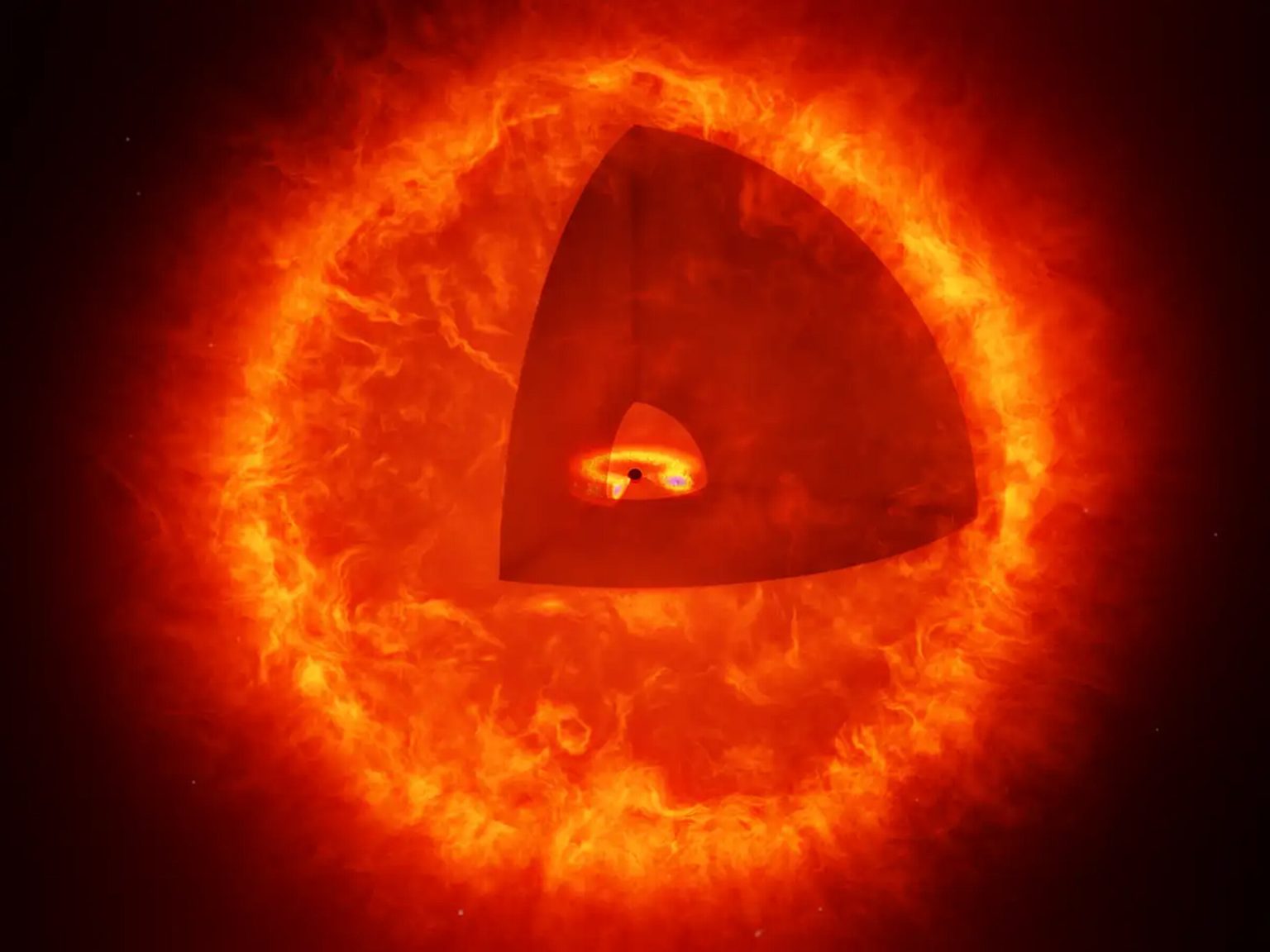
Mysterious “red dots”
Using the first datasets released by the telescope in 2022, an international team of scientists, including Penn State researchers, discovered mysterious “little red dots”. The researchers suggested the objects may be galaxies that were as mature as our current Milky Way, which is roughly 13.6 billion years old, just 500 to 700 million years after the Big Bang.
Informally dubbed “universe breakers” by the team, the objects were originally thought to be galaxies far older than anyone expected in the infant universe, calling into question what scientists previously understood about galaxy formation. Now, in a paper published in the journal Astronomy & Astrophysics, the international team of astronomers and physicists, including those at Penn State, suggests that the dots may not be galaxies but an entirely new type of object: a black hole star.
They said their analysis indicates that the tiny pinpoints of light may be giant spheres of hot gas that are so dense they look like the atmospheres of typical nuclear fusion-powered stars; however, instead of fusion, they are powered by supermassive black holes in their center that rapidly pull in matter, converting it into energy and giving off light.
Cold stars
“Basically, we looked at enough red dots until we saw one that had so much atmosphere that it couldn’t be explained as typical stars we’d expect from a galaxy,” said Joel Leja, the Dr. Keiko Miwa Ross Mid-Career Associate Professor of Astrophysics at Penn State and co-author on the paper. “It’s an elegant answer, really, because we thought it was a tiny galaxy full of many separate cold stars, but it’s actually, effectively, one gigantic, very cold star”.
Cold stars emit little light due to their low temperatures compared to normal stars, Leja explained. Most stars in the universe are low-mass, colder stars, but they are typically harder to see as they are washed out by rarer, more luminous massive stars.
Astronomers identify cold stars by their glow, which is primarily in the red optical or near-infrared spectrum, wavelengths of light that are no longer visible. While the gas around supermassive black holes is typically very hot, millions of degrees Celsius, the light from these “red dot” black holes was instead dominated by very cold gas, the researchers said, similar to the atmospheres of low-mass, cold stars, based on the wavelengths of light they were giving off.
Exploring the spectra of distant objects
From the moment the telescope turned on, researchers around the world began to spot “little red dots”, objects that appeared far more massive than galaxy models predicted.
At first, Leja said, he and his colleagues thought the objects were mature galaxies, which tend to get redder as the stars within them age. But the objects were too bright to be explained – the stars would need to be packed in the galaxies with impossible density.
To better understand the mystery, the researchers needed spectra, a type of data that could provide information about how much light the objects emitted at different wavelengths. Between January and December 2024, the astronomers used nearly 60 hours of Webb time to obtain spectra from a total of 4,500 distant galaxies. It is one of the largest spectroscopic datasets yet obtained with the telescope.
In July 2024, the team spotted an object with a spectrum that indicated a huge amount of mass, making it the most extreme case of such an early and large object. The astronomers nicknamed the object in question “The Cliff”, flagging it as the most promising test case to investigate just what those “little red dots” were.
The object was so distant that its light took roughly 11.9 billion years to reach Earth. The spectra analysis of that light indicated it was actually a supermassive black hole, pulling in its surroundings at such a rate that it cocooned itself in a fiery ball of hydrogen gas. The light that Leja and his colleagues spotted was coming not from thick clusters of stars, but from one giant object.
«Black hole stars»
Black holes are at the center of most galaxies, Leja explained. In some cases, those black holes are millions or even billions of times more massive than our solar system’s sun, pulling in nearby matter with such strength that it converts to energy and shines.
“No one’s ever really known why or where these gigantic black holes at the center of galaxies come from,” said Leja, who is also affiliated with Penn State’s Institute for Computational and Data Sciences. “These black hole stars might be the first phase of formation for the black holes that we see in galaxies today – supermassive black holes in their little infancy stage”.
He added that JWST has already found signs of high-mass black holes in the early universe. These new black hole star objects, which are essentially turbocharged mass-builders, could help explain the early evolution of the universe – and may be a welcome addition to current models. The team is planning future work to test this hypothesis by examining the density of gas and strength of these early black hole stars, Leja said.
Provided by: phys.org

