

Scientists have studied a scattering of protostars located in the constellation Ophiuchus. Such places are called stellar nurseries. A distinctive feature of this one is an excess of ultraviolet radiation, which has presented researchers with a new puzzle.
New discovery
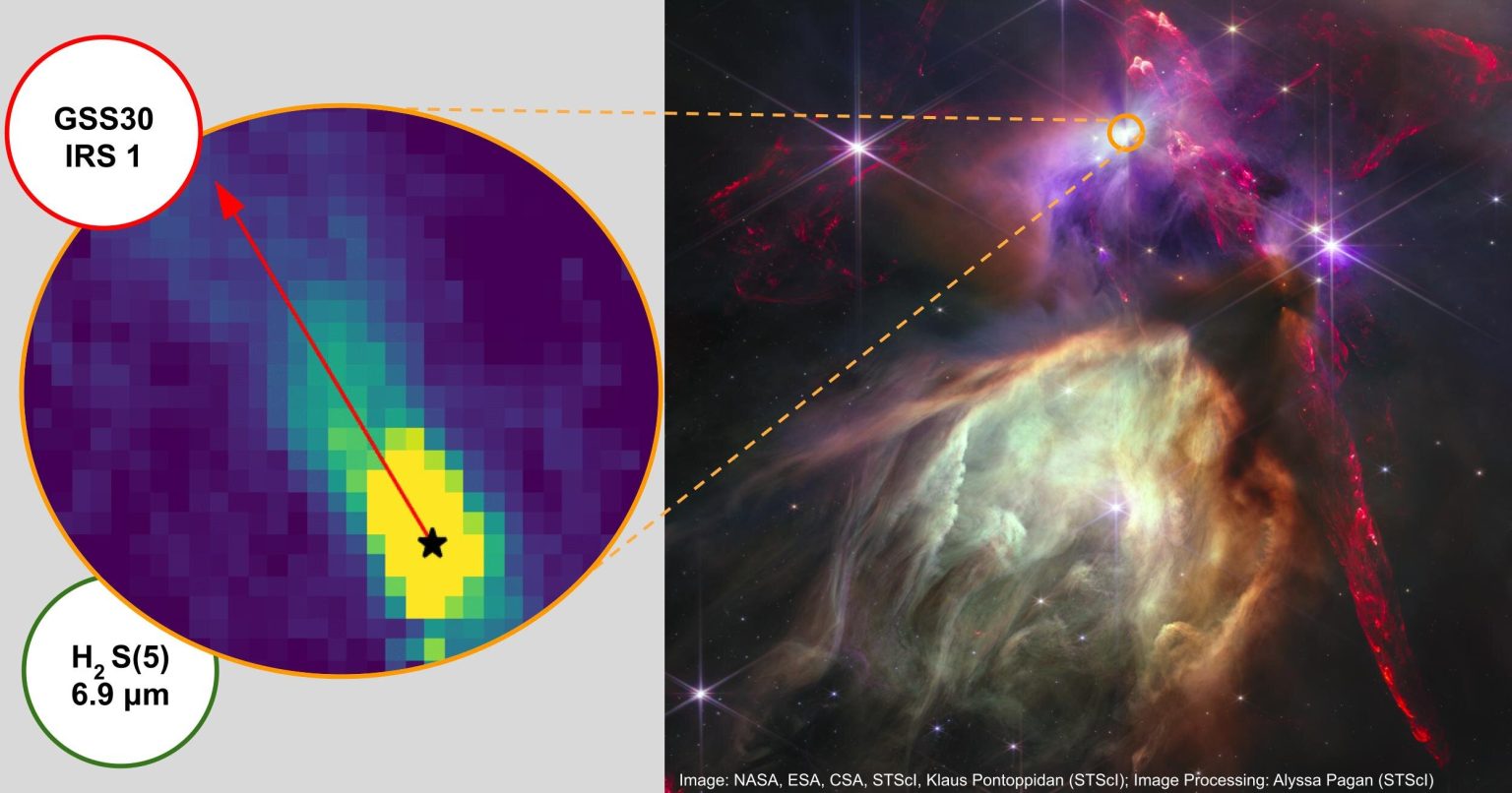
Researchers used the MIRI instrument aboard the James Webb Space Telescope to detect ultraviolet radiation in five young stars in the Ophiuchus region and to understand its role in star formation. The discovery of ultraviolet radiation around these protostars and its significant influence on the surrounding matter challenges models describing star formation.
The article was published in the journal Astronomy & Astrophysics. The research team included Iason Skretas, a graduate student at MPIfR, Dr. Agata Karska (Center for Advanced Interdisciplinary Technologies at Nicolaus Copernicus University in Toruń, Poland, and Max Planck Institute for Radio Astronomy (MPIfR), Bonn, Germany).
Study of protostars and ultraviolet radiation
During their research, scientists discovered that as protostars accumulate mass, they push part of it outward in the form of jets. These jets are called outflows and are the most vivid sign of star formation. Scientists have been able to prove that in order to understand the chemistry and physics of these molecular outflows from young stars, it is necessary to take into account the presence of ultraviolet radiation.
“This is the first surprise. Young stars are not capable of being a source of radiation; they cannot ‘produce’ radiation. Therefore, we should not expect this. However, we have proven that ultraviolet radiation occurs near protostars. Where does it come from, what is its source: internal or external?” says Agata Karska.
Observing the constellation Ophiuchus with the James Webb Telescope’s MIRI instrument
James Webb targeted young stars in the constellation Ophiuchus using MIRI, its mid-infrared instrument. Located 450 light-years away, the Ophiuchus molecular cloud contains several B-type stars, which are very young, hot, and emit strong ultraviolet radiation. Five objects located at different distances from these massive stars were selected for detailed observation.
The MIRI instrument allows astronomical objects to be observed in the wavelength range from 2 to 28 micrometers, covering several lines of molecular hydrogen (H2) that cannot be observed from Earth due to the Earth’s atmosphere. James Webb is indispensable for this type of observation, as it allows these lines to be observed even from very faint objects with high resolution.
For astronomers, H2 is the most important molecule in the Universe. First, it is the most abundant molecule, as on average there is 10,000 times more H2 than carbon monoxide, the second most abundant molecule in space.
At the same time, the structure of H2 makes it difficult to observe in molecular clouds, as the temperature is too low to excite the molecule. However, emissions from young stars create shock waves that compress and heat the material, creating bright H2 emissions. Therefore, JWST/MIRI is the ideal combination for studying leaks from protostars.
Search for a source of ultraviolet radiation
Analysis of JWST observations in the constellation Ophiuchus clearly demonstrates the presence of ultraviolet radiation near protostars and their outflows due to the effect of ultraviolet radiation on molecular hydrogen. This raises the question: where does this radiation come from? Is it related to processes occurring in the immediate vicinity of the protostar?
Scientists began with the hypothesis that ultraviolet radiation came from nearby massive stars illuminating the birthplaces of the next generation of stars. Astronomers used two methods to estimate the external ultraviolet radiation. The first was based on the properties of the surrounding stars and the distance from the observed sources. The second was based on dust, which has the ability to absorb ultraviolet radiation and re-emit it at longer wavelengths.
“Using these two methods, we showed that UV radiation—in terms of external conditions—varies significantly between our protostars, and therefore we should see differences in molecular emission. As it turns out, we don’t see them,” adds Skretas.
Thus, astronomers had to reject the hypothesis of an external source of radiation. Nevertheless, ultraviolet radiation is present in the vicinity of the protostar, as it undoubtedly affects the observed molecular lines. From this, scientists conclude that the origin of ultraviolet radiation should be internal.
Implications for future research
The results of this study indicate the need to include ultraviolet radiation formation in models describing star formation. Future analysis of JWST observations will focus not only on gas but also on dust and ice reservoirs, offering alternative ways to constrain the origin of ultraviolet radiation around protostars.
Increasing the number of monitored sources, including observations covering the entire volume of sources, will be a decisive step in establishing stricter limits on ultraviolet formation sites.
According to phys.org

