

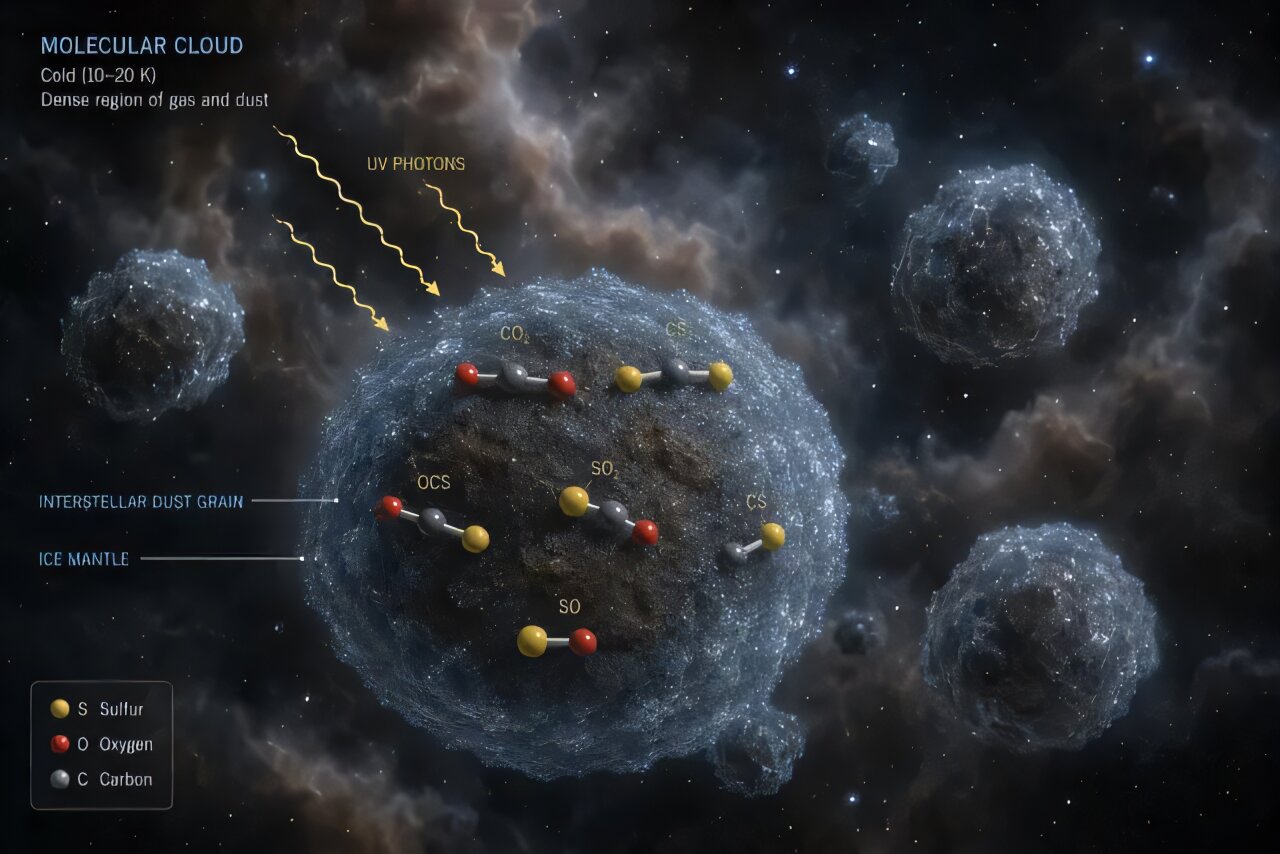
In dense, cold molecular clouds where stars form, approximately 99% of the expected sulfur is not detected during observations. Scientists suspect that it is hidden within icy dust grains, but verifying this is difficult. A new computer model has, for the first time, replicated a laboratory experiment with sulfur under interstellar ice conditions and helped test the current understanding of how sulfur behaves in interstellar ice.
Hidden in the ice
Researchers from the Max Planck Institute for Extraterrestrial Physics and the Center for Astrobiology (Spain) have modeled the behavior of sulfur in interstellar ice using the pyRate software. This is the first successful model of the chemistry of a multicomponent analogue of interstellar ice constructed using the method of rate differential equations.
The model replicated a specific laboratory experiment conducted in 2024. A mixture of carbon dioxide and carbon disulfide was cooled to 10 kelvins (minus 263 degrees Celsius) and irradiated with vacuum ultraviolet photons. The radiation broke down the molecules and generated new sulfur-containing compounds, including sulfur dioxide, carbonyl sulfide, and chain-like allotropes of pure sulfur.
The model replicated a specific laboratory experiment conducted in 2024. A mixture of carbon dioxide and carbon disulfide was cooled to 10 kelvins (minus 263 degrees Celsius) and irradiated with vacuum ultraviolet photons. The radiation broke down the molecules and generated new sulfur-containing compounds, including sulfur dioxide, carbonyl sulfide, and chain-like allotropes of pure sulfur.
Motion of molecules in ice
The simulation revealed an important detail about how molecules interact under these conditions. Astrochemists typically assume that molecules drift across the surface via thermal diffusion until they collide with one another. However, when the model relied solely on this mechanism, the reaction came to a halt.
Under normal conditions, molecules move slowly across the surface of the ice and react only after a random collision. At a temperature of 10 kelvins, such motion is virtually nonexistent, so normal diffusion ceases. In non-diffusive chemistry, аtoms can interact with their neighbors immediately after being separated from the molecule.
Penetration depth of photons
Another finding was a more precise determination of how deeply a vacuum ultraviolet photon can penetrate ice structures. The simulation showed that the limit is approximately 100 individual layers of ice molecules. Previously, there had been ongoing debate among scientists regarding this figure.
The data obtained can now be incorporated into future versions of astrochemical software. This will enable more accurate modeling of chemical processes in interstellar ice during future studies.
Between the model and reality
However, discrepancies emerged between the simulation and the actual experiment conducted in 2024. The model predicted a completely different set of compounds than those that actually formed, and in different proportions. This suggests that our current understanding of chemical reactions in interstellar ice is still incomplete.
A more detailed analysis of the infrared spectra explained some of the discrepancies. The chemical signatures of sulfur monoxide and carbon monosulfide coincided with the spectrum of sulfur dioxide and were most likely masked by it during the initial analysis.
Next steps
The results obtained will make it possible to refine pyRate so that the model more accurately reflects laboratory measurements. At the same time, new data on photon penetration depth and the role of non-diffusive chemistry could influence the planning of future observational campaigns using the James Webb Space Telescope.
The study also showed that some of the sulfur that disappears during the experiment does not give clear spectral characteristics and is therefore difficult to detect using modern observational methods.This mechanism may also explain the absence of sulfur in observations of real molecular clouds.
Sulfur plays a role in prebiotic chemistry—the processes that precede the emergence of life—and is considered an essential element for biological systems. Therefore, understanding the distribution of sulfur in molecular clouds is also important for determining whether future planets are suitable for life.
According to phys.org

