

The solar wind constantly bombards Earth’s magnetic shield, but scientists still don’t understand what exactly causes plasma to transition between calm and chaotic states. NASA is inviting anyone interested to help analyze real scientific data as part of a new volunteer project called Shock Detectives.
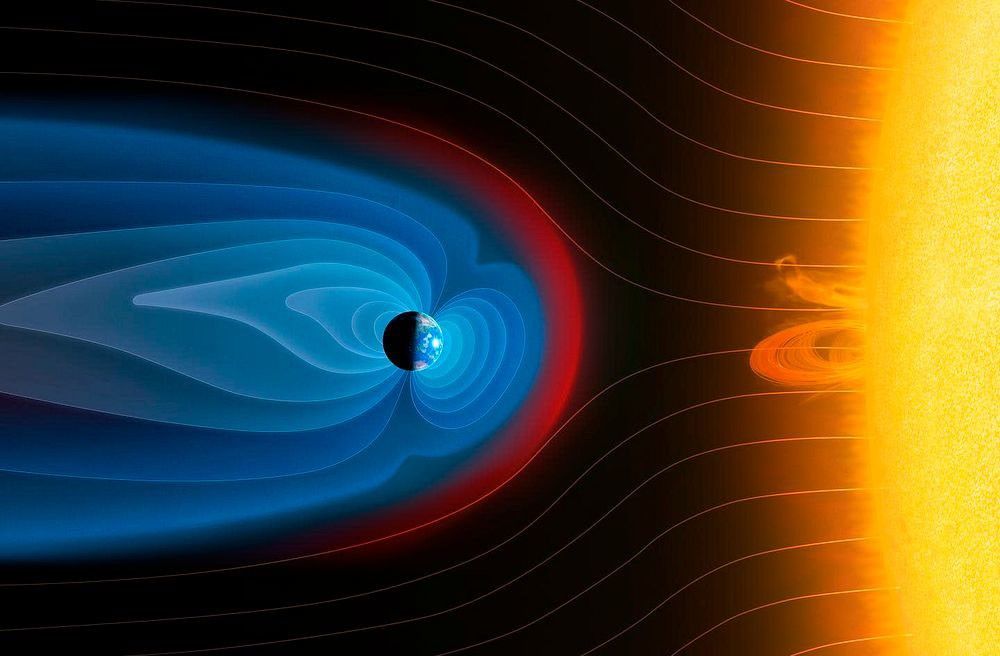
Where a shock wave originates
About 90,000 kilometers in front of Earth, on the side facing the Sun, the solar wind—a stream of charged particles—collides with our planet’s magnetic field. The collision generates a shock wave that extends for hundreds of thousands of kilometers.
At this boundary, the magnetic field is constantly changing, and the solar wind plasma behaves in different ways. Sometimes it becomes chaotic and turbulent; other times, it remains calm and stable. This determines how much energy penetrates Earth’s magnetosphere.
Why is this important?
When chaotic plasma predominates, energy flows more actively into the magnetosphere. This can cause disruptions to GPS, communication systems, and power grids.
Scientists do not yet understand what determines the transition between stable and chaotic states, or exactly how these changes affect the transfer of energy to Earth. This is precisely what the project is investigating.
Data from ten years
NASA’s MMS (Magnetospheric Multiscale) mission has been collecting data from this region for over a decade. The volume of data collected is so vast that scientists cannot keep up with analyzing it on their own.
Volunteers for the Shock Detectives project will sort data sets by plasma type—chaotic or calm. These classifications will serve as the basis for further scientific analysis.
The Shock Detectives project is inviting volunteers to classify data from NASA’s MMS mission regarding shock waves. No experience is necessary—just a desire to analyze real scientific data.
Connection to other projects
Shock Detectives is closely linked to another NASA volunteer project—Space Umbrella—which also uses MMS data. Space Umbrella studies the broad boundary between Earth’s magnetic shield and the solar wind, while Shock Detectives focuses on the transition zone immediately beyond that boundary. It is up to 17 kilometers thick.
Together, these two projects provide a more complete picture of near-Earth space. They are part of more than 40 NASA volunteer initiatives that invite people to search for comets, study exoplanets, and observe the aurora.
You can join the initiative by clicking here: zooniverse.org
According to science.nasa.gov

