

NASA officials have announced that the number of lunar landing sites under consideration for the Artemis IV mission has been narrowed down to nine. All of them are located near the Moon’s south pole, close to areas where water ice may be present.
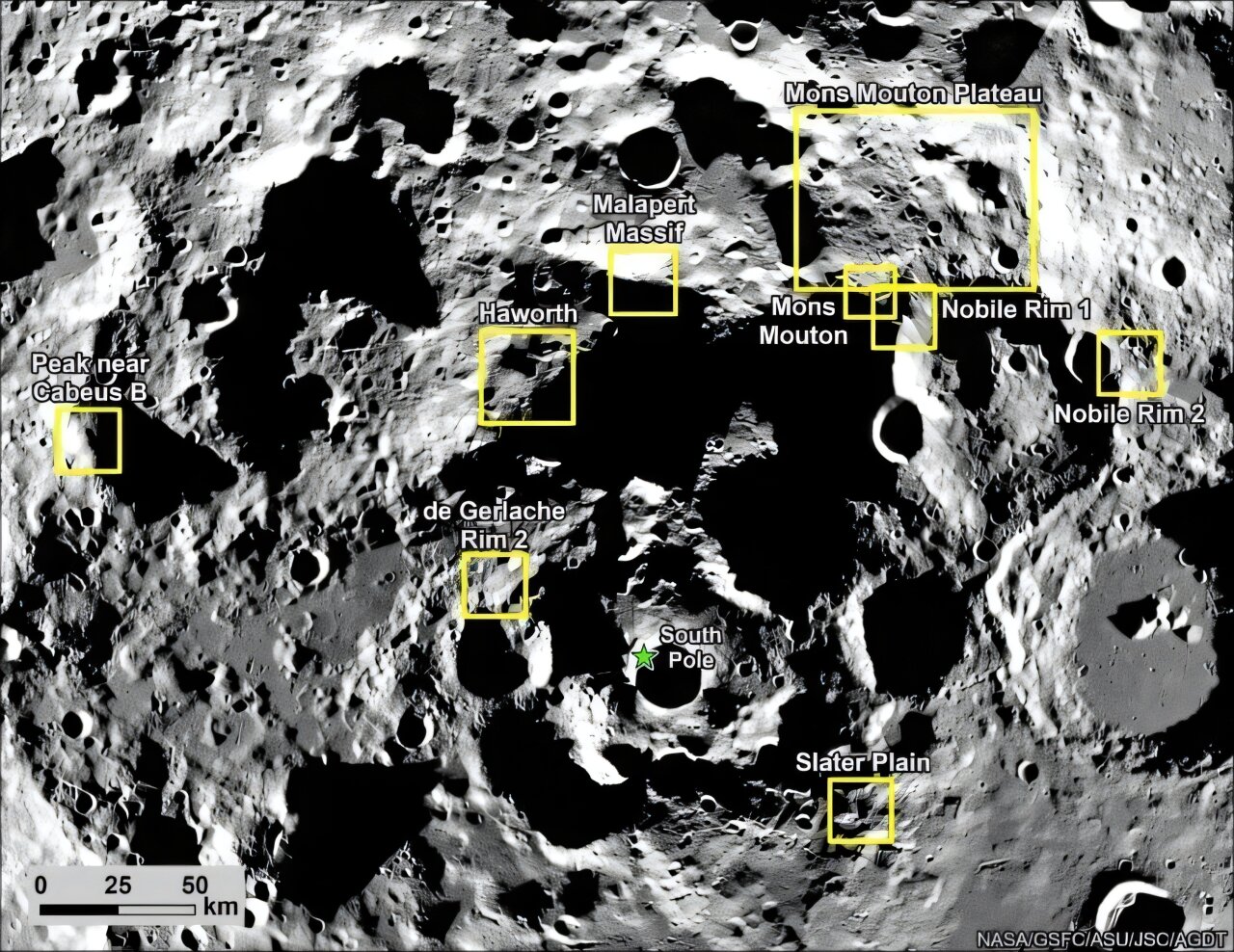
Landing site for the lunar mission
On the eve of the Artemis-2 mission, NASA experts turned their attention to the aftermath. This refers specifically to choosing the location where humans will set foot on the Moon again for the first time since the 1970s. Experts are still working on this issue and making progress.
Actually, the possibility of the landing in the South Pole region has been known for quite some time. A couple of years ago, scientists identified 13 potential sites from which a selection would be made. However, a lot has changed since then. The Artemis program went through a difficult period when it was, in fact, on the verge of being shut down. Subsequently, significant changes were made to the mission: the third mission was reassigned to the Earth-orbit rendezvous program, and the lunar landing was postponed to the fourth mission.
According to current plans, the moon landing is scheduled for 2028. And, in fact, there isn’t much time left. Everyone is already waiting for the engineers to finally figure out where the module carrying the astronauts will land.
9 sites
However, even in the new statement issued during the 57th Conference on Earth and Moon Sciences, there was still no definitive answer as to where exactly Artemis-4 would land. Nevertheless, the scientists have narrowed the selection down to nine sites, which is a significant step forward.
In fact, the choice is not at all obvious. The reason for landing specifically at the South Pole is the presence of permanently shadowed craters there. The sun never reaches the bottom of these craters because the angle of the Moon’s axis of rotation relative to the plane of the ecliptic is much greater than that of the Earth. Therefore, the rays of our sun in these regions are directed almost parallel to the surface.
The presence of permanently shadowed areas suggests the possible existence of water ice, which is essential for the operation of a lunar base. At the same time, no other special conditions are required—all you need is a flat area near the crater. For this reason, scientists are considering all possible options and are not rushing to make a final decision.
According to phys.org

