

During the official presentation of the crew for the third Artemis mission, the agency also announced significant changes to the program. An updated mission plan, a new orbital profile for Artemis IV, and a scientific research program were unveiled. NASA confirmed that the program is on track despite the incident involving Blue Origin.
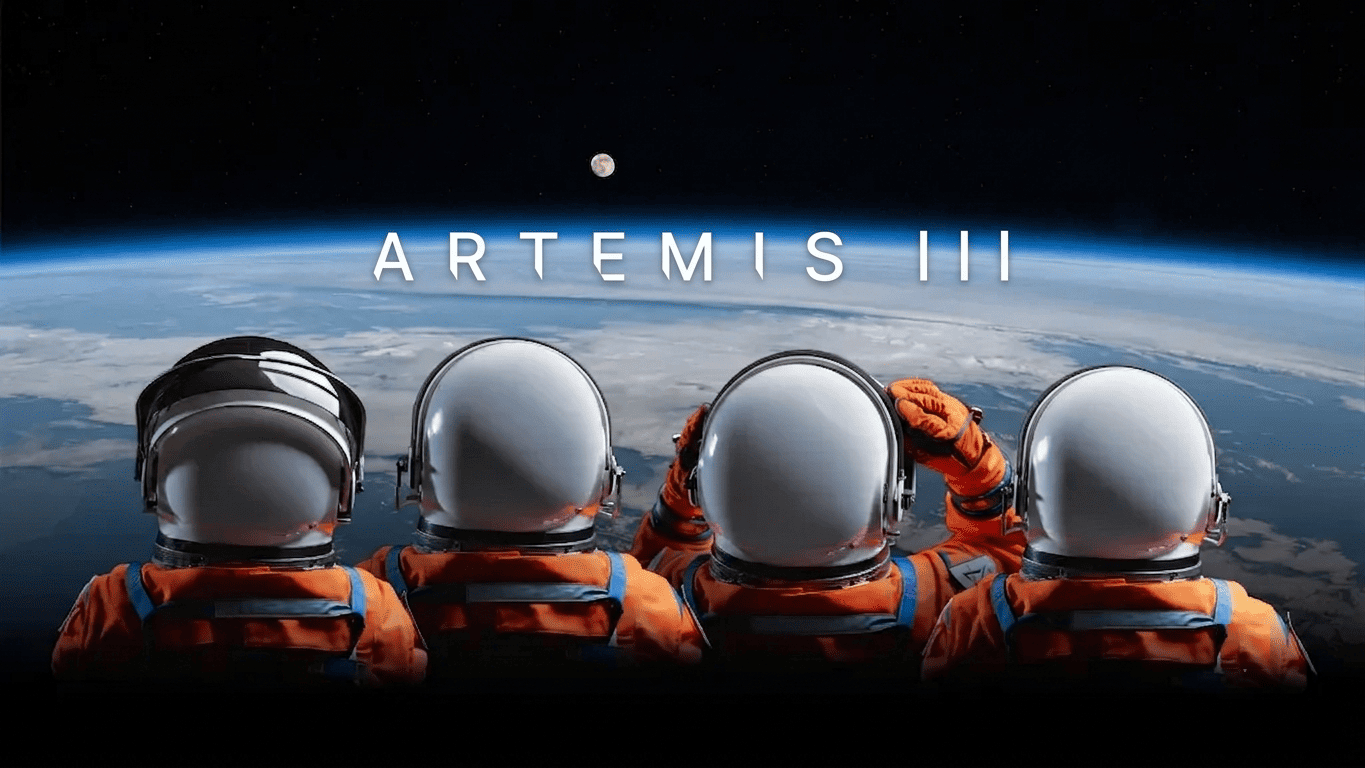
Crew and ESA’s first astronaut
Randy Bresnik has been appointed commander; this will be his third flight. The mission will also be carried out by specialists Frank Rubio and Andre Douglas, with Bob Hines serving as the backup crew member.
The first pilot in the history of the Artemis program will be Luca Parmitano, an Italian astronaut with the European Space Agency.
Earth orbit
Artemis III is no longer a lunar landing mission. The crew will head to Earth orbit in 2027 to test prototype versions of commercial lunar landers from Blue Origin and SpaceX.
First, Orion will perform a rendezvous and docking maneuver with the Blue Origin spacecraft. The astronauts will enter the lander through the docking hatch and spend about two days checking the propulsion, life support, and communications systems.
After that, the spacecraft will dock with SpaceX’s Starship and remain docked for about 24 hours. Orion will then return to Earth, splashing down in the Pacific Ocean. The total duration of the mission will be about two weeks.
Blue Origin Incident
A serious incident occurred at the Blue Origin launch site on May 28. NASA has actively joined the investigation and recovery efforts, providing the company with access to its experts and testing facilities.
Blue Origin has confirmed that the lander for Artemis III will be ready for launch in 2027. Meanwhile, construction work is continuing at Launch Complex 36B. NASA has emphasized that it views the incident as a learning opportunity and remains confident in its partner’s readiness.
New plan for Artemis IV
SpaceX representatives have announced a change to the orbital plan for Artemis IV. Under the updated plan, Starship will dock with Orion in low Earth orbit, then perform an inter-lunar transfer and deliver the crew to low lunar orbit prior to landing.
This approach reduces the amount of fuel that needs to be assembled in space and improves crew safety. The critical docking will now take place near Earth rather than near the Moon, providing more opportunities to abort the mission in the event of an emergency.
New technologies
Orion will be equipped with an upgraded docking system, which will make its debut on Artemis III, and an optical communication link for data exchange between the spacecraft and ground control. Among other things, this is expected to improve the quality of public broadcasts during the mission.
Assembly of the SLS rocket will begin this summer in the Vehicle Assembly Building (VAB) at Kennedy Space Center. A full-fuel dress rehearsal is scheduled for later this year.
Earth Science from Orbit
Artemis III will be the program’s first mission focused on Earth observation. NASA’s Associate Administrator for Science, Niki Fox, said that the crew would conduct systematic observations of Earth’s atmosphere, solar activity, and the environment around the Orion capsule during the flight.
Data on how atmospheric drag slows Orion down at different altitudes will make it possible to assess the state of the atmosphere based on the level of solar activity.
A separate task will be to determine the capsule’s chemical composition. Upon returning from Orion, samples will be collected to later distinguish the capsule’s own traces from the lunar material that the Artemis IV crew will bring back from the surface.
For the first time, ground-based observations of Orion will also be conducted, something that was not possible during Artemis II due to the spacecraft’s brief time in low Earth orbit.
Artemis IV and the Moon in 2028
Artemis III serves as direct preparation for the first crewed lunar landing under Artemis IV, which is scheduled for 2028.
Successful in-orbit rendezvous and docking, testing of commercial spacecraft, and the scientific data collected will demonstrate the systems’ readiness for a full-scale lunar expedition.
According to nasa.gov, youtube/nasa

