

The first manned mission to the Moon in 50 years may indeed launch into space on February 6. At least, according to NASA’s announced plans to roll out the SLS rocket to the launch pad on January 17. Final pre-launch tests will begin there.
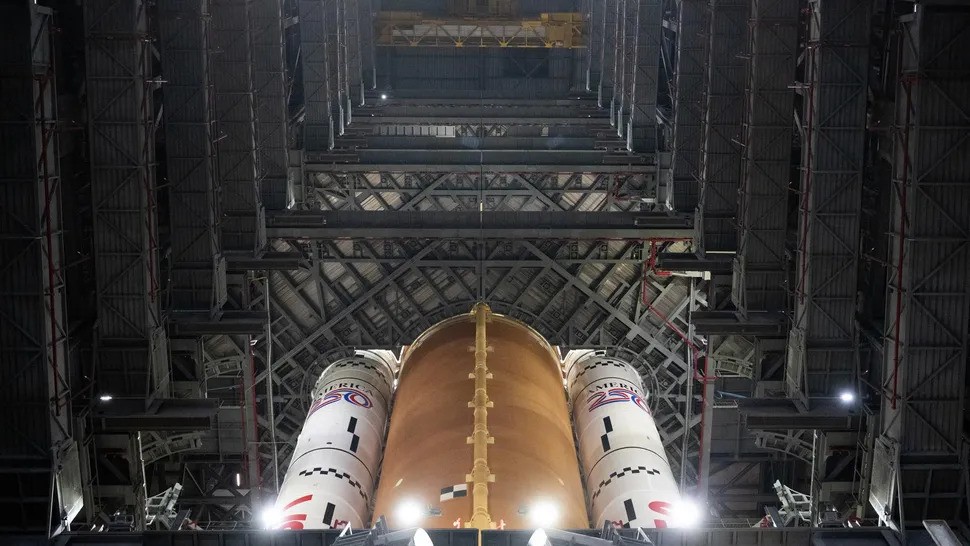
Transportation of the rocket
On Friday evening (January 9), NASA announced that it plans to move the Space Launch System (SLS) rocket and Orion spacecraft, which will fly on the Artemis 2 lunar mission, to the launch pad for pre-flight checks on January 17, weather permitting and subject to technical readiness.
The Crawler-Transporter 2, a specialized vehicle, will transport the SLS-Orion from the Vehicle Assembly Building (VAB) at the Kennedy Space Center in Florida to launch pad 39B, a distance of 4 miles (6.4 km), which could take up to 12 hours.
“We are moving closer to Artemis 2, with rollout just around the corner,” said Lori Glaze, acting deputy administrator of NASA’s Exploration Systems Development Mission Directorate, in a statement on Friday.
Artemis 2 mission objective
Artemis 2 will send four astronauts — Reid Wiseman, Victor Glover, and Christina Koch from NASA, and Jeremy Hansen from the Canadian Space Agency — on a 10-day journey around the Moon and back to Earth.
Although it will not land on it or enter orbit around Earth’s closest neighbor, Artemis 2 will be humanity’s first trip to lunar territory since Apollo 17 in December 1972.
Rocket test
Once the Artemis 2 complex arrives at launch pad 39B, technicians will subject the rocket and capsule to a variety of tests and checks. One of the most important is the fueling test, known as the “wet dress rehearsal.”
“During wet rehearsals, teams demonstrate their ability to fill the rocket with more than 700,000 gallons [2.65 million liters] of cryogenic fuel, count down to launch, and safely remove fuel from the rocket without astronauts on board,” NASA representatives said in a statement.
Such tests do not always go smoothly. For example, during a wet dress rehearsal for the Artemis 1 mission, liquid hydrogen leaks were discovered, requiring several returns to the VAB to fix the problem.
Once Artemis 2 wet dress rehearsals are complete, mission team members will conduct a flight readiness review that will assess the status of all systems necessary for a successful launch and mission around the Moon. Following the review, the team will announce the official target launch date.
Possible launch date
This date will fall between February 6 and April 10. But there are only 15 potential launch dates in this two-month window, NASA explained in a statement on Friday. The organization is dividing the Artemis 2 launch window into three periods, each with a limited set of possible launch dates.
- Launch period January 31 – February 14: launch opportunities on February 6, 7, 8, 10, and 11
- Launch period February 28 – March 1: launch opportunities on March 6, 7, 8, 9, and 11
- Launch period March 27–April 10: launch opportunities on April 1, 3, 4, 5, and 6
In addition to launch opportunities determined by orbital mechanics and performance requirements, there are also restrictions on which days within the launch window may be suitable. These depend on resupply, weather conditions, and the schedule of other users of the Eastern Launch Complex. In general, up to four launch attempts can usually be made within a launch window of approximately one week.
According to www.space.com

