

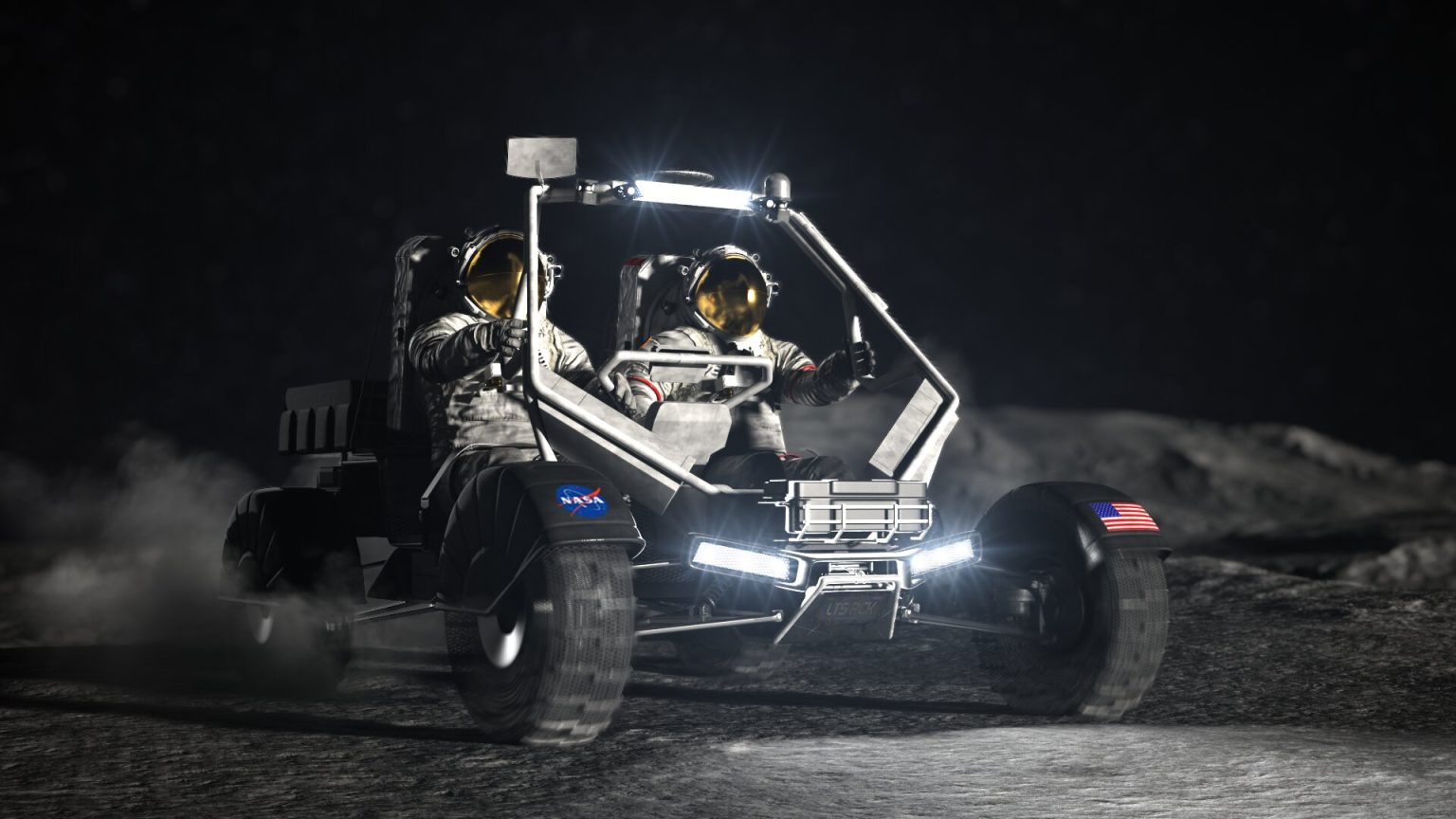
LTV is a vehicle that NASA is developing for the Artemis lunar program. Recently, scientists selected three devices that will be used for lunar expeditions. Two of them will be installed on this futuristic vehicle.
Instruments for LTV
NASA has selected three instruments for the Moon mission, two of which are planned to be integrated into the LTV (Lunar Terrain Vehicle), and one to be used in future orbital missions.
LTV is part of NASA’s efforts to explore the surface of the Moon as part of the Artemis campaign and is the first crewed vehicle to be operated on the Moon in the last 50 years. This ground vehicle, designed for two astronauts and capable of operating remotely without a crew, will enable NASA to achieve more of its scientific and research goals across the vast expanse of the lunar surface.
Combining the best achievements of human and robotic research, the scientific instruments selected for LTV will make discoveries that will provide us with information about Earth’s closest neighbor, as well as contribute to the health and safety of our astronauts and spacecraft on the Moon.
Three spectrometers for the Artemis mission
The Artemis Infrared Reflection and Emission Spectrometer (AIRES) will identify, quantify, and map minerals and volatile substances on the Moon that easily evaporate, such as water, ammonia, or carbon dioxide. The instrument will collect spectral data superimposed on visible light images of both specific objects of interest and wide panoramas to reveal the distribution of minerals and volatiles in the southern polar region of the Moon.
The Lunar Microwave Active-Passive Spectrometer (L-MAPS) will help determine what lies beneath the Moon’s surface and search for possible locations of ice. This device, which contains both a spectrometer and ground-penetrating radar, will measure temperature, density, and underground structures at depths of more than 131 feet (40 meters) below the surface.
When combined, the data from these two instruments will provide insight into the composition of the Moon’s surface and interior, which will aid in human exploration of the Moon and reveal the secrets of the history of the rocky worlds of our Solar System. The instruments will also help scientists characterize the Moon’s resources, including its composition, possible locations of ice, and changes in the Moon over time.
In addition to the instruments selected for integration into LTV, NASA has also selected the Ultra-Compact Imaging Spectrometer for the Moon (UCIS-Moon) for future orbital flight. This instrument will provide regional context for discoveries made with LTV. From the height, UCIS-Moon will map the geology and volatiles of the Moon and measure how human activity affects these volatiles. The spectrometer will also help identify scientifically valuable areas for astronauts to collect lunar samples, and its wide-angle images will provide general context for where those samples will be collected. The UCIS-Moon instrument will provide data with the highest spatial resolution on surface water on the Moon, mineral composition, and thermophysical properties.
Thanks to the instruments listed above, scientists will be able to characterize the surface not only in areas where astronauts work, but also in the southern polar region of the Moon, paving the way for exciting opportunities for scientific discoveries and research for many years to come.
The correct design option
Before selecting these vehicles, NASA collaborated with all three lunar vehicle suppliers — Intuitive Machines, Lunar Outpost, and Venturi Astrolab — to complete a preliminary review of their designs. This review demonstrates that the initial design of each commercial lunar rover meets all NASA system requirements and shows that the correct design options have been selected, interfaces have been defined, and verification methods have been described.
NASA will evaluate task proposals received from each LTV supplier and make a decision on the selection of a demonstration mission by the end of 2025.
According to phys.org

