

Scientists have studied the source of X-ray waves from the rare pulsar J1023, which appears to switch between active and passive states. A space telescope helped them in their research.
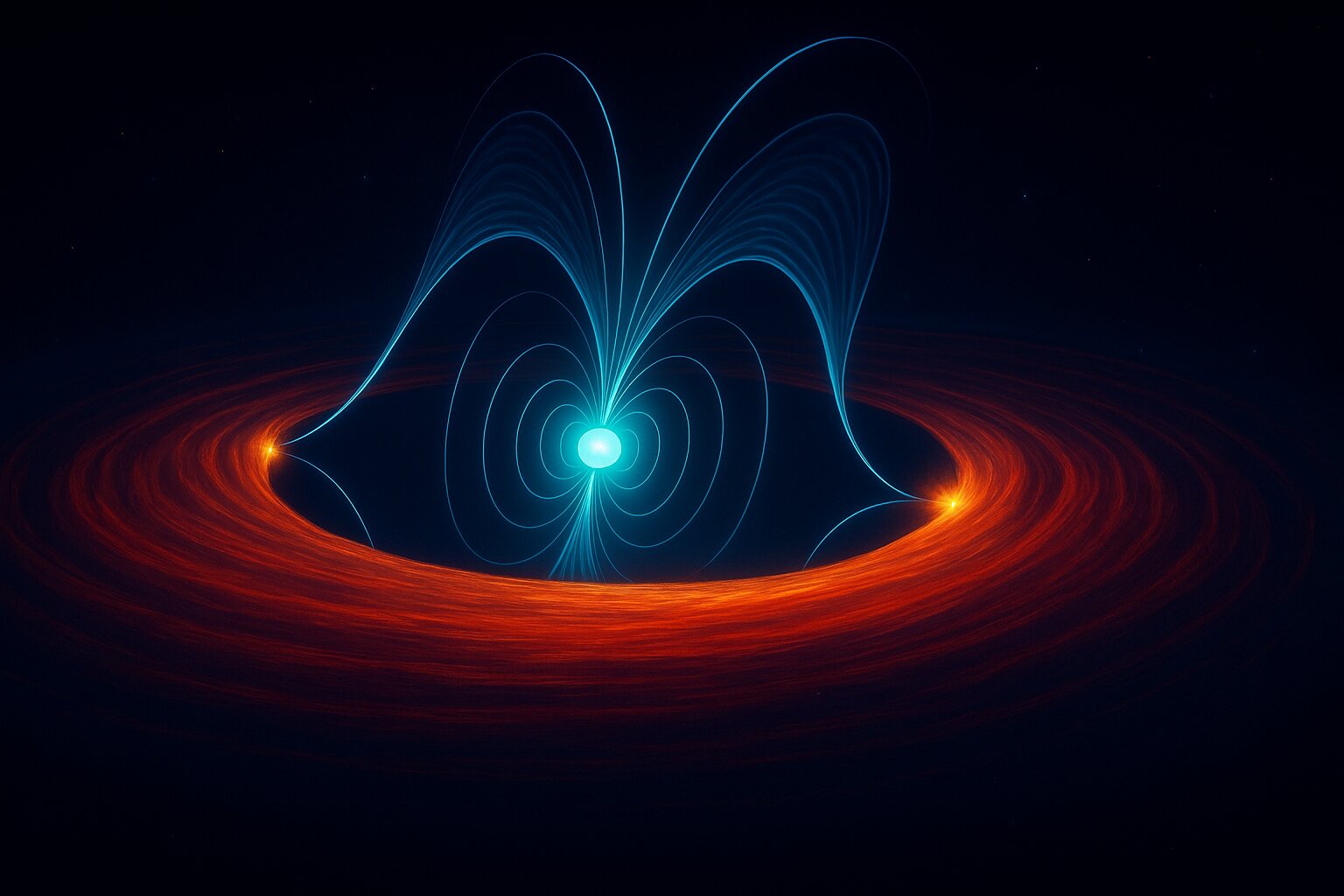
Mysterious pulsar J1023
An international team of astronomers has discovered new evidence explaining how pulsating remnants of exploded stars interact with surrounding matter in the depths of space, using observations from NASA’s IXPE (Imaging X-ray Polarimetry Explorer) and other telescopes.
Scientists from the US, Italy, and Spain have focused their attention on a mysterious cosmic pair called PSR J1023+0038, or simply J1023. This system consists of a neutron star that rotates rapidly and feeds on material from its low-mass companion star. The latter created an accretion disk around the neutron star. In addition, the neutron star is a pulsar — it emits powerful double beams of light from its magnetic poles, rotating like a lighthouse.
The J1023 system is rare and valuable for research because the pulsar clearly transitions between an active state, in which it feeds on its companion star, and a quieter state, when it emits pulsations that manifest as radio waves. This makes it a “transient millisecond pulsar.”
Source of X-rays
The main question that interested scientists about this pulsar system was: where do the X-rays come from? The answer to this question could provide grounds for broader theories about particle acceleration, accretion physics, and the environment surrounding neutron stars in the universe.
It turned out that the source of X-ray radiation is pulsar wind — a chaotic mixture of gas, shock waves, magnetic fields, and particles accelerated to nearly the speed of light. This stream collides with the accretion disk, causing radiation in the X-ray range.
Polarization angle measurement
To determine this, astronomers had to measure the polarization angle in both X-ray and optical light. Polarization is a measure of the orderliness of light waves. They studied the polarization of X-rays using IXPE, the only telescope capable of performing such measurements in space, and compared it with the optical polarization obtained using the Very Large Telescope of the European Southern Observatory in Chile. IXPE was launched in December 2021, and it’s done a lot of pulsar observations, but J1023 was the first system of its kind that it studied.
NICER (Neutron star Interior Composition Explorer) and NASA’s Neil Gehrels Swift Observatory provided valuable observations of the system in high-energy light. Other telescopes that provided data included Karl G. Jansky Very Large Array in Magdalena, New Mexico.
Result: Scientists discovered the same polarization angle for different wavelengths.
New data
This interpretation calls into question the conventional opinion about the radiation of neutron stars in binary systems, the researchers note. Previous models indicated that X-ray radiation originates from the accretion disk, but this new study shows that it comes from the pulsar wind.
“IXPE has observed many isolated pulsars and found that the pulsar wind powers the X-rays,” said NASA astrophysicist Philip Kaaret, IXPE principal investigator at NASA’s Marshall Space Flight Center in Huntsville, Alabama. “These new observations show that the pulsar wind powers most of the energy output of the system.”
Astronomers continue to study transitional millisecond pulsars, assessing how the observed physical mechanisms compare with those of other pulsars and pulsar wind nebulae. Scientists agree that the conclusions drawn from these observations could help improve theoretical models describing how pulsar winds generate radiation and bring researchers one step closer to fully understanding the physical mechanisms at work in these unusual cosmic systems.
According to phys.org

