

The nearly complete Roman Space Telescope has taken another important step toward launch. It has passed important tests confirming its readiness to go into space.
Purpose of the Roman telescope
Roman is NASA’s new flagship telescope. It is equipped with a 2.4-meter mirror, similar to the one installed on the Hubble telescope. This will allow it to obtain images with similar detail. At the same time, Roman will have a field of view 100 times larger.
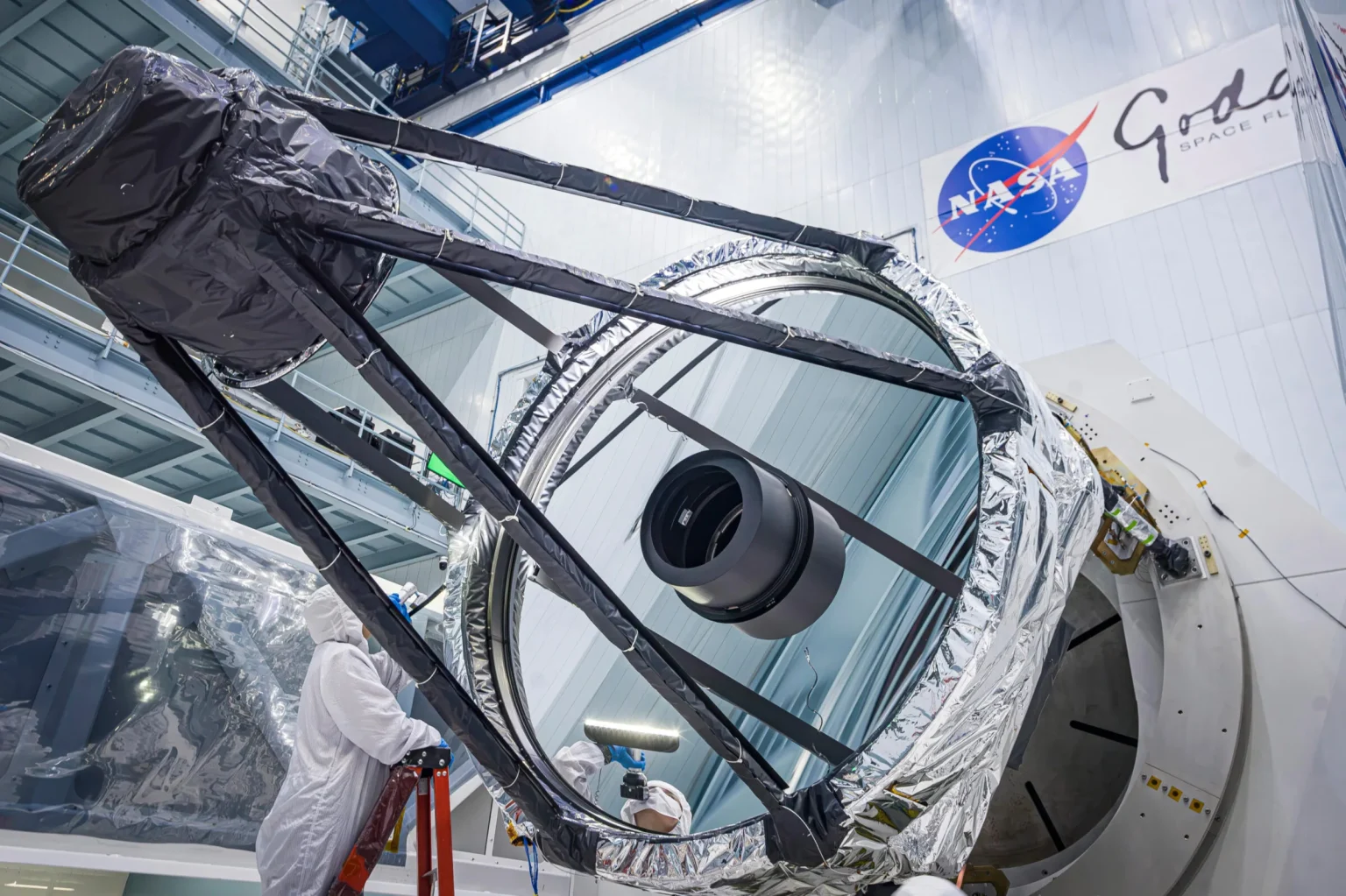
Roman’s main task is to study large-scale structures in the Universe, investigate the influence of dark matter on galaxies, and search for supernovae and gravitational lenses. The telescope will conduct observations in the near-infrared range. This will allow it to find bodies hidden in dense clouds of interstellar dust, as well as observe extremely distant objects whose radiation has shifted into the infrared region of the spectrum.
The new telescope is also planned to be used for searching for and photographing exoplanets. For this purpose, it has been equipped with a coronagraph with a diameter of 1.7 meters. It is equipped with a complex set of masks and active mirrors that will eclipse stars.
Roman Telescope Tests
The Roman telescope consists of an outer and inner section. The outer section is a shell designed to maintain a stable temperature and protect the scientific equipment from scattered light. It is 5 meters high and 4 meters wide.
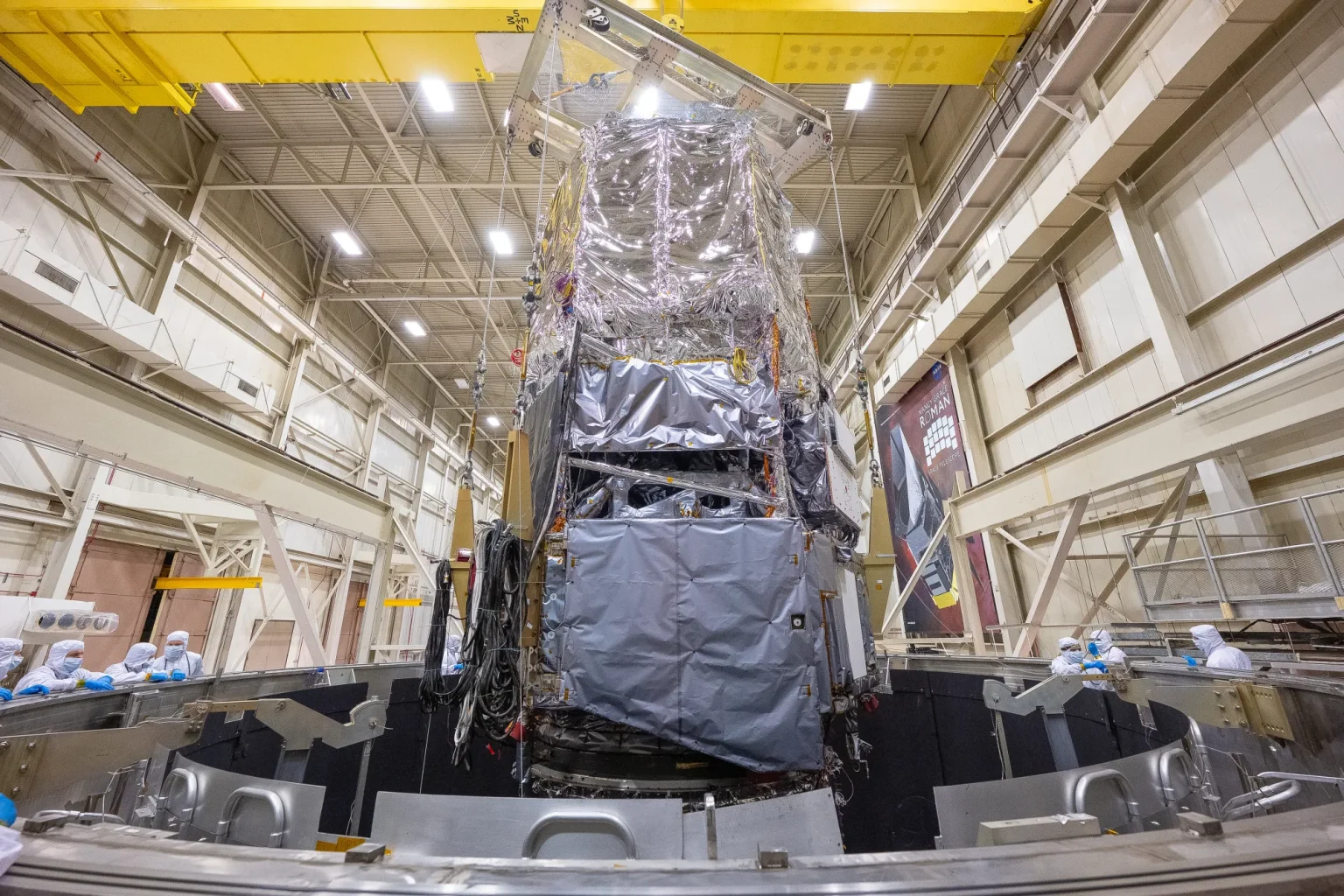
In the autumn, NASA engineers subjected the exterior of Roman to acoustic and vibration tests simulating the conditions that will occur during its launch. During the acoustic tests, a large chamber with giant horns mimicked the rumbling sounds of launch, which cause high-frequency vibrations. During the tests, operators raised the sound volume to 138 decibels, which was maintained for one minute.
After being moved to a massive vibration table, the Roman’s outer shell underwent a series of tests that reproduced the low-frequency vibrations that occur when a rocket is launched. Each individual test lasts only about a minute, covering a range from 5 to 50 hertz (the lowest note on a piano vibrates at 27.5 hertz), but NASA engineers tested three axes of motion over several weeks, breaking the tests down into stages with on-site data analysis.
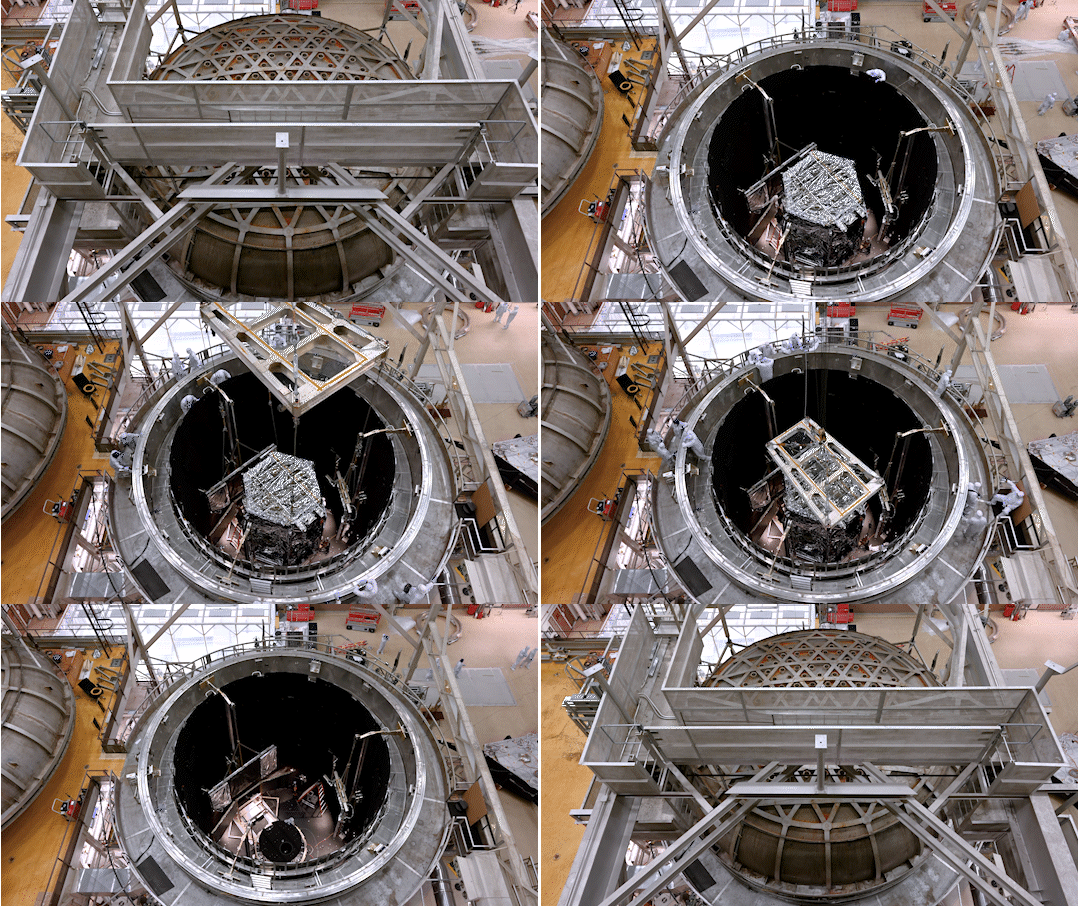
In turn, the interior of the observatory underwent a rigorous 65-day thermal vacuum test. It showed that Roman’s systems and scientific instruments will function normally in space.
NASA engineers plan to connect the two main parts of Roman in the near future. After final testing, the telescope will be delivered to the Kennedy Space Center. Roman’s launch is still scheduled for May 2027, but the team is aiming to launch it as early as autumn 2026.
According to NASA

