

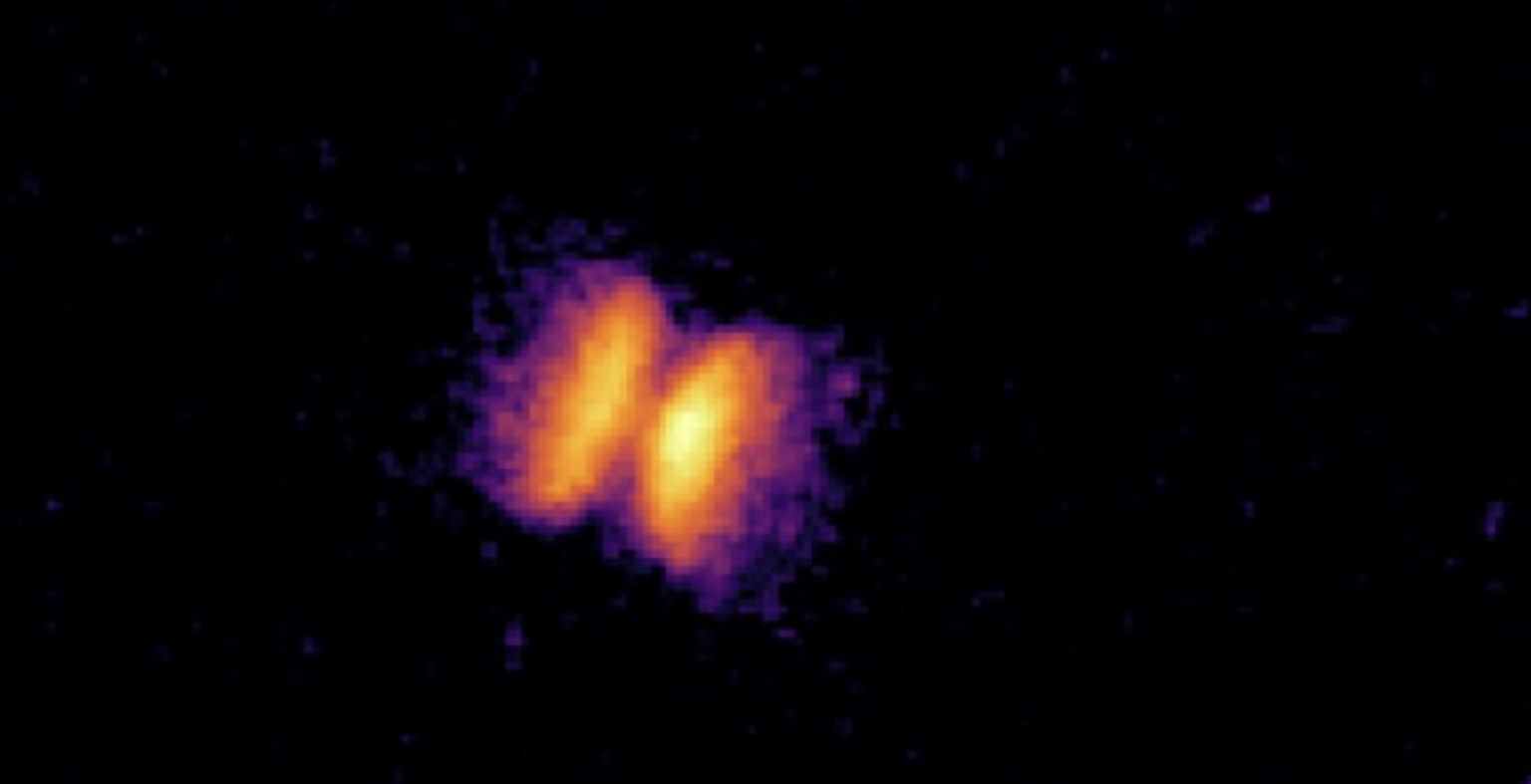
The dust produced by an ancient explosion deep within our Galaxy has finally thinned out. Through it, astronomers can now see what remained hidden for more than two decades. It turned out that the outburst was caused by a pair of stars with an unusual composition. Dense clumps were also detected within the ejected material, traveling at enormous speeds.
Helium Instead of Hydrogen
In a binary system, a white dwarf—the dense remnant of a dead star—gradually accumulates gas from its companion on its surface. The pressure and temperature increase until an uncontrolled thermonuclear reaction begins. Such an explosion is called a nova.
In most cases, the transferred material is rich in hydrogen. V445 Puppis, located in the constellation Puppis, is unusual because hydrogen is almost absent. Instead, helium predominates, so the event was assigned to a separate class of helium novae. It is the only confirmed case in the Milky Way.
A Quarter-Century of Uncertainty
The catastrophe at the end of 2000 produced a bipolar outflow extending for more than 1.5 trillion kilometers. At the same time, a dense dust disk formed around the binary system and completely obscured its inner region.
For nearly a quarter of a century, astronomers could only study the expanding nebula formed by the ejected material. The nature of the stars themselves that caused this explosion remained unknown.
A Combination of Four Instruments
The situation changed when the veil became more transparent. As phys.org reports, John Mills, a researcher and doctoral student at the University of Warwick, combined observations from four observatories collected over many years. Together, they covered the infrared and visible ranges, spectra, and changes in brightness.
The study was based on data from the European Southern Observatory’s Very Large Telescope, optical images from Hubble, long-term spectroscopy from the Southern African Large Telescope, and photometric measurements from the TESS space telescope.
The material flows onto the white dwarf from a helium star that has almost completely lost its outer hydrogen shell. This most likely happened during an earlier stage in the binary system’s evolution, when interaction with its companion caused it to be ejected.
Stars of this type are extremely rare. According to current estimates, there are only a few thousand of them in the Milky Way, compared to hundreds of billions of ordinary stars.
The Mystery of the Fast-Moving Structures
Dense clumps of gas, probably enriched with oxygen, were detected inside the debris cloud. They are moving at approximately 8,900 kilometers per second, or nearly 3% of the speed of light.
Scientists have not yet been able to explain how these structures formed. John Mills suggests that they appeared after the explosion itself, although nothing similar has been observed in other novae. The results were presented at the Royal Astronomical Society’s National Astronomy Meeting in Birmingham, so the conclusions have not yet undergone formal peer review.
A Possible Connection with Supernovae
Astronomers suggest that repeated helium outbursts may represent one possible pathway to Type Ia supernovae. Such explosions have highly consistent luminosities and are therefore used as standard candles to estimate distances to galaxies. These measurements formed the basis of the discovery of the accelerating expansion of the Universe, which was recognized with the Nobel Prize.
The data also indicate that matter is once again flowing between the components of the system and that the binary completes one orbit every 3.7 days, approximately twice as long as previously believed.
American astronomer Bradley Schaefer had previously estimated this period at approximately 1.87 days and, on that basis, argued in The Astrophysical Journal that V445 Puppis would never become a Type Ia supernova because it loses more mass during each cycle than it accumulates. The doubled value means that the system’s parameters will have to be recalculated.

